







Question: 1. Constructing Demand from Value (Benefit) The Donut Monster loves donuts. The table shopwn reflects the value (i.e. benefit) the Donut Monster places on each
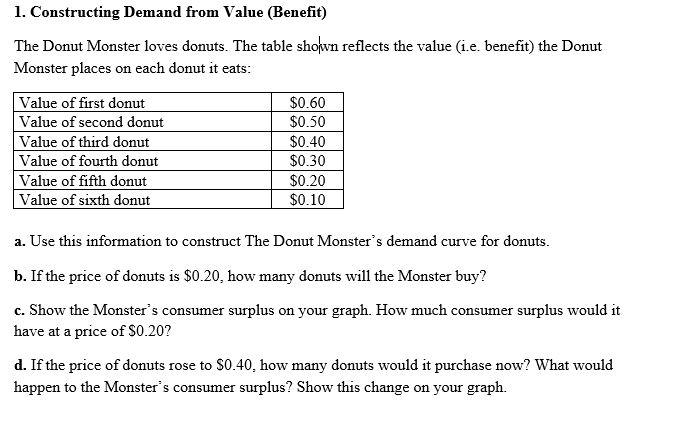
1. Constructing Demand from Value (Benefit) The Donut Monster loves donuts. The table shopwn reflects the value (i.e. benefit) the Donut Monster places on each donut it eats: a. Use this information to construct The Donut Monster's demand curve for donuts. b. If the price of donuts is $0.20, how many donuts will the Monster buy? c. Show the Monster's consumer surplus on your graph. How much consumer surplus would it have at a price of $0.20? d. If the price of donuts rose to $0.40, how many donuts would it purchase now? What would happen to the Monster's consumer surplus? Show this change on your graph. 1. Constructing Demand from Value (Benefit) The Donut Monster loves donuts. The table shopwn reflects the value (i.e. benefit) the Donut Monster places on each donut it eats: a. Use this information to construct The Donut Monster's demand curve for donuts. b. If the price of donuts is $0.20, how many donuts will the Monster buy? c. Show the Monster's consumer surplus on your graph. How much consumer surplus would it have at a price of $0.20? d. If the price of donuts rose to $0.40, how many donuts would it purchase now? What would happen to the Monster's consumer surplus? Show this change on your graph
Step by Step Solution
There are 3 Steps involved in it

Get step-by-step solutions from verified subject matter experts
 Study Help