







Question: 1. Create a sequence to be used with the DEPARTMENT table's primary key column. The sequence should start at 60 and have a maximum value
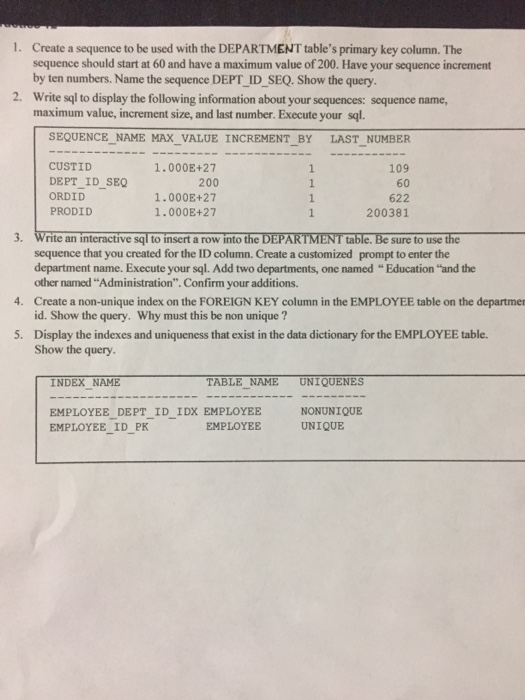
1. Create a sequence to be used with the DEPARTMENT table's primary key column. The sequence should start at 60 and have a maximum value of 200. Have your sequence increment by ten numbers. Name the sequence DEPT ID SEQ. Show the query. Write sql to display the following information about your sequences: sequence name, maximum value, increment size, and last number. Execute your sql 2. SEQUENCE NAME MAX VALUE INCREMENT BY LAST NUMBER CUSTID DEPT ID SEQ ORDID PRODID 1.000E+27 200 1.000E+27 1.000E+27 109 60 622 200381 an i a row Be sure to use sequence that you created for the ID column. Create a customized prompt to enter the department name. Execute your sql. Add two departments, one named Education "and the other named "Administration". Confirm your additions. 4. Create a non-unique index on the FOREIGN KEY column in the EMPLOYEE table on the departmer id. Show the query. Why must this be non unique? 5. Display the indexes and uniqueness that exist in the data dictionary for the EMPLOYEE table Show the query INDEX NAME TABLE NAME UNIQUENEs EMPLOYEE_DEPT_ID_IDX EMPLOYEENONUNIQUE EMPLOYEE_ID_PK EMPLOYEE UNIQUE
Step by Step Solution
There are 3 Steps involved in it

Get step-by-step solutions from verified subject matter experts
 Study Help