







Question: 1 D steady state conduction This problem involves calculating the heat loss by conduction through the support legs of a tank storing liquid hydrogen. A
D steady state conduction
This problem involves calculating the heat loss by conduction
through the support legs of a tank storing liquid hydrogen.
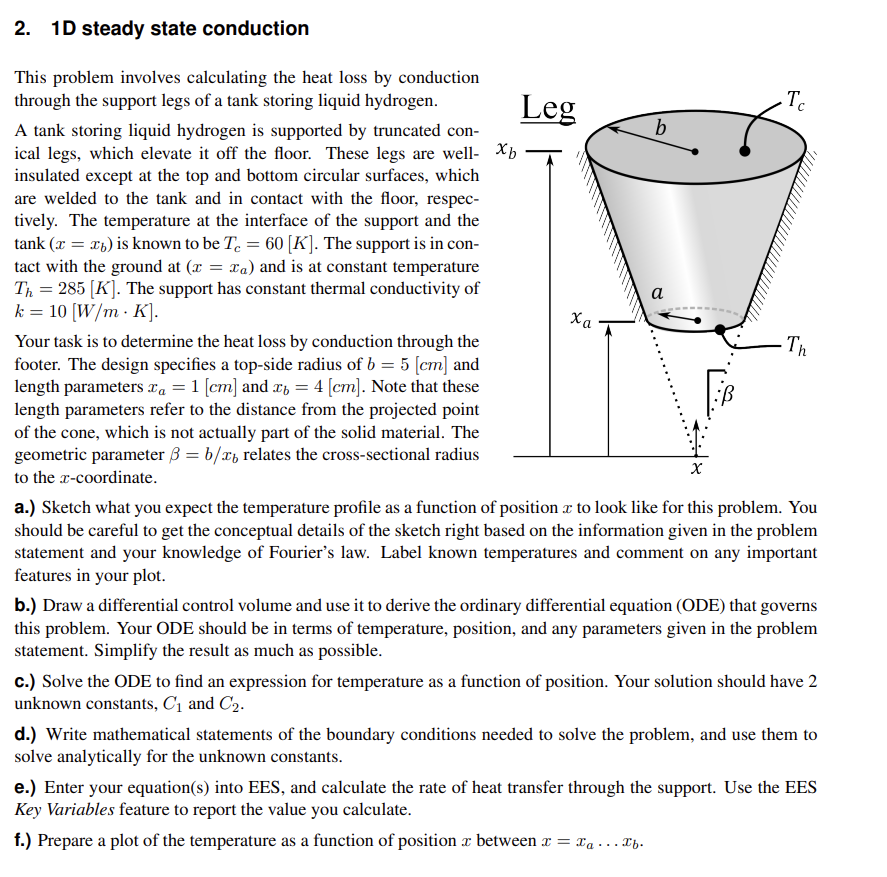
A tank storing liquid hydrogen is supported by truncated con
ical legs, which elevate it off the floor. These legs are well
insulated except at the top and bottom circular surfaces, which
are welded to the tank and in contact with the floor, respec
tively. The temperature at the interface of the support and the
is known to be The support is in con
tact with the ground at and is at constant temperature
The support has constant thermal conductivity of
Your task is to determine the heat loss by conduction through the
footer. The design specifies a topside radius of and
length parameters and Note that these
length parameters refer to the distance from the projected point
of the cone, which is not actually part of the solid material. The
geometric parameter relates the crosssectional radius
to the coordinate.
a Sketch what you expect the temperature profile as a function of position to look like for this problem. You
should be careful to get the conceptual details of the sketch right based on the information given in the problem
statement and your knowledge of Fourier's law. Label known temperatures and comment on any important
features in your plot.
b Draw a differential control volume and use it to derive the ordinary differential equation ODE that governs
this problem. Your ODE should be in terms of temperature, position, and any parameters given in the problem
statement. Simplify the result as much as possible.
c Solve the ODE to find an expression for temperature as a function of position. Your solution should have
unknown constants, and
d Write mathematical statements of the boundary conditions needed to solve the problem, and use them to
solve analytically for the unknown constants.
e Enter your equations into EES, and calculate the rate of heat transfer through the support. Use the EES
Key Variables feature to report the value you calculate.
f Prepare a plot of the temperature as a function of position between
Step by Step Solution
There are 3 Steps involved in it
1 Expert Approved Answer
Step: 1 Unlock

Question Has Been Solved by an Expert!
Get step-by-step solutions from verified subject matter experts
Step: 2 Unlock
Step: 3 Unlock
 Study Help