Question: 1. Develop a Project Scope Management Statement 2:develop Scope baseline of the project? Real World Scenario Project Case Study: New Kitchen Heaven Retail Store You
1. Develop a Project Scope Management Statement
2:develop Scope baseline of the project?
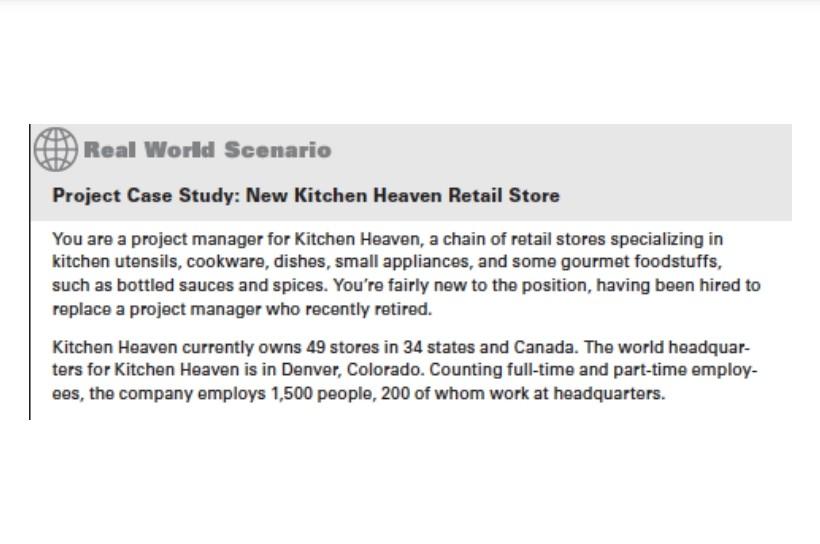
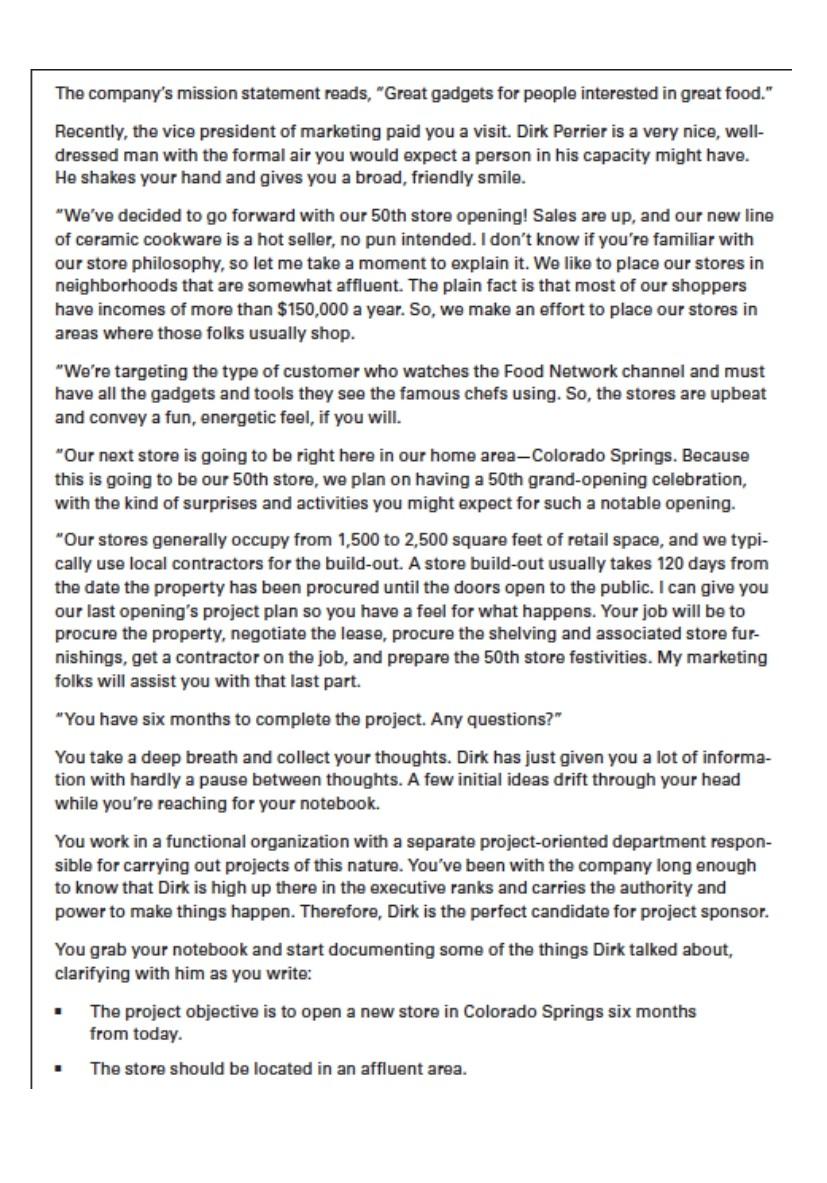
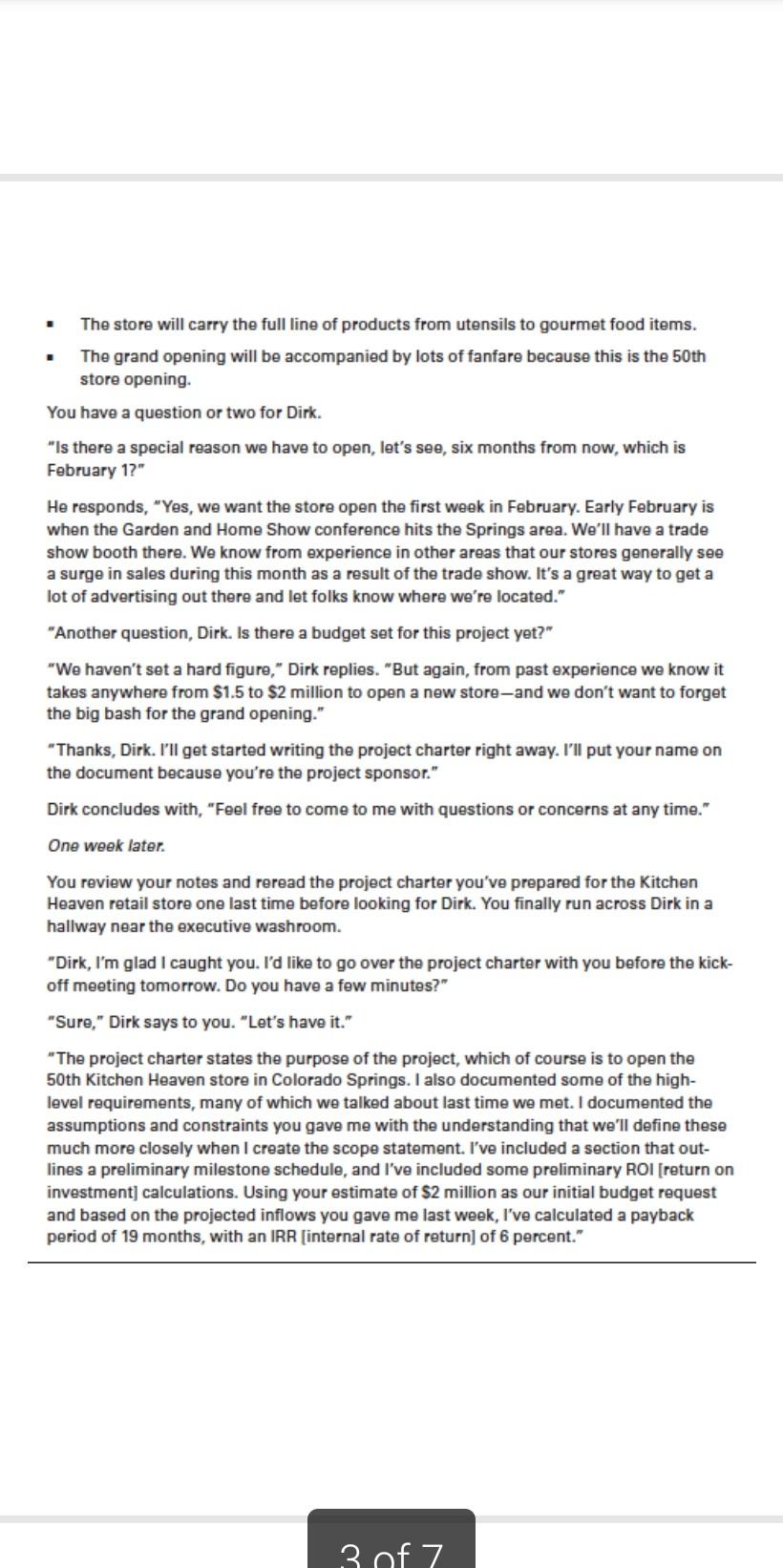
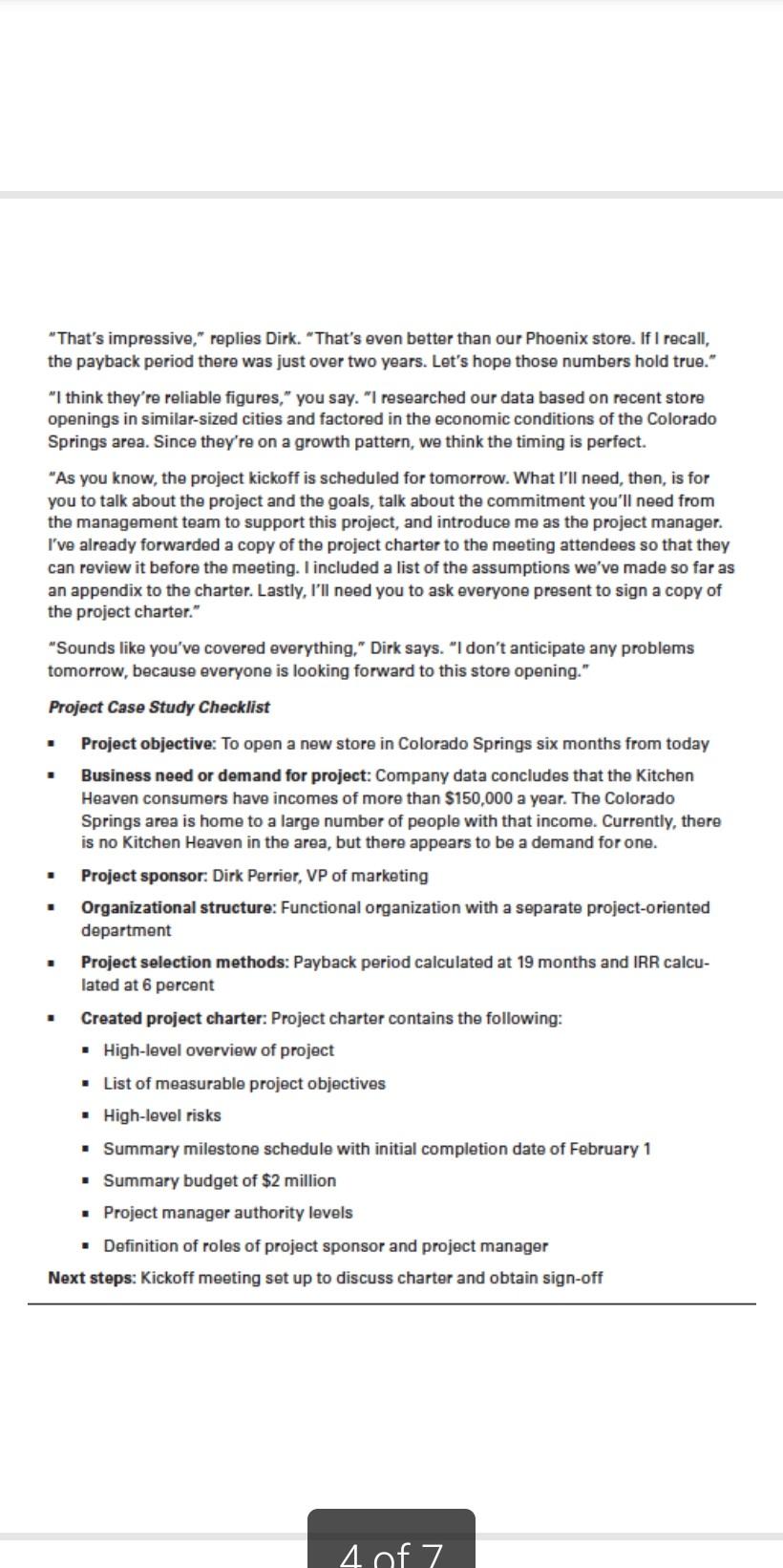
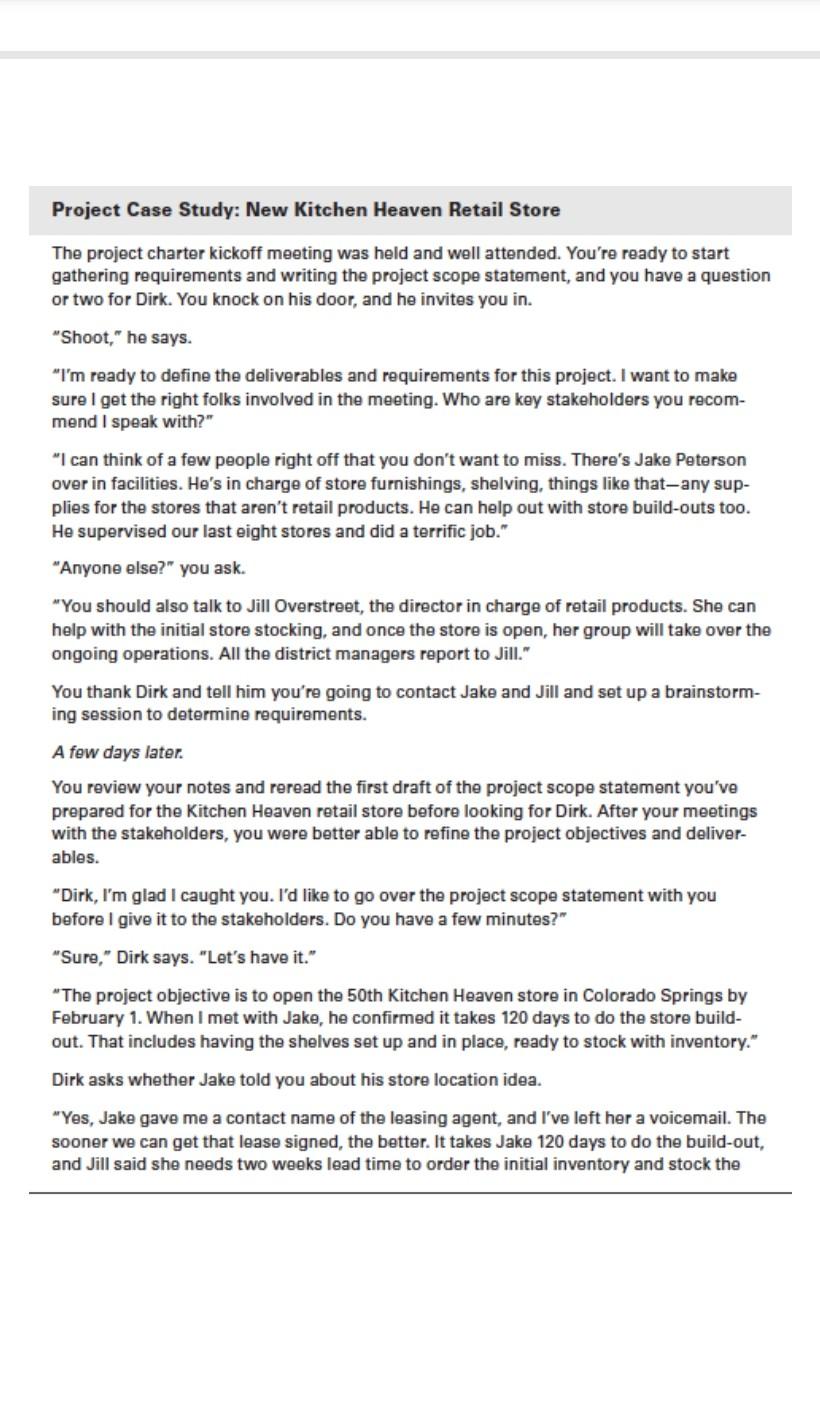
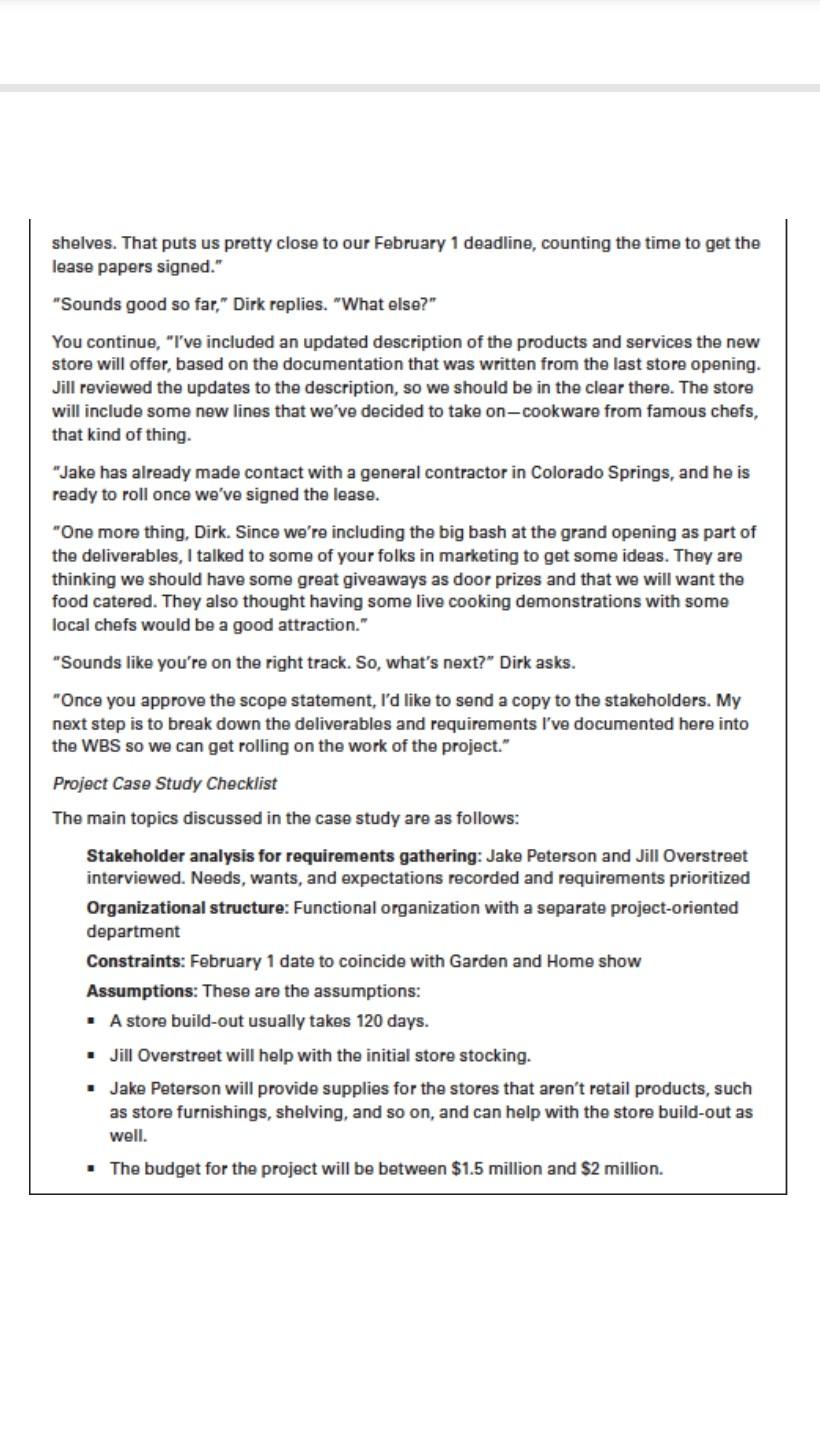
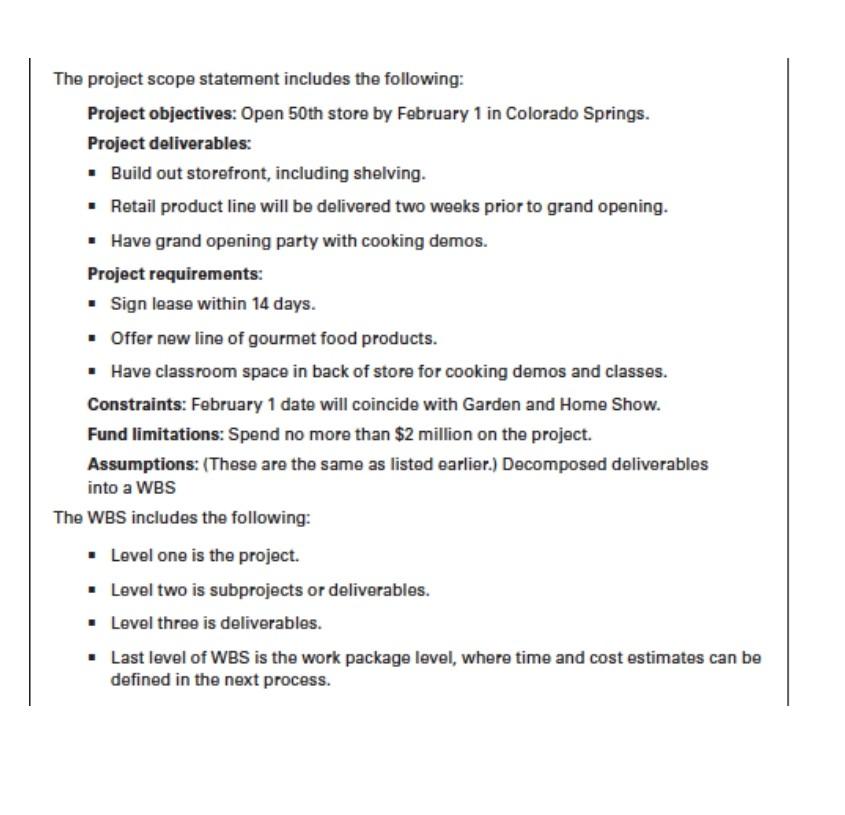
Real World Scenario Project Case Study: New Kitchen Heaven Retail Store You are a project manager for Kitchen Heaven, a chain of retail stores specializing in kitchen utensils, cookware, dishes, small appliances, and some gourmet foodstuffs, such as bottled sauces and spices. You're fairly new to the position, having been hired to replace a project manager who recently retired. Kitchen Heaven currently owns 49 stores in 34 states and Canada. The world headquar- ters for Kitchen Heaven is in Denver, Colorado. Counting full-time and part-time employ- ees, the company employs 1,500 people, 200 of whom work at headquarters. The company's mission statement reads, "Great gadgets for people interested in great food." Recently, the vice president of marketing paid you a visit. Dirk Perrier is a very nice, well- dressed man with the formal air you would expect a person in his capacity might have. He shakes your hand and gives you a broad, friendly smile. "We've decided to go forward with our 50th store opening! Sales are up, and our new line of ceramic cookware is a hot seller, no pun intended. I don't know if you're familiar with our store philosophy, so let me take a moment to explain it. We like to place our stores in neighborhoods that are somewhat affluent. The plain fact is that most of our shoppers have incomes of more than $150,000 a year. So, we make an effort to place our stores in areas where those folks usually shop. "We're targeting the type of customer who watches the Food Network channel and must have all the gadgets and tools they see the famous chefs using. So, the stores are upbeat and convey a fun, energetic feel, if you will "Our next store is going to be right here in our home area-Colorado Springs. Because this is going to be our 50th store, we plan on having a 50th grand-opening celebration, with the kind of surprises and activities you might expect for such a notable opening. "Our stores generally occupy from 1,500 to 2,500 square feet of retail space, and we typi- cally use local contractors for the build-out. A store build-out usually takes 120 days from the date the property has been procured until the doors open to the public. I can give you our last opening's project plan so you have a feel for what happens. Your job will be to procure the property, negotiate the lease, procure the shelving and associated store fur- nishings, get a contractor on the job, and prepare the 50th store festivities. My marketing folks will assist you with that last part. "You have six months to complete the project. Any questions?" You take a deep breath and collect your thoughts. Dirk has just given you a lot of informa- tion with hardly a pause between thoughts. A few initial ideas drift through your head while you're reaching for your notebook. You work in a functional organization with a separate project-oriented department respon- sible for carrying out projects of this nature. You've been with the company long enough to know that Dirk is high up there in the executive ranks and carries the authority and power to make things happen. Therefore, Dirk is the perfect candidate for project sponsor. You grab your notebook and start documenting some of the things Dirk talked about, clarifying with him as you write: The project objective is to open a new store in Colorado Springs six months from today. . The store should be located in an affluent area. . . The store will carry the full line of products from utensils to gourmet food items. The grand opening will be accompanied by lots of fanfare because this is the 50th store opening. You have a question or two for Dirk. "Is there a special reason we have to open, let's see, six months from now, which is February 17" He responds, "Yes, we want the store open the first week in February. Early February is when the Garden and Home Show conference hits the Springs area. We'll have a trade show booth there. We know from experience in other areas that our stores generally see a surge in sales during this month as a result of the trade show. It's a great way to get a lot of advertising out there and let folks know where we're located." "Another question, Dirk. Is there a budget set for this project yet?" "We haven't set a hard figure," Dirk replies. "But again, from past experience we know it takes anywhere from $1.5 to $2 million to open a new store-and we don't want to forget the big bash for the grand opening." "Thanks, Dirk. I'll get started writing the project charter right away. I'll put your name on the document because you're the project sponsor." Dirk concludes with, "Feel free to come to me with questions or concerns at any time." One week later. You review your notes and reread the project charter you've prepared for the Kitchen Heaven retail store one last time before looking for Dirk. You finally run across Dirk in a hallway near the executive washroom. "Dirk, I'm glad I caught you. I'd like to go over the project charter with you before the kick- off meeting tomorrow. Do you have a few minutes?" "Sure," Dirk says to you. "Let's have it." "The project charter states the purpose of the project, which of course is to open the 50th Kitchen Heaven store in Colorado Springs. I also documented some of the high- level requirements, many of which we talked about last time we met. I documented the assumptions and constraints you gave me with the understanding that we'll define these much more closely when I create the scope statement. I've included a section that out- lines a preliminary milestone schedule, and I've included some preliminary ROI (return on investment calculations. Using your estimate of $2 million as our initial budget request and based on the projected inflows you gave me last week, I've calculated a payback period of 19 months, with an IRR [internal rate of return) of 6 percent." 3 of 7 "That's impressive," replies Dirk. "That's even better than our Phoenix store. If I recall, the payback period there was just over two years. Let's hope those numbers hold true." "I think they're reliable figures," you say. "I researched our data based on recent store openings in similar-sized cities and factored in the economic conditions of the Colorado Springs area. Since they're on a growth pattern, we think the timing is perfect. "As you know, the project kickoff is scheduled for tomorrow. What I'll need, then, is for you to talk about the project and the goals, talk about the commitment you'll need from the management team to support this project, and introduce me as the project manager. I've already forwarded a copy of the project charter to the meeting attendees so that they can review it before the meeting. I included a list of the assumptions we've made so far as an appendix to the charter. Lastly, I'll need you to ask everyone present to sign a copy of the project charter." "Sounds like you've covered everything," Dirk says. "I don't anticipate any problems tomorrow, because everyone is looking forward to this store opening." Project Case Study Checklist . . . Project objective: To open a new store in Colorado Springs six months from today Business need or demand for project: Company data concludes that the Kitchen Heaven consumers have incomes of more than $150,000 a year. The Colorado Springs area is home to a large number of people with that income. Currently, there is no Kitchen Heaven in the area, but there appears to be a demand for one. Project sponsor: Dirk Perrier, VP of marketing Organizational structure: Functional organization with a separate project-oriented department Project selection methods: Payback period calculated at 19 months and IRR calcu- lated at 6 percent Created project charter: Project charter contains the following: High-level overview of project List of measurable project objectives High-level risks Summary milestone schedule with initial completion date of February 1 Summary budget of $2 million Project manager authority levels Definition of roles of project sponsor and project manager Next steps: Kickoff meeting set up to discuss charter and obtain sign-off . 4 of 7 Project Case Study: New Kitchen Heaven Retail Store The project charter kickoff meeting was held and well attended. You're ready to start gathering requirements and writing the project scope statement, and you have a question or two for Dirk. You knock on his door, and he invites you in. "Shoot," he says. "I'm ready to define the deliverables and requirements for this project. I want to make sure I get the right folks involved in the meeting. Who are key stakeholders you recom- mend I speak with?" "I can think of a few people right off that you don't want to miss. There's Jake Peterson over in facilities. He's in charge of store furnishings, shelving, things like that-any sup- plies for the stores that aren't retail products. He can help out with store build-outs too. He supervised our last eight stores and did a terrific job." "Anyone else?" you ask. "You should also talk to Jill Overstreet, the director in charge of retail products. She can help with the initial store stocking, and once the store is open, her group will take over the ongoing operations. All the district managers report to Jill." You thank Dirk and tell him you're going to contact Jake and Jill and set up a brainstorm- ing session to determine requirements. A few days later. You review your notes and reread the first draft of the project scope statement you've prepared for the Kitchen Heaven retail store before looking for Dirk. After your meetings with the stakeholders, you were better able to refine the project objectives and deliver- ables. "Dirk, I'm glad I caught you. I'd like to go over the project scope statement with you before I give it to the stakeholders. Do you have a few minutes?" "Sure," Dirk says. "Let's have it." "The project objective is to open the 50th Kitchen Heaven store in Colorado Springs by February 1. When I met with Jake, he confirmed it takes 120 days to do the store build- out. That includes having the shelves set up and in place, ready to stock with inventory." Dirk asks whether Jake told you about his store location idea. "Yes, Jake gave me a contact name of the leasing agent, and I've left her a voicemail. The sooner we can get that lease signed, the better. It takes Jake 120 days to do the build-out, and Jill said she needs two weeks lead time to order the initial inventory and stock the shelves. That puts us pretty close to our February 1 deadline, counting the time to get the lease papers signed." "Sounds good so far," Dirk replies. "What else?" You continue, "I've included an updated description of the products and services the new store will offer, based on the documentation that was written from the last store opening. Jill reviewed the updates to the description, so we should be in the clear there. The store will include some new lines that we've decided to take on-cookware from famous chefs, that kind of thing. "Jake has already made contact with a general contractor in Colorado Springs, and he is ready to roll once we've signed the lease. "One more thing, Dirk. Since we're including the big bash at the grand opening as part of the deliverables, I talked to some of your folks in marketing to get some ideas. They are thinking we should have some great giveaways as door prizes and that we will want the food catered. They also thought having some live cooking demonstrations with some local chefs would be a good attraction." "Sounds like you're on the right track. So, what's next?" Dirk asks. "Once you approve the scope statement, I'd like to send a copy to the stakeholders. My next step is to break down the deliverables and requirements I've documented here into the WBS so we can get rolling on the work of the project." Project Case Study Checklist The main topics discussed in the case study are as follows: Stakeholder analysis for requirements gathering: Jake Peterson and Jill Overstreet interviewed. Needs, wants, and expectations recorded and requirements prioritized Organizational structure: Functional organization with a separate project-oriented department Constraints: February 1 date to coincide with Garden and Home show Assumptions: These are the assumptions: A store build-out usually takes 120 days. Jill Overstreet will help with the initial store stocking. Jake Peterson will provide supplies for the stores that aren't retail products, such as store furnishings, shelving, and so on, and can help with the store build-out as well. The budget for the project will be between $1.5 million and $2 million. The project scope statement includes the following: Project objectives: Open 50th store by February 1 in Colorado Springs. Project deliverables: Build out storefront, including shelving. Retail product line will be delivered two weeks prior to grand opening. Have grand opening party with cooking demos. Project requirements: Sign lease within 14 days. Offer new line of gourmet food products. Have classroom space in back of store for cooking demos and classes. Constraints: February 1 date will coincide with Garden and Home Show. Fund limitations: Spend no more than $2 million on the project. Assumptions: (These are the same as listed earlier.) Decomposed deliverables into a WBS The WBS includes the following: Level one is the project. Level two is subprojects or deliverables. Level three is deliverables. Last level of WBS is the work package level, where time and cost estimates can be defined in the next process









 Study Help