







Question: 1 . Develop an algorithm that can be used to determine whether a Stack object S has exactly one element. 2 . Develop an algorithm
Develop an algorithm that can be used to determine whether a Stack object S has exactly one element.
Develop an algorithm that adds the value val to a queue object Q The queue is represented using an array data of size s The algorithm should assume that the queue is not full. The most recently added item is at index r rear and the least recently added item is at index f front If the queue is empty, r f
Develop an algorithm that removes the least recently added item from a queue Q The queue is represented using an array of size s The algorithm assumes that the queue is not empty. The most recently added item is at index r rear and the least recently added item is at index f front If the queue is empty, r f
Develop an algorithm that computes the degree of each vertex in a graph. The graph is represented using adjacency lists A; Ai is a reference to the first node in a linked list of nodes representing the vertices adjacent to vertex i The next field in each node, except the last, references the next node in the list. The next field of the last node is null. The vertices are
Develop a recursive algorithm that returns the number of nodes in a binary tree with root r
Develop an algorithm that inserts the value val into a binary search tree with root. If the tree is empty, root null. The algorithm returns the root of the tree containing the added item. You should assume that new node creates a new node with data field data and reference fields left for left child and right for right child
Show each AVL tree created from each of the following insertion:
Show the AVL tree created by the following array
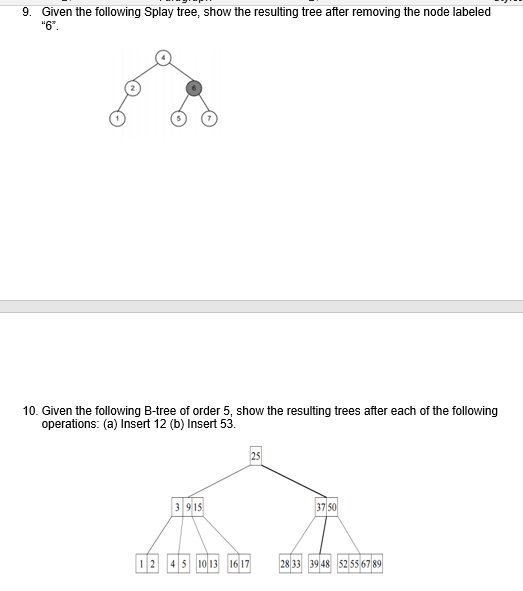
Given the following Splay tree, show the resulting tree after removing the node labeled
Given the following Btree of order show the resulting trees after each of the following operations: a Insert b Insert
Prove that if n keys are uniformly distributed in m buckets, the number of comparisons in an unsuccessful search is given by nm
Show the heap built from this array Then fix the heap to become a priority queue tree.
Step by Step Solution
There are 3 Steps involved in it
1 Expert Approved Answer
Step: 1 Unlock

Question Has Been Solved by an Expert!
Get step-by-step solutions from verified subject matter experts
Step: 2 Unlock
Step: 3 Unlock
 Study Help