







Question: 1. Draw a second quadrant vector B. (remember that boldface characters represent vector quantities). Show the standard angle B, for this vector (= angle that
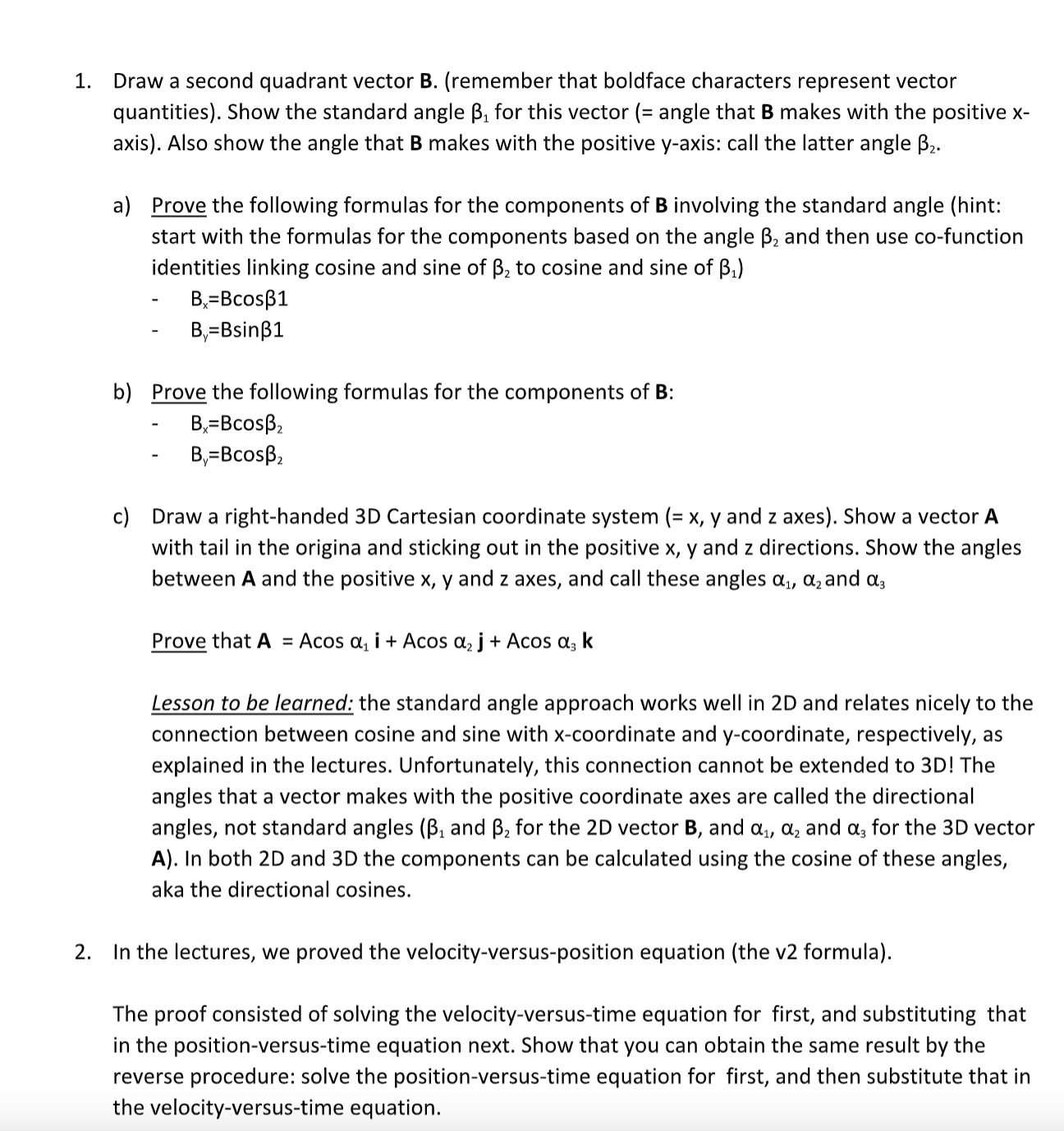
1. Draw a second quadrant vector B. (remember that boldface characters represent vector quantities). Show the standard angle B, for this vector (= angle that B makes with the positive x- axis). Also show the angle that B makes with the positive y-axis: call the latter angle (3,. a) Prove the following formulas for the components of 8 involving the standard angle (hint: start with the formulas for the components based on the angle (3, and then use co-function identities linking cosine and sine of (32 to cosine and sine of (3,) - B,=Bcos(31 - B,=BsinB1 b) Prove the following formulas for the components of B: - B,,=Bcos[32 - B,=Bcos(32 (3) Draw a right-handed 3D Cartesian coordinate system (= x, y and z axes). Show a vector A with tail in the origina and sticking out in the positive x, y and 2 directions. Show the angles between A and the positive x, y and z axes, and call these angles (1,, (hand 0L3 Prove that A = Acos 0L1 i + Acos azj + Acos 0L3 k Lesson to be learned: the standard angle approach works well in 2D and relates nicely to the connection between cosine and sine with x-coordinate and y-coordinate, respectively, as explained in the lectures. Unfortunately, this connection cannot be extended to 3D! The angles that a vector makes with the positive coordinate axes are called the directional angles, not standard angles (B, and B, for the 2D vector B, and 011, a, and a, for the 3D vector A). In both 2D and 3D the components can be calculated using the cosine of these angles, aka the directional cosines. 2. In the lectures, we proved the velocity-versus-position equation (the v2 formula). The proof consisted of solving the velocity-versus-time equation for first, and substituting that in the positionversus-time equation next. Show that you can obtain the same result by the reverse procedure: solve the positiOn-versustime equation for first, and then substitute that in the velocityversustime equation
Step by Step Solution
There are 3 Steps involved in it

Get step-by-step solutions from verified subject matter experts
 Study Help