







Question: 1. During a semimicroscale boiling point determination, the sample is heated until a constant stream of bubbles is observed. The boiling point is taken after
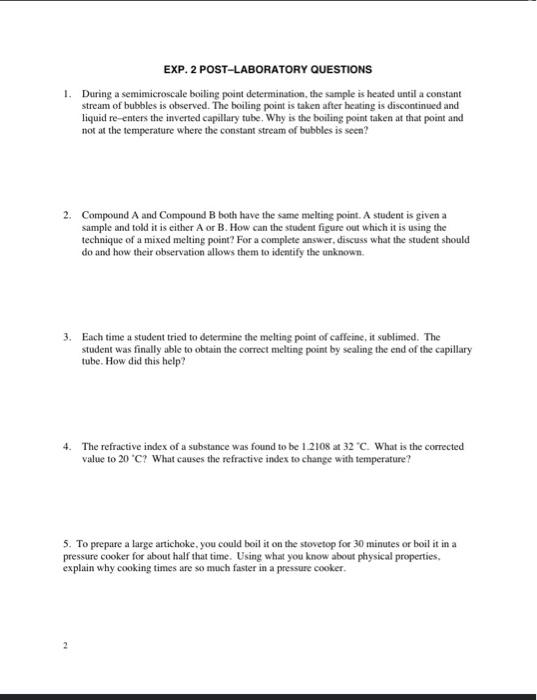
1. During a semimicroscale boiling point determination, the sample is heated until a constant stream of bubbles is observed. The boiling point is taken after heating is discontinued and liquid re-enters the inverted capillary tube. Why is the boiling point taken at that point and not at the temperature where the constant stream of bubbles is seen? 2. Compound A and Compound B both have the same melting point. A student is given a sample and told it is either A or B. How can the student figure out which it is using the technique of a mixed melting point? For a complete answer, discuss what the student should do and how their observation allows them to identify the unknown. 3. Each time a student tried to determine the meling point of caffeine, it sublimed. The student was finally able to obtain the correct melting point by sealing the end of the capillary tube. How did this help? 4. The refractive index of a substance was found to be 1.2108 at 32C. What is the corrected value to 20C ? What causes the refractive index to change with temperature? 5. To prepare a large artichoke, you could boil it on the stovetop for 30 minutes or boil it in a pressure cooker for about half that time. Using what you know about physical properties. explain why cooking times are so much faster in a pressure cooker
Step by Step Solution
There are 3 Steps involved in it

Get step-by-step solutions from verified subject matter experts
 Study Help