







Question: 1. (Effects of the correlation in estimation.) a) First consider the following statistical model: Let Z (1),. . . , Z (n) independent and identically
1. (Effects of the correlation in estimation.)
a) First consider the following statistical model:
Let Z (1),. . . , Z (n) independent and identically observations distributed (i.i.d.)
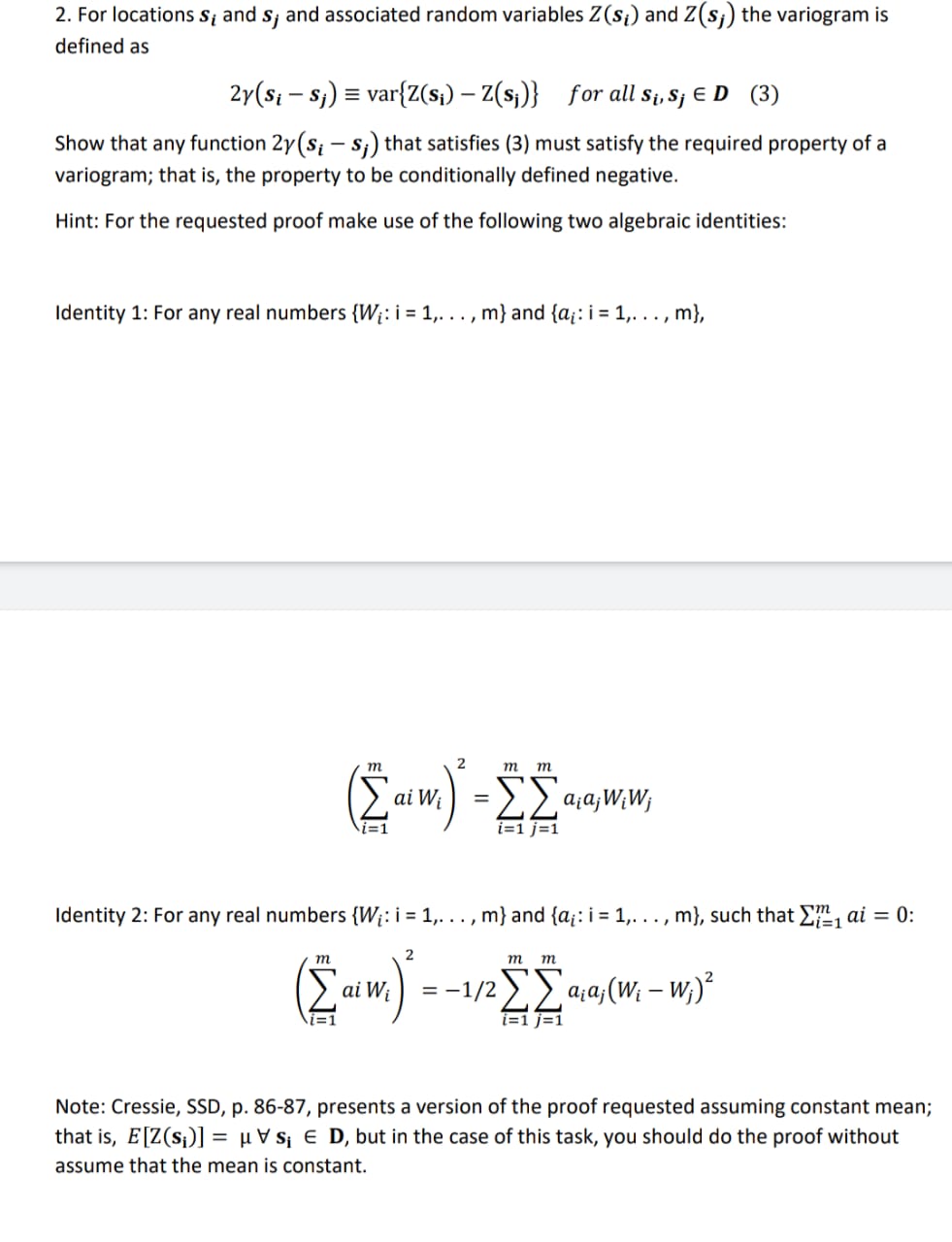
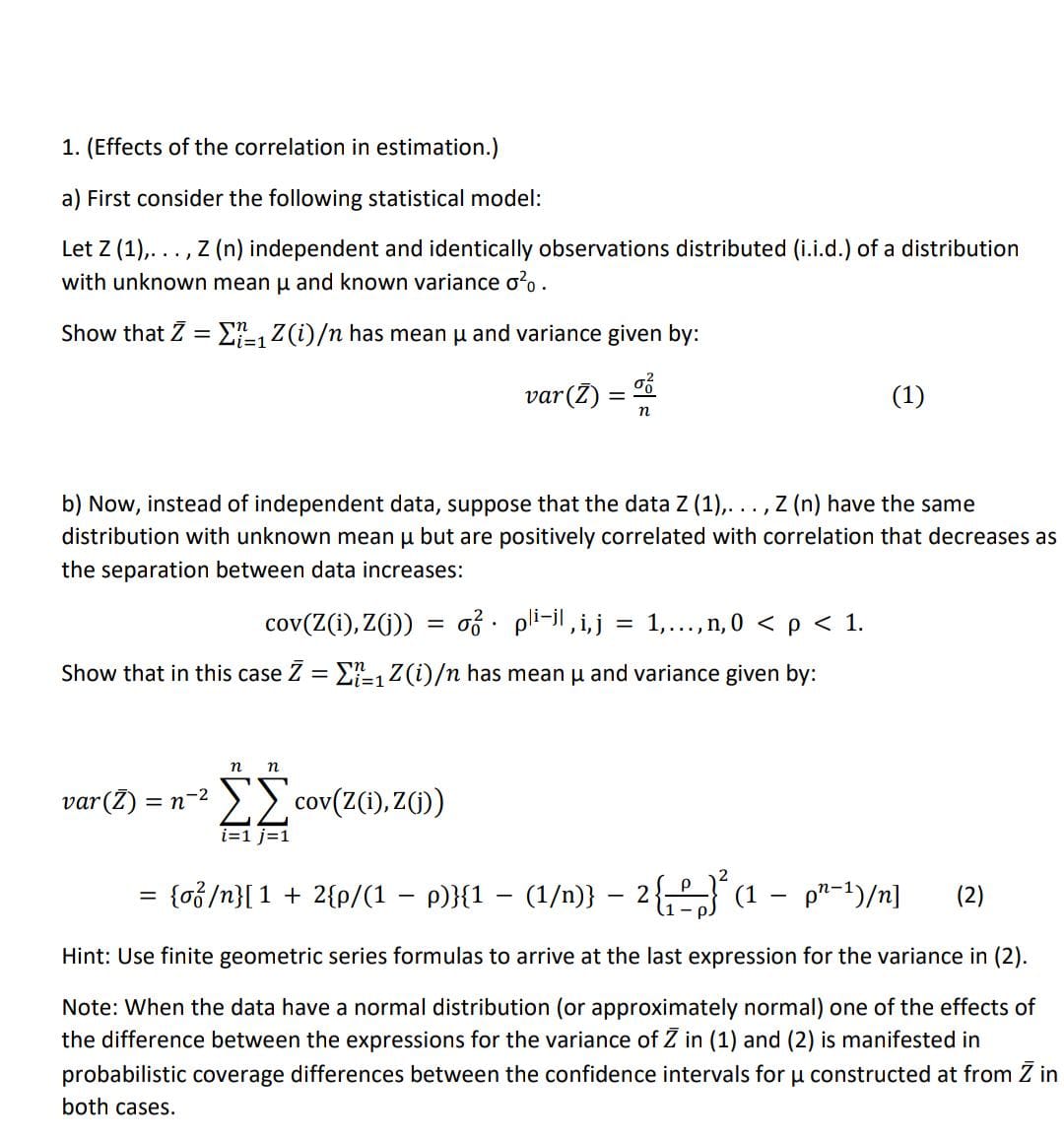
2. For locations S, and s, and associated random variables Z(s;) and Z(s; ) the variogram is defined as 2y(si - s;) = var{Z(s;) - Z(s;)} for all sus; ED (3) Show that any function 2y(S; - s;) that satisfies (3) must satisfy the required property of a variogram; that is, the property to be conditionally defined negative. Hint: For the requested proof make use of the following two algebraic identities: Identity 1: For any real numbers (W;: i = 1,. . ., m} and {a;: i= 1,. .., m}, (Law.) = ELaqwW, Identity 2: For any real numbers {Wi: i = 1,. . ., m} and {a;: i= 1,. . ., m}, such that EM, ai = 0: ( [aiw) = - 1/2 [[ ma ( W - W.)? Note: Cressie, SSD, p. 86-87, presents a version of the proof requested assuming constant mean; that is, E[Z(s;)] = u V s, E D, but in the case of this task, you should do the proof without assume that the mean is constant.1. (Effects of the correlation in estimation.) a) First consider the following statistical model: Let Z (1),. . . , Z (n) independent and identically observations distributed (i.i.d.) of a distribution with unknown mean uand known variance ole. Show that Z = E?=1Z(i) has mean u and variance given by: var(Z) = 1\" (1) b) Now, instead of independent data, suppose that the data 2 (1),. . . , Z (n) have the same distribution with unknown mean u but are positively correlated with correlation that decreases as the separation between data increases: cov(Z(i), 20)) = 03- lel ,i,j = 1, n, 0
Step by Step Solution
There are 3 Steps involved in it

Get step-by-step solutions from verified subject matter experts
 Study Help