



Question: 1. Explain how moral sensitivity and moral intensity apply to the unethical behavior among several SNC-Lavalin executives and other staff. 2. this case describes several
1. Explain how moral sensitivity and moral intensity apply to the unethical behavior among several SNC-Lavalin executives and other staff.
2. this case describes several incidents of unethical and illegal behavior at SNC- Lavalin. To what extent did motivation, ability, role perceptions, and situation influence this behavior among executives and employees? How did the personal values of these people affect their actions?
3. What steps should SNC-Lavalin and other companies in this situation take to minimize these types of corporate wrongdoing?
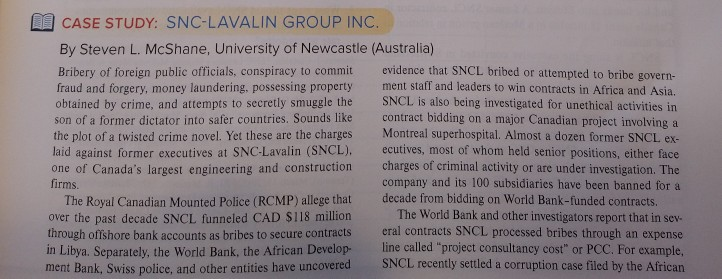
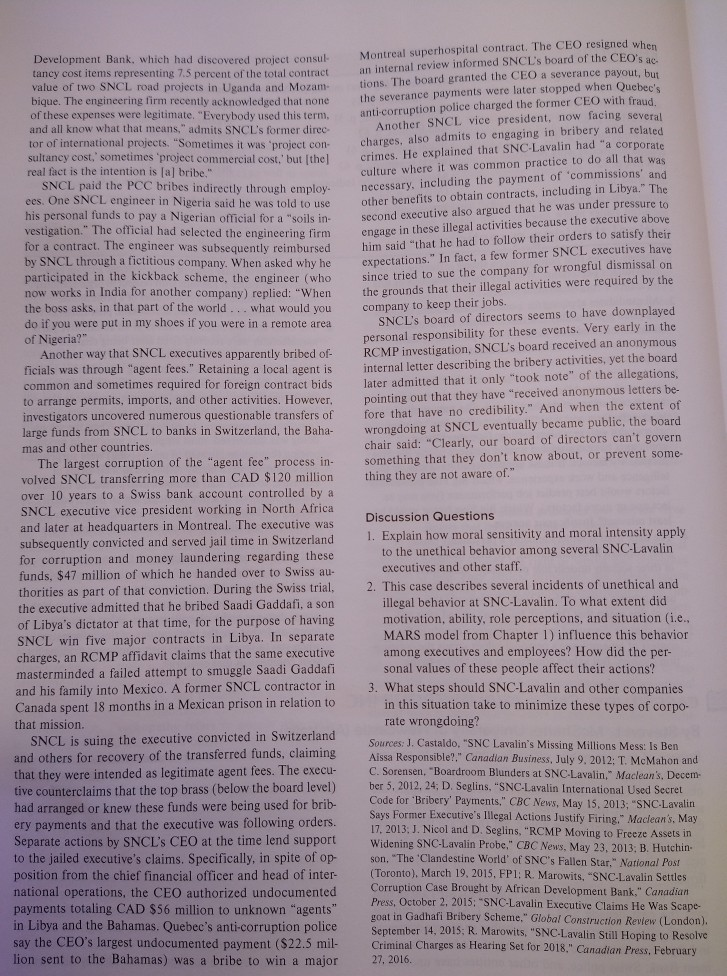
CASE STUDY: SNC-LAVALIN GROUP INC. By Steven L. McShane, University of Newcastle (Australia) Bribery of foreign public officials, conspiracy to commit evidence that SNCL bribed or attempted to bribe govern- fraud and forgery, money laundering, possessing property ment staff and leaders to win contracts in Africa and Asia. obtained by crime, and attempts to secretly smuggle the SNCL is also being investigated for unethical activities in son of a former dictator into safer countries. Sounds like contract bidding on a major Canadian project involving a the plot of a twisted crime novel. Yet these are the charges Montreal superhospital. Almost a dozen former SNCL ex- laid against former executives at SNC-Lavalin (SNCL). ecutives, most of whom held senior positions, either face charges of criminal activity or are under investigation. The One of Canada's largest engineering and construction firms. company and its 100 subsidiaries have been banned for a The Royal Canadian Mounted Police (RCMP) allege that decade from bidding on World Bank-funded contracts. over the past decade SNCL funneled CAD $118 million The World Bank and other investigators report that in sev- through offshore bank accounts as bribes to secure contracts eral contracts SNCL processed bribes through an expense in Libya. Separately, the World Bank, the African Develop line called "project consultancy cost" or PCC. For example, SNCL recently settled a corruption case filed by the African ment Bank, Swiss police, and other entities have uncovered Montreal superhospital contract. The CEO resigned when an internal review informed SNCL's board of the CEO's ac tions. The board granted the CEO a severance payout, but the severance payments were later stopped when Quebec's anti-corruption police charged the former CEO with fraud, Another SNCL vice president, now facing several charges, also admits to engaging in bribery and related crimes. He explained that SNC-Lavalin had "a corporate culture where it was common practice to do all that was necessary, including the payment of commissions and other benefits to obtain contracts, including in Libya." The second executive also argued that he was under pressure to engage in these illegal activities because the executive above him said that he had to follow their orders to satisfy their expectations." In fact, a few former SNCL executives have since tried to sue the company for wrongful dismissal on the grounds that their illegal activities were required by the company keep their jobs. SNCL's board of directors seems to have downplayed personal responsibility for these events. Very early in the RCMP investigation, SNCL's board received an anonymous internal letter describing the bribery activities, yet the board later admitted that it only "took note" of the allegations, pointing out that they have received anonymous letters be- fore that have no credibility." And when the extent of wrongdoing at SNCL eventually became public, the board chair said: "Clearly, our board of directors can't govern something that they don't know about, or prevent some thing they are not aware of." Development Bank, which had discovered project consul- tancy cost items representing 7.5 percent of the total contract value of two SNCL road projects in Uganda and Mozam- bique. The engineering firm recently acknowledged that none of these expenses were legitimate. "Everybody used this term, and all know what that means," admits SNCL's former direc tor of international projects. "Sometimes it was 'project con- sultancy cost, sometimes "project commercial cost.' but the real fact is the intention is (a) bribe." SNCL paid the PCC bribes indirectly through employ ees. One SNCL engineer in Nigeria said he was told to use his personal funds to pay a Nigerian official for a "soils in vestigation." The official had selected the engineering firm for a contract. The engineer was subsequently reimbursed by SNCL through a fictitious company. When asked why he participated in the kickback scheme, the engineer (who now works in India for another company) replied: "When the boss asks, in that part of the world ... what would you do if you were put in my shoes if you were in a remote area of Nigeria?" Another way that SNCL executives apparently bribed of- ficials was through "agent fees." Retaining a local agent is common and sometimes required for foreign contract bids to arrange permits, imports, and other activities. However, investigators uncovered numerous questionable transfers of large funds from SNCL to banks in Switzerland, the Baha- mas and other countries The largest corruption the "agent fee" process in- volved SNCL transferring more than CAD $120 million over 10 years to to a Swiss bank account controlled by a SNCL executive vice president working in North Africa and later at headquarters in Montreal. The executive was and served jail time in Switzerland for corruption and money laundering regarding these subsequently convicted funds. $47 million of which he handed over to Swiss au- funds. 4 part of that conviction. During the Swiss trial, the executive admitted that he bribed Saadi Gaddafi, a son of Libya's dictator at that time, for the purpose of f having SNCL win five major contracts in Libya. In separate charges, an RCMP affidavit claims that the same executive masterminded a failed attempt to smuggle Saadi Gaddafi and his family into Mexico. A former SNCL contractor in Canada spent 18 months in a Mexican prison in relation to that mission. SNCL is suing the executive convicted in Switzerland and others for recovery of the transferred funds, claiming that they were intended as legitimate agent fees. The execu- tive counterclaims that the top brass (below the board level) had arranged or knew these funds were being used for brib- ery payments and that the executive was following orders. Separate actions by SNCL's CEO at the time lend support to the jailed executive's claims. Specifically, in spite of op- position from the chief financial officer and head national operations, the CEO authorized undocumented payments totaling CAD $56 million to unknown "agents' in Libya and the Bahamas. Quebec's anti-corruption police say the CEO's largest undocumented payment ($22.5 mil- lion sent to the Bahamas) was a bribe to win a major Discussion Questions 1. Explain how moral sensitivity and moral intensity apply to the unethical behavior among several SNC-Lavalin executives and other staff. 2. This case describes several incidents of unethical and illegal behavior at SNC-Lavalin. To what extent did motivation, ability, role perceptions, and situation (i.e., MARS model from Chapter 1) influence this behavior among executives and employees? How did the per- sonal values of these people affect their actions? 3. What steps should SNC-Lavalin and other companies in this situation take to minimize these types of corpo- rate wrongdoing? Sources: J. Castaldo, "SNC Lavalin's Missing Millions Mess: Is Ben Aissa Responsible?" Canadian Business, July 9. 2012; T. McMahon and C. Sorensen. "Boardroom Blunders at SNC-Lavalin," Maclean's Decem ber 5, 2012, 24; D. Seglins, "SNC-Lavalin International Used Secret Code for "Bribery' Payments," CBC News, May 15, 2013: "SNC-Lavalin Says Former Executive's Illegal Actions Justify Firing." Maclean's, May 17. 2013: J. Nicol and D. Seglins,"RCMP Moving to Freeze Assets in Widening SNC-Lavalin Probe," CBC News, May 23, 2013; B. Hutchin son. "The 'Clandestine World of SNC's Fallen Star," National Post (Toronto), March 19, 2015 Marowits, "SNC-Lavalin Settles Corruption Case Brought by African Development Bank," Canadian Press, October 2, 2015: "SNC-Lavalin Executive Claims He Was Scape- goat in Gadhafi Bribery Scheme." Global Construction Review (London). September 14, 2015; R. Marowits, "SNC-Lavalin Still Hoping to Resolve Criminal Charges as Hearing Set for 2018." Canadian Press, February 27, 2016Step by Step Solution
There are 3 Steps involved in it
1 Expert Approved Answer
Step: 1 Unlock

Question Has Been Solved by an Expert!
Get step-by-step solutions from verified subject matter experts
Step: 2 Unlock
Step: 3 Unlock