







Question: 1. Explain the difference between maximizing profit and adding value using an example of an organization and explain why adding value is so critical to
1. Explain the difference between maximizing profit and adding value using an example of an organization and explain why adding value is so critical to an organization. (Learning Outcome, Module 7 #1)
2. Does compound interest have more of an impact on short-term investments or long-term investments? Do you think it's possible to have uninterrupted compound growth? (Learning Outcome, Module 7 #2)
3. In Jay-Z's "The Story of O.J.," he says that young people should invest in their future as he has:
"Financial freedom my only hope/ F**k living rich and dying broke/I bought some artwork for one million/ Two years later, that s**t worth two million/ Few years later, that s**t worth eight million."
But only after he spent millions on his car collection and since cars are a depreciating asset and the value drops ~20% the moment it's driven off the lot or off a flatbed:
"I bought every V12 engine/ Wish I could take it back to the beginnin'/ I coulda bought a place in DUMBO before it was DUMBO/ For like 2 million/ That same building today worth 25 million/ Guess how I'm feelin'? Dumbo.
Explain how the time value of money concept goes beyond cash and what it means for portfolio investing. (Learning Outcome, Module 7 #3)
Links:
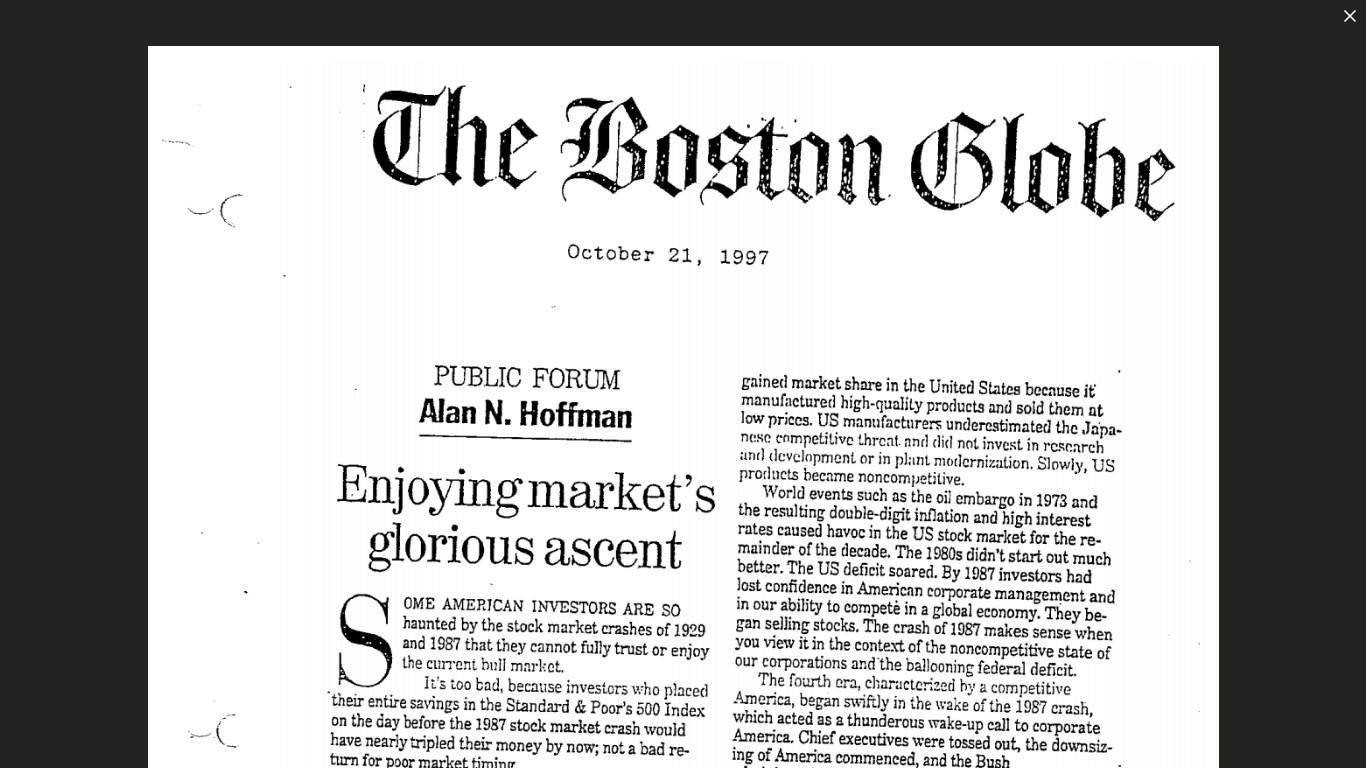
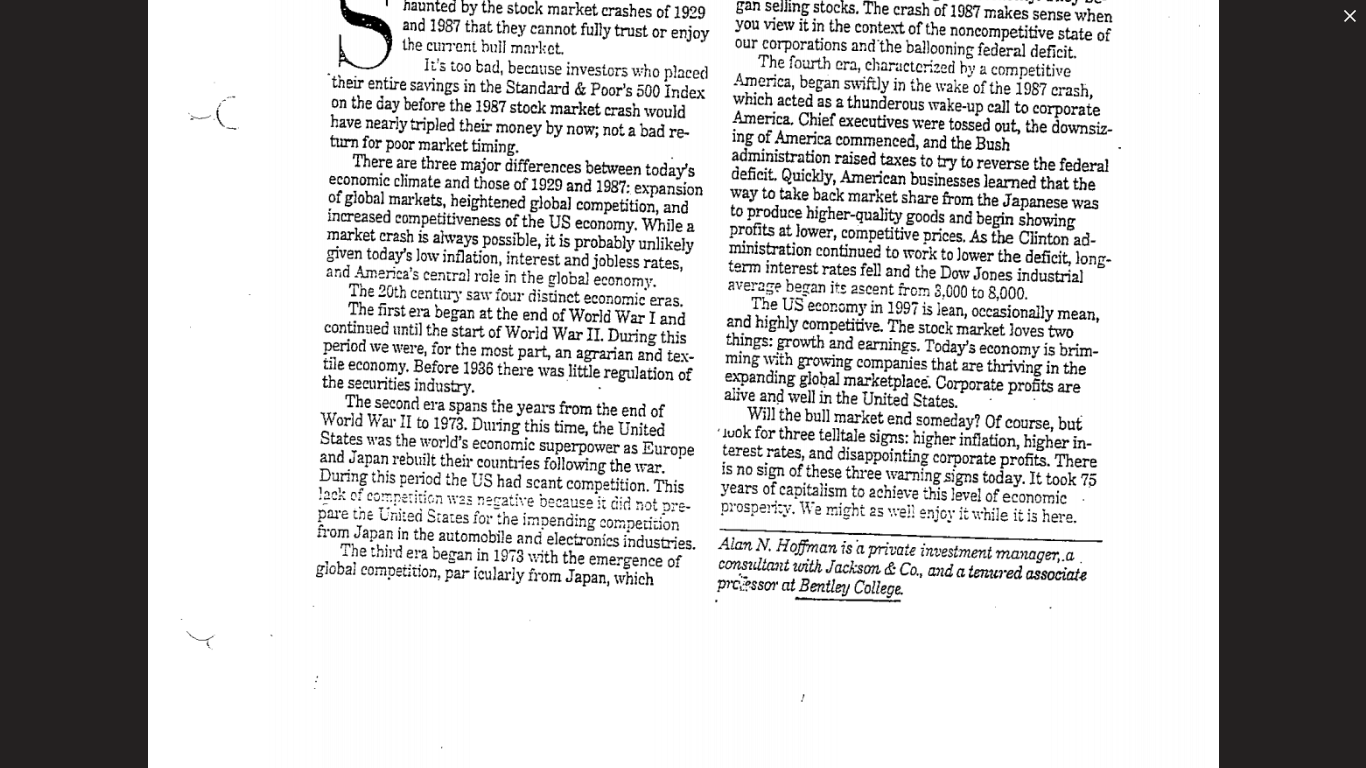
The Boston Globe October 21, 1997 PUBLIC FORUM Alan N. Hoffman Enjoying market's glorious ascent S OME AMERICAN INVESTORS ARE SO haunted by the stock market crashes of 1929 and 1987 that they cannot fully trust or enjoy the current bull market. It's too bad, because investors who placed their entire savings in the Standard & Poor's 500 Index on the day before the 1987 stock market crash would have nearly tripled their money by now; not a bad re- turn for poor market timing gained market share in the United States because it' manufactured high-quality products and sold them at low prices. US manufacturers underestimated the Japa- nese competitive threat and did not invest in research and development or in plant modernization. Slowly, US products became noncompetitive. World events such as the oil embargo in 1973 and the resulting double-digit inflation and high interest rates caused havoc in the US stock market for the re- mainder of the decade. The 1980s didn't start out much better. The US deficit soared. By 1987 investors had lost confidence in American corporate management and in our ability to compet in a global economy. They be- gan selling stocks. The crash of 1987 makes sense when you view it in the context of the noncompetitive state of our corporations and the ballooning federal deficit. The fourth era, characterized by a competitive America, began swiftly in the wake of the 1987 crash, which acted as a thunderous wake-up call to corporate America. Chief executives were tossed out, the downsiz- ing of America commenced, and the Bush
Step by Step Solution
There are 3 Steps involved in it

Get step-by-step solutions from verified subject matter experts
 Study Help