







Question: 1. Fill in the missing numbers. Show simple workings. (a) (101.10011001...1001...)2 = () 10 (b) (1011.011)2 x (1.1)2 = ()2 (c) (DA.2102) 16 = ()2
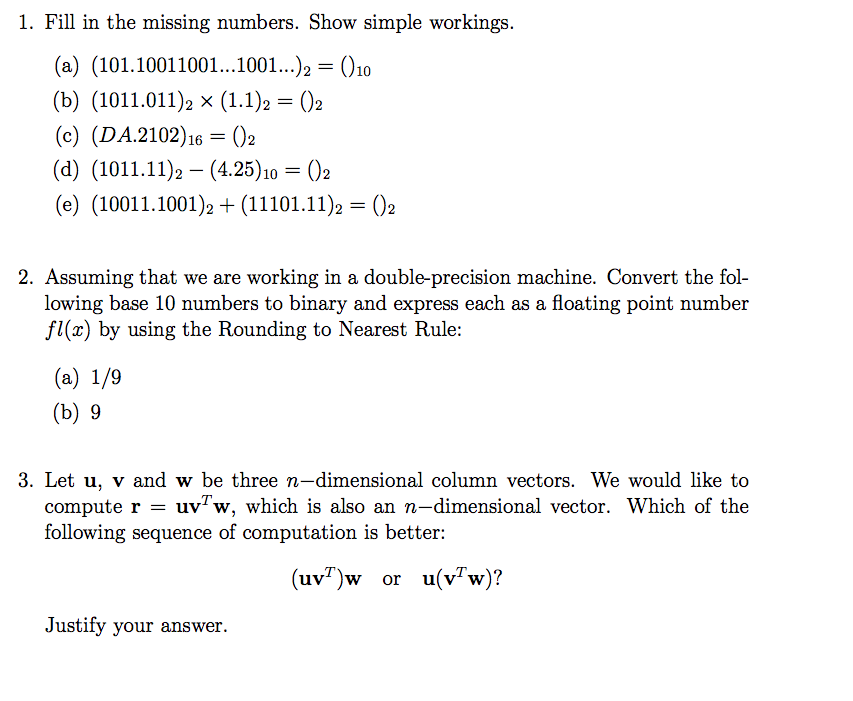
1. Fill in the missing numbers. Show simple workings. (a) (101.10011001...1001...)2 = () 10 (b) (1011.011)2 x (1.1)2 = ()2 (c) (DA.2102) 16 = ()2 (d) (1011.11)2 (4.25)10 = ()2 (e) (10011.1001)2 + (11101.11)2 = ()2 2. Assuming that we are working in a double-precision machine. Convert the fol- lowing base 10 numbers to binary and express each as a floating point number fl(x) by using the Rounding to Nearest Rule: (a) 1/9 (b) 9 3. Let u, v and w be three n-dimensional column vectors. We would like to compute r = uvIw, which is also an n-dimensional vector. Which of the following sequence of computation is better: (uvt)w or u(vw)? Justify your
Step by Step Solution
There are 3 Steps involved in it

Get step-by-step solutions from verified subject matter experts
 Study Help