







Question: 1. Financial Leverage and Capital Structure (8 points) a) (4 points) Break-Even EBIT There are two different capital structures. The first option consist of 20,000
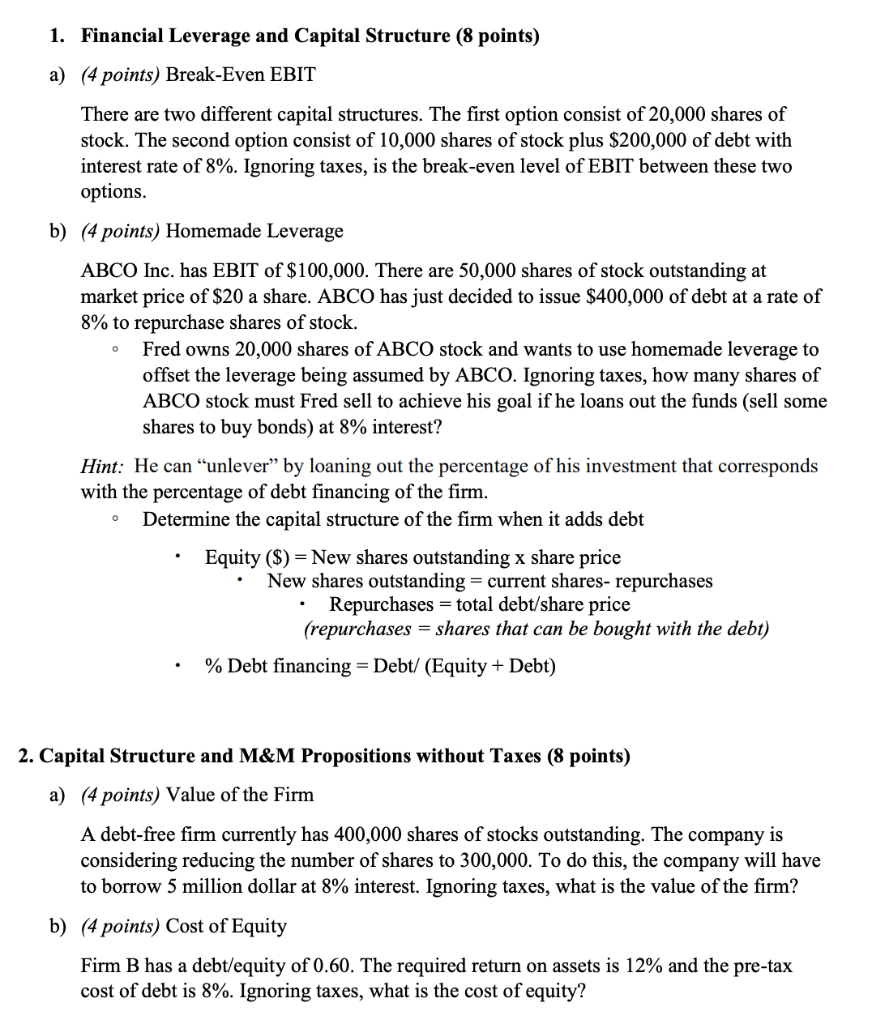
1. Financial Leverage and Capital Structure (8 points) a) (4 points) Break-Even EBIT There are two different capital structures. The first option consist of 20,000 shares of stock. The second option consist of 10,000 shares of stock plus $200,000 of debt with interest rate of 8%. Ignoring taxes, is the break-even level of EBIT between these two options. b) (4 points) Homemade Leverage ABCO Inc. has EBIT of $100,000. There are 50,000 shares of stock outstanding at market price of $20 a share. ABCO has just decided to issue $400,000 of debt at a rate of 8% to repurchase shares of stock. Fred owns 20,000 shares of ABCO stock and wants to use homemade leverage to offset the leverage being assumed by ABCO. Ignoring taxes, how many shares of ABCO stock must Fred sell to achieve his goal if he loans out the funds (sell some shares to buy bonds) at 8% interest? Hint: He can unlever by loaning out the percentage of his investment that corresponds with the percentage of debt financing of the firm. Determine the capital structure of the firm when it adds debt Equity ($) = New shares outstanding x share price New shares outstanding = current shares- repurchases Repurchases = total debt/share price (repurchases = shares that can be bought with the debt) % Debt financing = Debt/ (Equity + Debt) 2. Capital Structure and M&M Propositions without Taxes (8 points) a) (4 points) Value of the Firm A debt-free firm currently has 400,000 shares of stocks outstanding. The company is considering reducing the number of shares to 300,000. To do this, the company will have to borrow 5 million dollar at 8% interest. Ignoring taxes, what is the value of the firm? b) (4 points) Cost of Equity Firm B has a debt/equity of 0.60. The required return on assets is 12% and the pre-tax cost of debt is 8%. Ignoring taxes, what is the cost of equity? 1. Financial Leverage and Capital Structure (8 points) a) (4 points) Break-Even EBIT There are two different capital structures. The first option consist of 20,000 shares of stock. The second option consist of 10,000 shares of stock plus $200,000 of debt with interest rate of 8%. Ignoring taxes, is the break-even level of EBIT between these two options. b) (4 points) Homemade Leverage ABCO Inc. has EBIT of $100,000. There are 50,000 shares of stock outstanding at market price of $20 a share. ABCO has just decided to issue $400,000 of debt at a rate of 8% to repurchase shares of stock. Fred owns 20,000 shares of ABCO stock and wants to use homemade leverage to offset the leverage being assumed by ABCO. Ignoring taxes, how many shares of ABCO stock must Fred sell to achieve his goal if he loans out the funds (sell some shares to buy bonds) at 8% interest? Hint: He can unlever by loaning out the percentage of his investment that corresponds with the percentage of debt financing of the firm. Determine the capital structure of the firm when it adds debt Equity ($) = New shares outstanding x share price New shares outstanding = current shares- repurchases Repurchases = total debt/share price (repurchases = shares that can be bought with the debt) % Debt financing = Debt/ (Equity + Debt) 2. Capital Structure and M&M Propositions without Taxes (8 points) a) (4 points) Value of the Firm A debt-free firm currently has 400,000 shares of stocks outstanding. The company is considering reducing the number of shares to 300,000. To do this, the company will have to borrow 5 million dollar at 8% interest. Ignoring taxes, what is the value of the firm? b) (4 points) Cost of Equity Firm B has a debt/equity of 0.60. The required return on assets is 12% and the pre-tax cost of debt is 8%. Ignoring taxes, what is the cost of equity
Step by Step Solution
There are 3 Steps involved in it

Get step-by-step solutions from verified subject matter experts
 Study Help