Question: 1) For a value of population parameter 0 equal to 2, which one of the following cases corresponds to an unbiased estimator with higher precision?
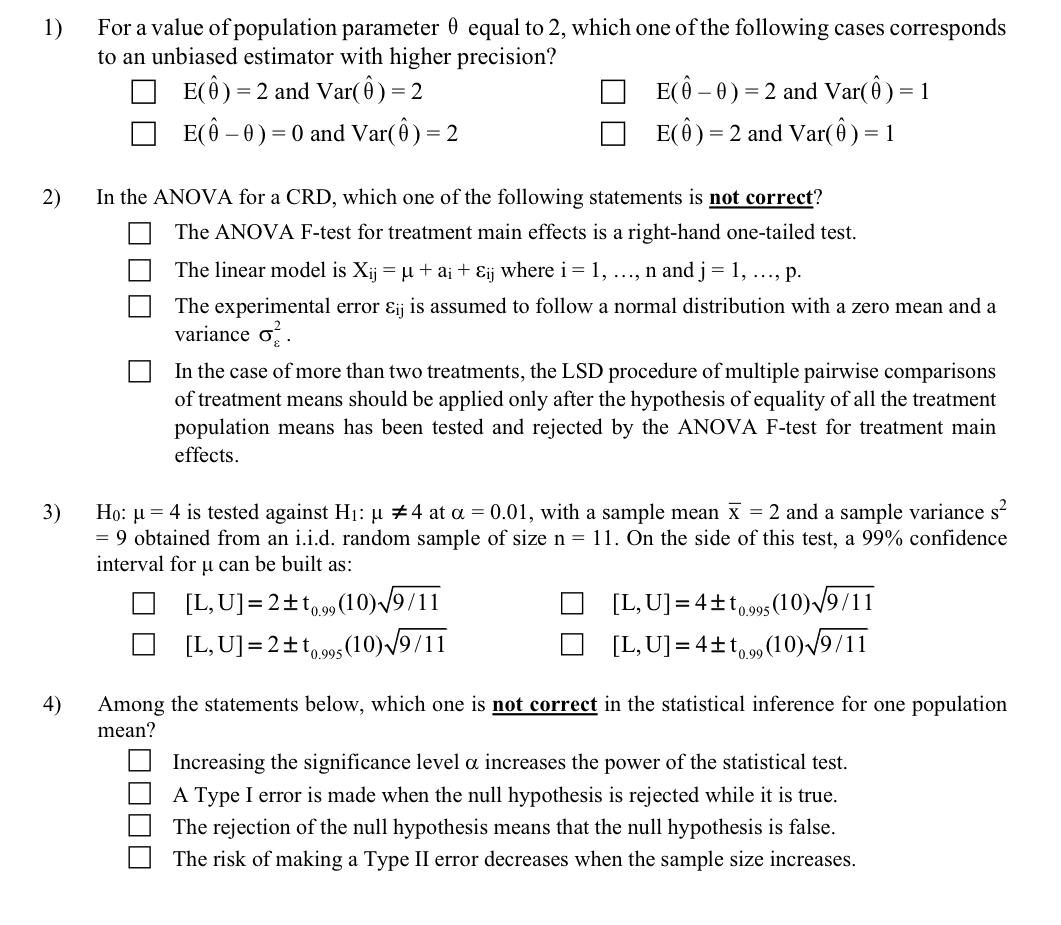
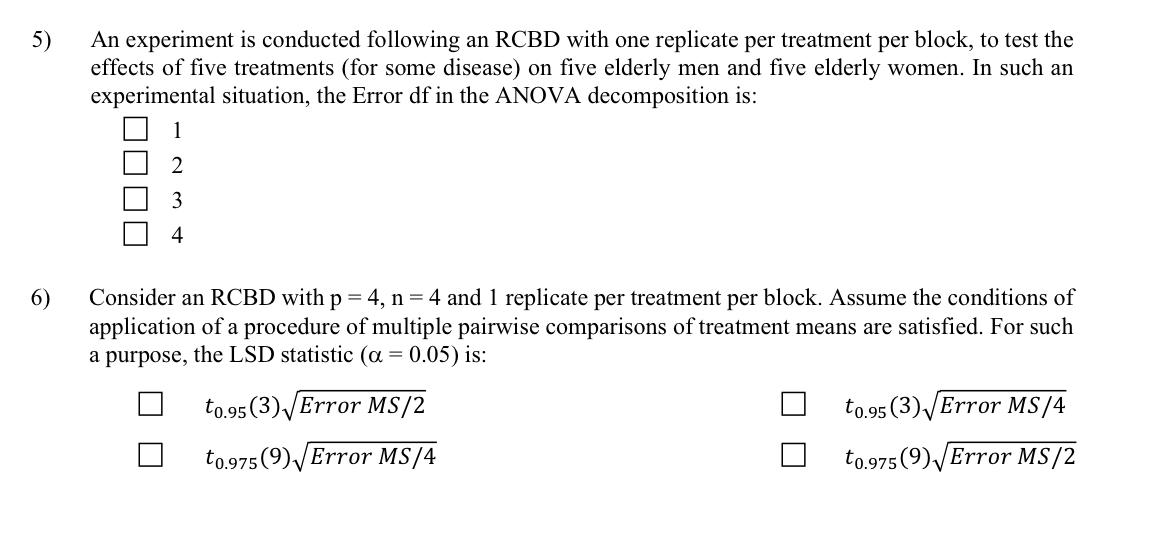
1) For a value of population parameter 0 equal to 2, which one of the following cases corresponds to an unbiased estimator with higher precision? Ech) = 2 and Var(@) = 2 ETn - 0) = 2 and Var() = 1 EC - 0) = 0 and Var( f) = 2 Eln) = 2 and Var(@) = 1 2) In the ANOVA for a CRD, which one of the following statements is not correct? The ANOVA F-test for treatment main effects is a right-hand one-tailed test. The linear model is Xij = u + ai + ij where i = 1, ..., n and j = 1, ..., p. The experimental error ij is assumed to follow a normal distribution with a zero mean and a variance In the case of more than two treatments, the LSD procedure of multiple pairwise comparisons of treatment means should be applied only after the hypothesis of equality of all the treatment population means has been tested and rejected by the ANOVA F-test for treatment main effects. 3) Ho: u = 4 is tested against Hi: u #4 at a = 0.01, with a sample mean x = 2 and a sample variance s? = 9 obtained from an i.i.d. random sample of size n = 11. On the side of this test, a 99% confidence interval for u can be built as: [L, U]=21,99(10)19/11 [L, U]=4 $t0,995 (10) 9/11 [L, U]= 2 $t0,995(10)19/11 [L, U]=4+t9(10)19/11 4) Among the statements below, which one is not correct in the statistical inference for one population mean? Increasing the significance level a increases the power of the statistical test. A Type I error is made when the null hypothesis is rejected while it is true. The rejection of the null hypothesis means that the null hypothesis is false. The risk of making a Type II error decreases when the sample size increases. An experiment is conducted following an RCBD with one replicate per treatment per block, to test the effects of five treatments (for some disease) on five elderly men and five elderly women. In such an experimental situation, the Error df in the ANOVA decomposition is: 2 3 4 6) Consider an RCBD with p = 4, n = 4 and 1 replicate per treatment per block. Assume the conditions of application of a procedure of multiple pairwise comparisons of treatment means are satisfied. For such a purpose, the LSD statistic (a = 0.05) is: 10.95(3) Error MS/2 10.95 (3) Error MS/4 10.975 (9) Error MS/4 t0.975(9) Error MS/2




