







Question: 1. For each function and block (including global) in the program, list the compilar generated offset-pairs for every varaible or function name that can be
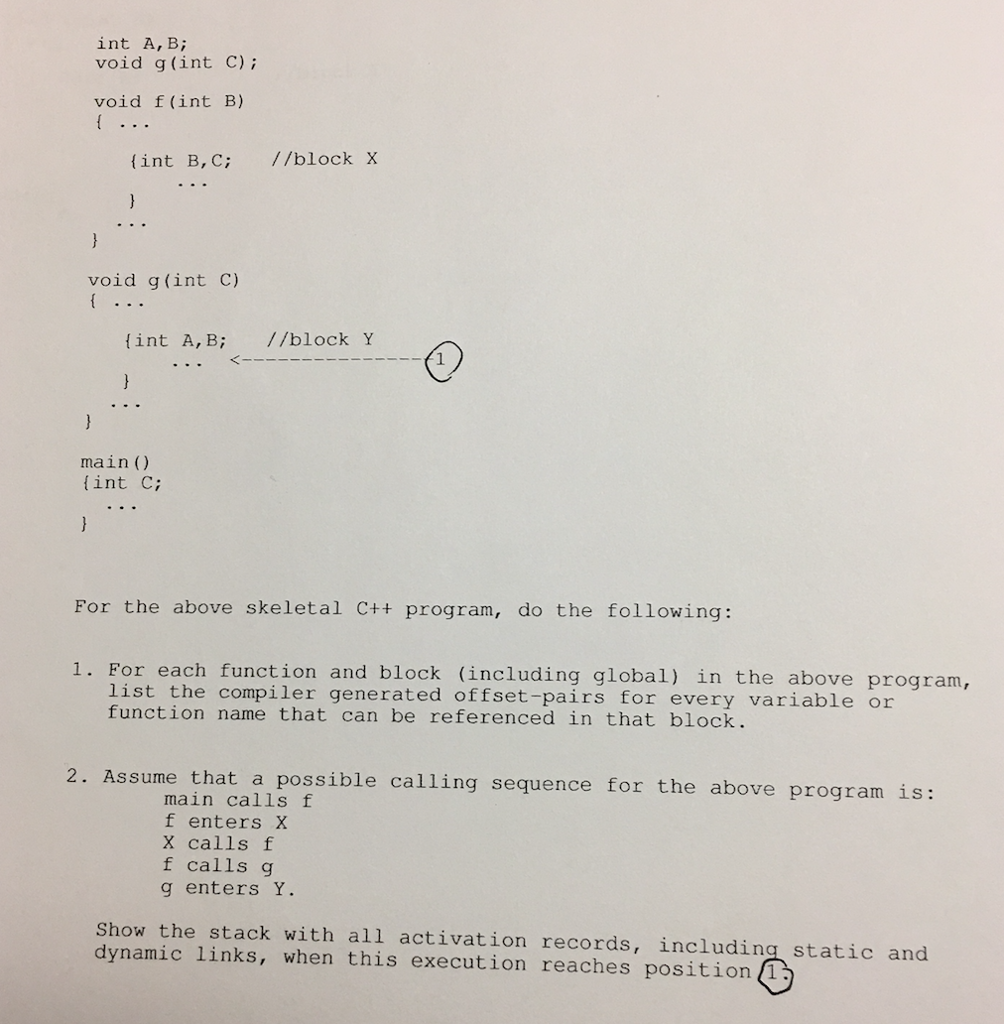
1. For each function and block (including global) in the program, list the compilar generated offset-pairs for every varaible or function name that can be referenced in that block.
2. Assume that a possible calling sequence for the above program is:
main calls f
f enters X
X calls f
f calls g
g enters Y.
Show the stack with all activation records, including static and dynamic links, when this execution reaches position 1.
int A, B; void g(int C) void f (int B) fint B, C; //block X void g(int C) fint A, B; //block Y main () (int c; For the above skeletal C++ program, do the following: 1. For each function and block (including global) in the above program, list the compiler generated offset-pairs for every variable or function name that can be referenced in that block. 2. Assume that a possible calling sequence for the above program is: main calls f f enters X x calls f f calls g g enters Y. Show the stack with all activation records, including static and dynamic links, when this execution reaches position (1 int A, B; void g(int C) void f (int B) fint B, C; //block X void g(int C) fint A, B; //block Y main () (int c; For the above skeletal C++ program, do the following: 1. For each function and block (including global) in the above program, list the compiler generated offset-pairs for every variable or function name that can be referenced in that block. 2. Assume that a possible calling sequence for the above program is: main calls f f enters X x calls f f calls g g enters Y. Show the stack with all activation records, including static and dynamic links, when this execution reaches position (1
Step by Step Solution
There are 3 Steps involved in it

Get step-by-step solutions from verified subject matter experts
 Study Help