







Question: 1. For this problem, assume that each instruction takes the same number of cycles, and use the code listed below. Loop: xor $r0, $r0,
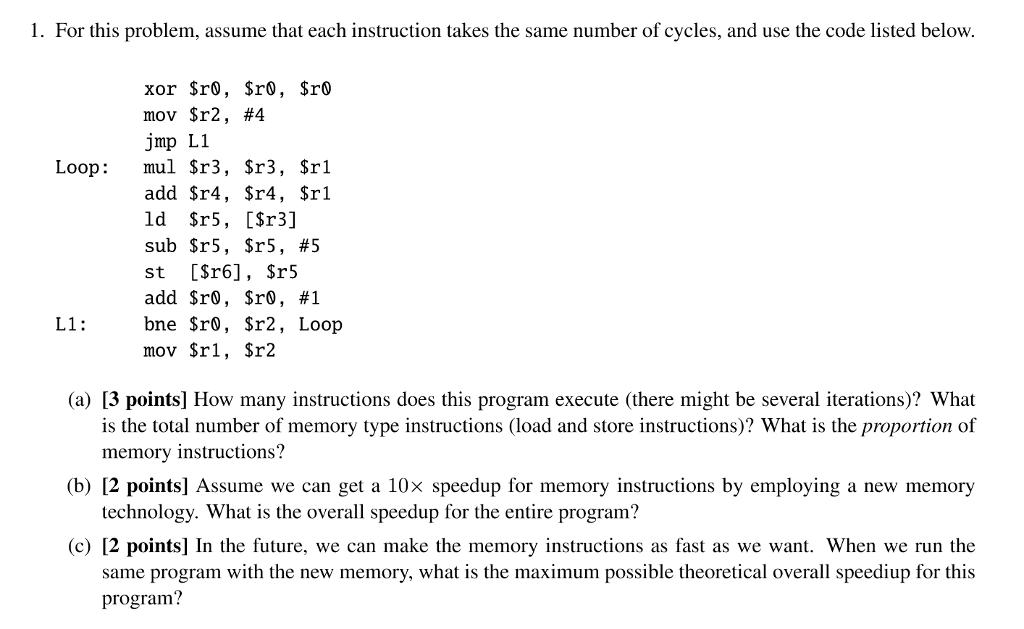
1. For this problem, assume that each instruction takes the same number of cycles, and use the code listed below. Loop: xor $r0, $r0, $r0 mov $r2, #4 jmp L1 mul $r3, $r3, $r1 add $r4, $r4, $r1 ld $r5, [$r3] sub $r5, $r5, #35 st [$r6], $r5 add $r0, $r0, #31 L1: bne $r0, $r2, Loop mov $r1, $r2 (a) [3 points] How many instructions does this program execute (there might be several iterations)? What is the total number of memory type instructions (load and store instructions)? What is the proportion of memory instructions? (b) [2 points] Assume we can get a 10 speedup for memory instructions by employing a new memory technology. What is the overall speedup for the entire program? (c) [2 points] In the future, we can make the memory instructions as fast as we want. When we run the same program with the new memory, what is the maximum possible theoretical overall speediup for this program?
Step by Step Solution
There are 3 Steps involved in it

Get step-by-step solutions from verified subject matter experts
 Study Help