







Question: 1 ) Formulate the school assignment problem as an optimization problem, incorporating capacity constraints at each school as well as constraints that all students must
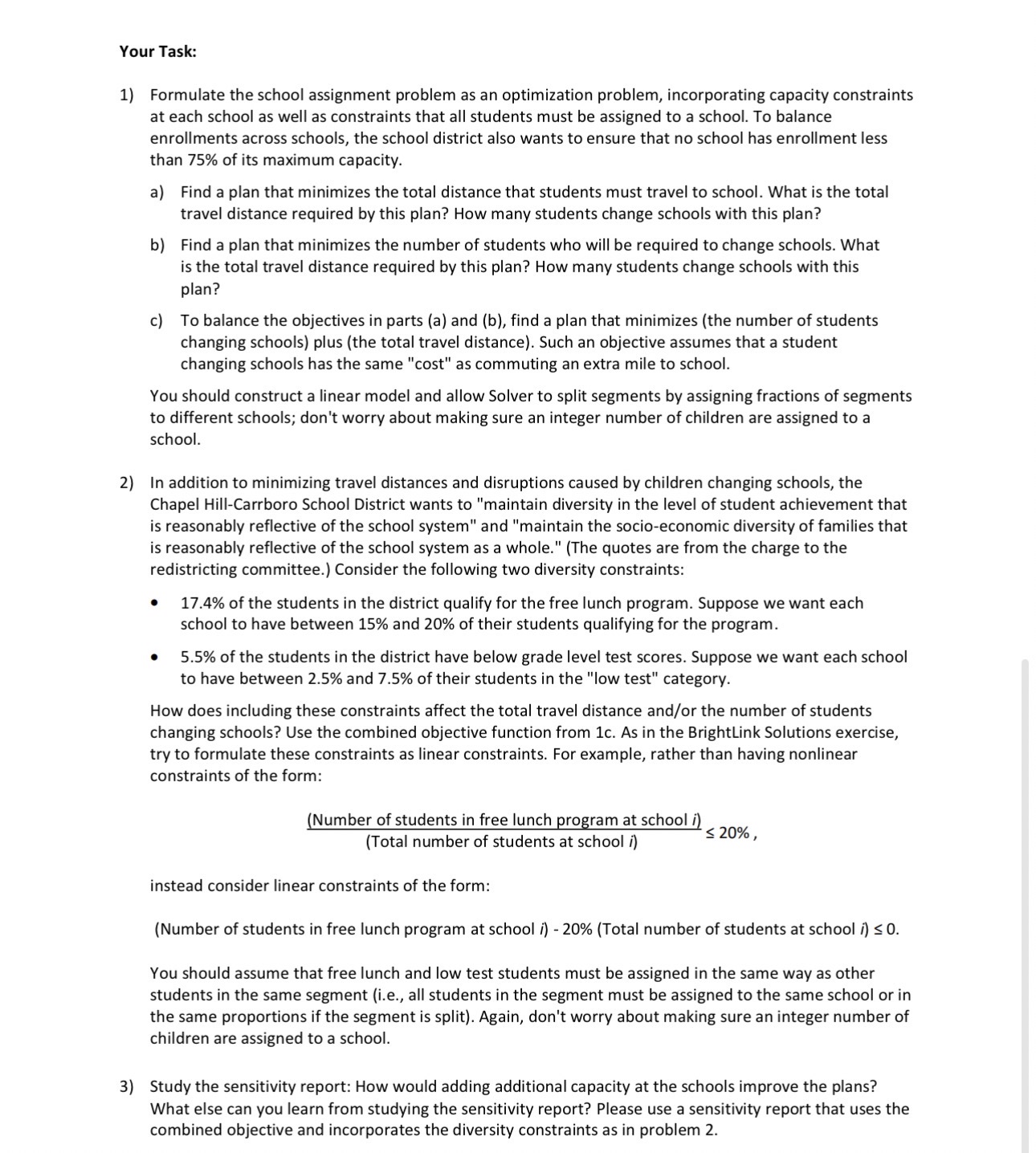
Formulate the school assignment problem as an optimization problem, incorporating capacity constraints at each school as well as constraints that all students must be assigned to a school. To balance enrollments across schools, the school district also wants to ensure that no school has enrollment less than of its maximum capacity.Your Task:
Formulate the school assignment problem as an optimization problem, incorporating capacity constraints
at each school as well as constraints that all students must be assigned to a school. To balance
enrollments across schools, the school district also wants to ensure that no school has enrollment less
than of its maximum capacity.
a Find a plan that minimizes the total distance that students must travel to school. What is the total
travel distance required by this plan? How many students change schools with this plan?
b Find a plan that minimizes the number of students who will be required to change schools. What
is the total travel distance required by this plan? How many students change schools with this
plan?
c To balance the objectives in parts a and b find a plan that minimizes the number of students
changing schools plus the total travel distance Such an objective assumes that a student
changing schools has the same "cost" as commuting an extra mile to school.
You should construct a linear model and allow Solver to split segments by assigning fractions of segments
to different schools; don't worry about making sure an integer number of children are assigned to a
school.
In addition to minimizing travel distances and disruptions caused by children changing schools, the
Chapel HillCarrboro School District wants to "maintain diversity in the level of student achievement that
is reasonably reflective of the school system" and "maintain the socioeconomic diversity of families that
is reasonably reflective of the school system as a whole." The quotes are from the charge to the
redistricting committee. Consider the following
a Find a plan that minimizes the total distance that students must travel to school. What is the total travel distance required by this plan? How many students change schools with this plan?
b Find a plan that minimizes the number of students who will be required to change schools. What is the total travel distance required by this plan? How many students change schools with this plan?
c To balance the objectives in parts a and b find a plan that minimizes the number of students changing schools plus the total travel distance Such an objective assumes that a student changing schools has the same "cost" as commuting an extra mile to school.
You should construct a linear model and allow Solver to split segments by assigning fractions of segments to different schools; don't worry about making sure an integer number of children are assigned to a school.
In addition to minimizing travel distances and disruptions caused by children changing schools, the Chapel HillCarrboro School District wants to "maintain diversity in the level of student achievement that is reasonably reflective of the school system" and "maintain the socioeconomic diversity of families that is reasonably reflective of the school system as a whole." The quotes are from the charge to the redistricting committee. Consider the following two diversity constraints:
of the students in the district qualify for the free lunch program. Suppose we want each school to have between and of their students qualifying for the program.
of the students in the district have below grade level test scores. Suppose we want each school to have between and of their students in the "low test" category.
How does including these constraints affect the total travel distance andor the number of students changing schools? Use the combined objective function from c As in the BrightLink Solutions exercise, try to formulate these constraints as linear constraints. For example, rather than having nonlinear constraints of the form:
Number of students in free lunch program at school i
Total number of students at school i
instead consider linear constraints of the form:
Number of students in free lunch program at school iTotal number of students at school i
You should assume that free lunch and low test students must be assigned in the same way as other students in the same segment ie all students in the segment must be assigned to the same school or in the same proportions if the segment is split Again, don't worry about making sure an integer number of children are assigned to a school.
Study the sensitivity report: How would adding additional capacity at the schools improve the plans?
What else can you learn from studying the sensitivity report? Please use a sensitivity report that uses the combined objective and incorporates the diversity constraints as in problem
Step by Step Solution
There are 3 Steps involved in it
1 Expert Approved Answer
Step: 1 Unlock

Question Has Been Solved by an Expert!
Get step-by-step solutions from verified subject matter experts
Step: 2 Unlock
Step: 3 Unlock
 Study Help