







Question: 1. From node S1, what portion of the interarrival rate 1 is directed toward the S2 node? 2.For node S3, what is the combined inbound
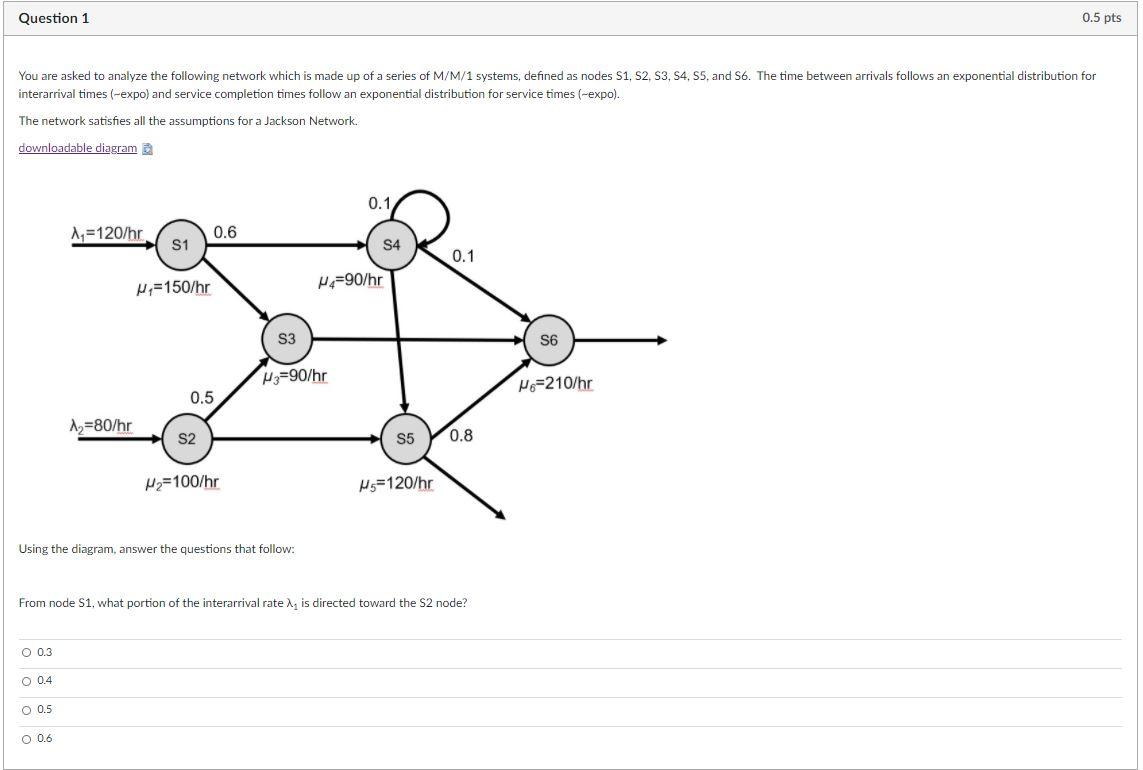
 1. From node S1, what portion of the interarrival rate 1 is directed toward the S2 node?
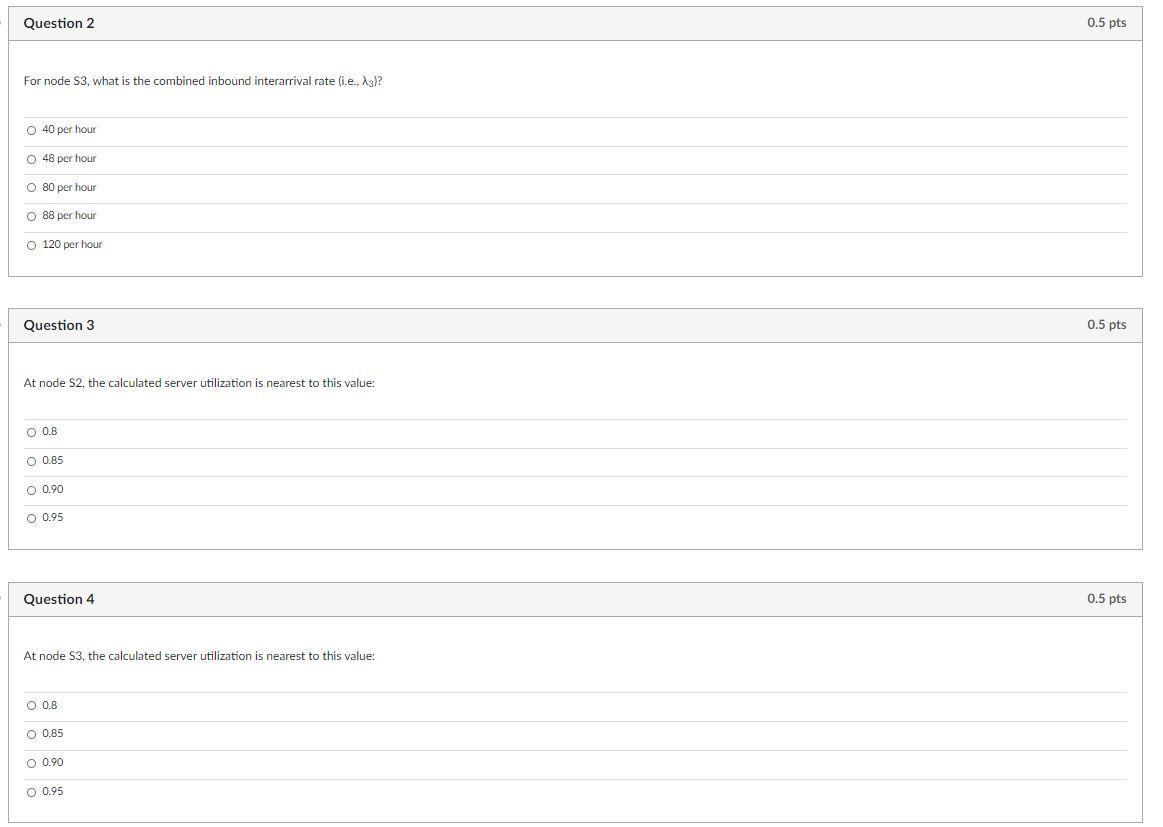
2.For node S3, what is the combined inbound interarrival rate (i.e., 3)?
3.At node S2, the calculated server utilization is nearest to this value:
4.At node S3, the calculated server utilization is nearest to this value:
Question 1 0.5 pts You are asked to analyze the following network which is made up of a series of M/M/1 systems, defined as nodes S1, S2, S3, S4, S5, and S6. The time between arrivals follows an exponential distribution for interarrival times (-expo) and service completion times follow an exponential distribution for service times (-expo). The network satisfies all the assumptions for a Jackson Network. downloadable diagram @ 0.1 1,=120/hr 0.6 S1 S4 0.1 M =150/hr M4=90/hr S3 S6 M3=90/hr Me=210/hr 0.5 12=80/hr S2 S5 0.8 M2=100/hr M5=120/hr Using the diagram, answer the questions that follow: From node S1, what portion of the interarrival rate, is directed toward the S2 node? O 0.3 O 0.4 O 0.5 O 0.6 Question 2 0.5 pts For node S3, what is the combined inbound interarrival rate (i.e., 13)? O 40 per hour 48 per hour O 80 per hour O 88 per hour O 120 per hour Question 3 0.5 pts At node S2, the calculated server utilization is nearest to this value: O 0.8 O 0.85 O 0.90 O 0.95 Question 4 0.5 pts At node S3, the calculated server utilization is nearest to this value: O 0.8 O 0.85 O 0.90 O 0.95Step by Step Solution
There are 3 Steps involved in it
1 Expert Approved Answer
Step: 1 Unlock

Question Has Been Solved by an Expert!
Get step-by-step solutions from verified subject matter experts
Step: 2 Unlock
Step: 3 Unlock
 Study Help