







Question: 1) Harmonic analysis revisited: Generate an artificial complex-valued signal comprising the 10 sum of 10 (ten) complex sinewaves, x, = > amem , t =0,-..,T-1,
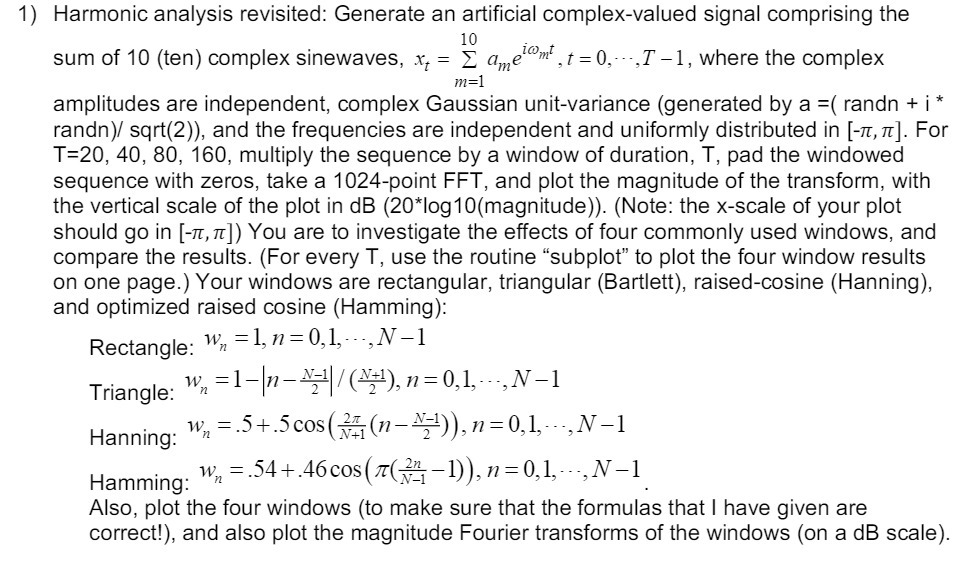
1) Harmonic analysis revisited: Generate an artificial complex-valued signal comprising the 10 sum of 10 (ten) complex sinewaves, x, = > ame"m , t =0,-..,T-1, where the complex m=1 amplitudes are independent, complex Gaussian unit-variance (generated by a =( randn + i* randn)/ sqrt(2)), and the frequencies are independent and uniformly distributed in [-It, It]. For T=20, 40, 80, 160, multiply the sequence by a window of duration, T, pad the windowed sequence with zeros, take a 1024-point FFT, and plot the magnitude of the transform, with the vertical scale of the plot in dB (20*log 10(magnitude)). (Note: the x-scale of your plot should go in [-7, it]) You are to investigate the effects of four commonly used windows, and compare the results. (For every T, use the routine "subplot" to plot the four window results on one page.) Your windows are rectangular, triangular (Bartlett), raised-cosine (Hanning), and optimized raised cosine (Hamming): Rectangle: Wn = 1, n = 0,1, ..., N-1 Triangle: W = 1- n - N- / (N+1), n = 0,1, -.., N-1 Hanning W =.5+.5cos (2( NHI (n-~-1)), n=0,1, -.-, N-1 Hamming W =.54+.46 cos ( 7( -1) ), n = 0,1, -.., N-1 Also, plot the four windows (to make sure that the formulas that I have given are correct!), and also plot the magnitude Fourier transforms of the windows (on a dB scale)
Step by Step Solution
There are 3 Steps involved in it

Get step-by-step solutions from verified subject matter experts
 Study Help