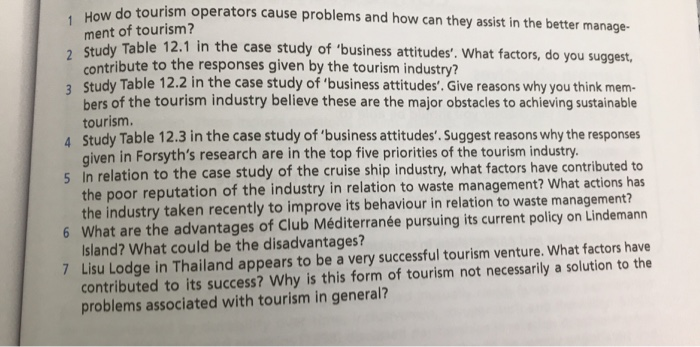
Question: 1 How do tourismo w do tourism operators cause problems and how can they assist in the better manage- ment of tourism? tudy Table 12.1
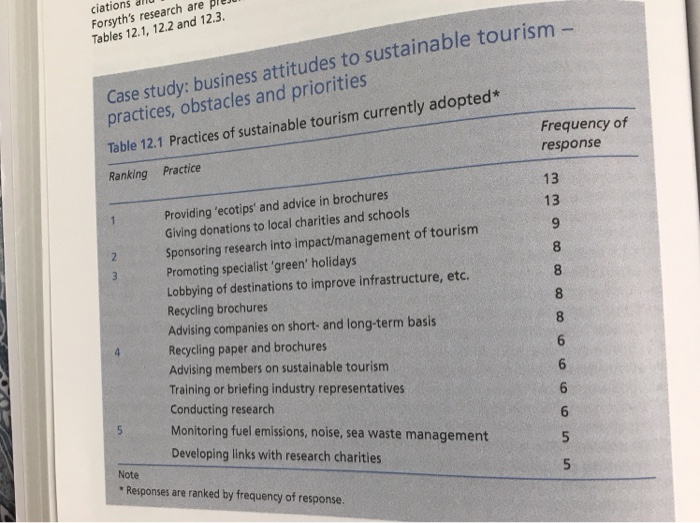
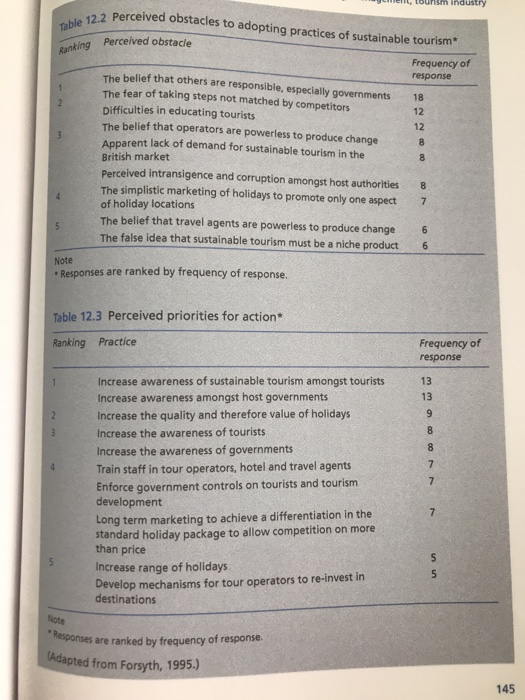
1 How do tourismo w do tourism operators cause problems and how can they assist in the better manage- ment of tourism? tudy Table 12.1 in the case study of 'business attitudes'. What factors, do you suggest, contribute to the responses given by the tourism industry? Study Table 12.2 in the case study of 'business attitudes'. Give reasons why you think mem- bers of the tourism industry believe these are the major obstacles to achieving sustainable tourism. A Study Table 12.3 in the case study of 'business attitudes'. Suggest reasons why the responses given in Forsyth's research are in the top five priorities of the tourism industry. 5 In relation to the case study of the cruise ship industry, what factors have contributed to the poor reputation of the industry in relation to waste management? What actions has the industry taken recently to improve its behaviour in relation to waste management? 6 What are the advantages of Club Mditerrane pursuing its current policy on Lindemann Island? What could be the disadvantages? 7 Lisu Lodge in Thailand appears to be a very successful tourism venture. What factors have contributed to its success? Why is this form of tourism not necessarily a solution to the problems associated with tourism in general? ciations and Forsyth's research are pledu Tables 12.1, 12.2 and 12.3. Case study: business attitudes to sustainable tourism practices, obstacles and priorities Table 12.1 Practices of sustainable tourism currently adopted* Ranking Practice Frequency of response w Providing 'ecotips' and advice in brochures Giving donations to local charities and schools Sponsoring research into impact/management of tourism Promoting specialist 'green' holidays Lobbying of destinations to improve infrastructure, etc. Recycling brochures Advising companies on short and long-term basis Recycling paper and brochures Advising members on sustainable tourism Training or briefing industry representatives Conducting research un uomo co Monitoring fuel emissions, noise, sea waste management Developing links with research charities Note * Responses are ranked by frequency of response. Cment, tour industry 22 Perceived obstacles to adopting practices of sustainable tourism Table 12.2 Perc anking Perceived obstacle Frequency of response The belief that others are responsible, especially governments The fear of taking steps not matched by competitors Difficulties in educating tourists The belief that operators are powerless to produce change Apparent lack of demand for sustainable tourism in the British market Perceived intransigence and corruption amongst host authorities The simplistic marketing of holidays to promote only one aspect of holiday locations The belief that travel agents are powerless to produce change The false idea that sustainable tourism must be a niche product 7 6 Note Responses are ranked by frequency of response. Table 12.3 Perceived priorities for action* Ranking Practice Frequency of response 0 0 Increase awareness of sustainable tourism amongst tourists Increase awareness amongst host governments Increase the quality and therefore value of holidays Increase the awareness of tourists Increase the awareness of governments Train staff in tour operators, hotel and travel agents Enforce government controls on tourists and tourism development Long term marketing to achieve a differentiation in the standard holiday package to allow competition on more than price Increase range of holidays Develop mechanisms for tour operators to re-invest in destinations un u Note esponses are ranked by frequency of response. Adapted from Forsyth, 1995.) 145 1 How do tourismo w do tourism operators cause problems and how can they assist in the better manage- ment of tourism? tudy Table 12.1 in the case study of 'business attitudes'. What factors, do you suggest, contribute to the responses given by the tourism industry? Study Table 12.2 in the case study of 'business attitudes'. Give reasons why you think mem- bers of the tourism industry believe these are the major obstacles to achieving sustainable tourism. A Study Table 12.3 in the case study of 'business attitudes'. Suggest reasons why the responses given in Forsyth's research are in the top five priorities of the tourism industry. 5 In relation to the case study of the cruise ship industry, what factors have contributed to the poor reputation of the industry in relation to waste management? What actions has the industry taken recently to improve its behaviour in relation to waste management? 6 What are the advantages of Club Mditerrane pursuing its current policy on Lindemann Island? What could be the disadvantages? 7 Lisu Lodge in Thailand appears to be a very successful tourism venture. What factors have contributed to its success? Why is this form of tourism not necessarily a solution to the problems associated with tourism in general? ciations and Forsyth's research are pledu Tables 12.1, 12.2 and 12.3. Case study: business attitudes to sustainable tourism practices, obstacles and priorities Table 12.1 Practices of sustainable tourism currently adopted* Ranking Practice Frequency of response w Providing 'ecotips' and advice in brochures Giving donations to local charities and schools Sponsoring research into impact/management of tourism Promoting specialist 'green' holidays Lobbying of destinations to improve infrastructure, etc. Recycling brochures Advising companies on short and long-term basis Recycling paper and brochures Advising members on sustainable tourism Training or briefing industry representatives Conducting research un uomo co Monitoring fuel emissions, noise, sea waste management Developing links with research charities Note * Responses are ranked by frequency of response. Cment, tour industry 22 Perceived obstacles to adopting practices of sustainable tourism Table 12.2 Perc anking Perceived obstacle Frequency of response The belief that others are responsible, especially governments The fear of taking steps not matched by competitors Difficulties in educating tourists The belief that operators are powerless to produce change Apparent lack of demand for sustainable tourism in the British market Perceived intransigence and corruption amongst host authorities The simplistic marketing of holidays to promote only one aspect of holiday locations The belief that travel agents are powerless to produce change The false idea that sustainable tourism must be a niche product 7 6 Note Responses are ranked by frequency of response. Table 12.3 Perceived priorities for action* Ranking Practice Frequency of response 0 0 Increase awareness of sustainable tourism amongst tourists Increase awareness amongst host governments Increase the quality and therefore value of holidays Increase the awareness of tourists Increase the awareness of governments Train staff in tour operators, hotel and travel agents Enforce government controls on tourists and tourism development Long term marketing to achieve a differentiation in the standard holiday package to allow competition on more than price Increase range of holidays Develop mechanisms for tour operators to re-invest in destinations un u Note esponses are ranked by frequency of response. Adapted from Forsyth, 1995.) 145









 Study Help