







Question: 1. How much work (Work Force x distance) was done when the weight fell? 2. If the work done to the aircraft is the
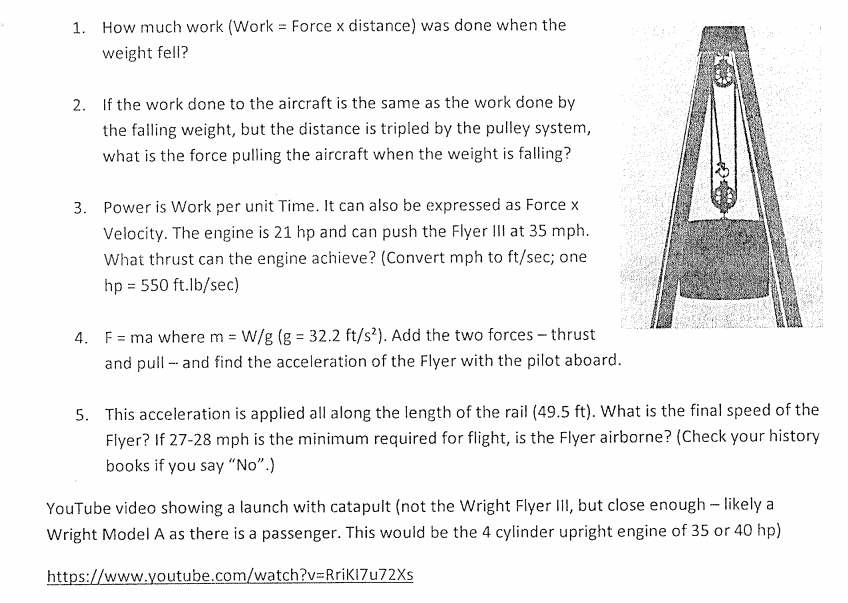
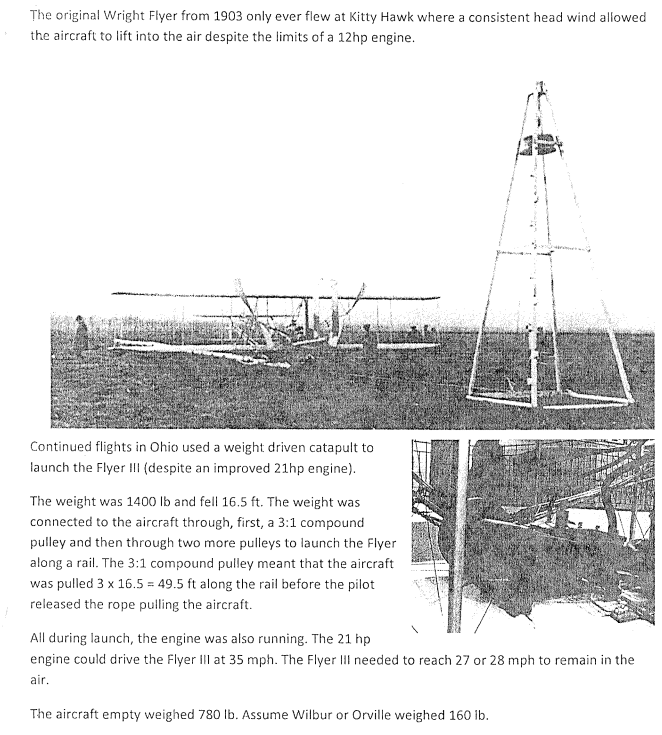
1. How much work (Work Force x distance) was done when the weight fell? 2. If the work done to the aircraft is the same as the work done by the falling weight, but the distance is tripled by the pulley system, what is the force pulling the aircraft when the weight is falling? 3. Power is Work per unit Time. It can also be expressed as Force x Velocity. The engine is 21 hp and can push the Flyer III at 35 mph. What thrust can the engine achieve? (Convert mph to ft/sec; one hp = 550 ft.lb/sec) 4. F=ma where m = W/g (g = 32.2 ft/s). Add the two forces - thrust and pull and find the acceleration of the Flyer with the pilot aboard. 5. This acceleration is applied all along the length of the rail (49.5 ft). What is the final speed of the Flyer? If 27-28 mph is the minimum required for flight, is the Flyer airborne? (Check your history books if you say "No".) YouTube video showing a launch with catapult (not the Wright Flyer III, but close enough -- likely a Wright Model A as there is a passenger. This would be the 4 cylinder upright engine of 35 or 40 hp) https://www.youtube.com/watch?v=RriKl7u72Xs The original Wright Flyer from 1903 only ever flew at Kitty Hawk where a consistent head wind allowed the aircraft to lift into the air despite the limits of a 12hp engine. Continued flights in Ohio used a weight driven catapult to launch the Flyer III (despite an improved 21hp engine). The weight was 1400 lb and fell 16.5 ft. The weight was connected to the aircraft through, first, a 3:1 compound pulley and then through two more pulleys to launch the Flyer along a rail. The 3:1 compound pulley meant that the aircraft was pulled 3 x 16.5 = 49.5 ft along the rail before the pilot released the rope pulling the aircraft. All during launch, the engine was also running. The 21 hp engine could drive the Flyer III at 35 mph. The Flyer III needed to reach 27 or 28 mph to remain in the air. The aircraft empty weighed 780 lb. Assume Wilbur or Orville weighed 160 lb.
Step by Step Solution
There are 3 Steps involved in it
Sol... View full answer

Get step-by-step solutions from verified subject matter experts
 Study Help