Question: 1. Identification (20 points) Identify what is being asked in the following statements. 1. These include customer-related reasons, organizational learning-related reasons, and other strategic reasons.
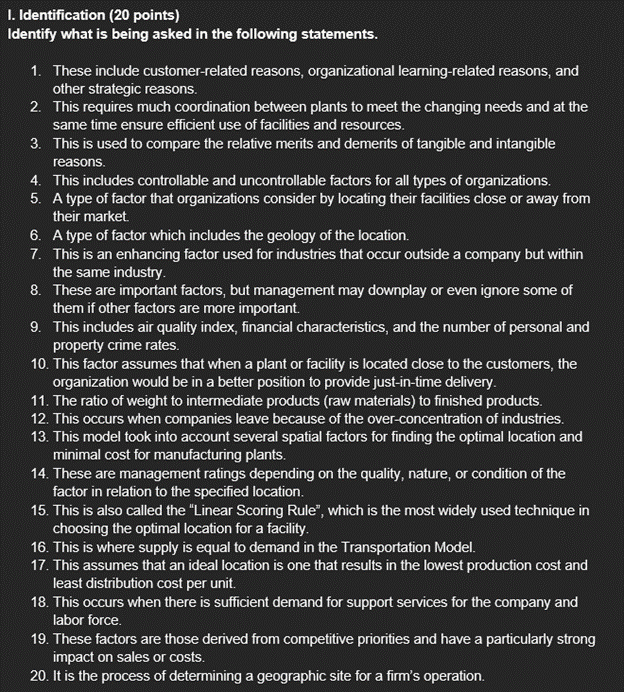
1. Identification (20 points) Identify what is being asked in the following statements. 1. These include customer-related reasons, organizational learning-related reasons, and other strategic reasons. 2. This requires much coordination between plants to meet the changing needs and at the same time ensure efficient use of facilities and resources. 3. This is used to compare the relative merits and demerits of tangible and intangible reasons. 4. This includes controllable and uncontrollable factors for all types of organizations. 5. A type of factor that organizations consider by locating their facilities close or away from their market 6. A type of factor which includes the geology of the location. 7. This is an enhancing factor used for industries that occur outside a company but within the same industry. 8. These are important factors, but management may downplay or even ignore some of them if other factors are more important. 9. This includes air quality index, financial characteristics, and the number of personal and property crime rates. 10. This factor assumes that when a plant or facility is located close to the customers, the organization would be in a better position to provide just-in-time delivery. 11. The ratio of weight to intermediate products (raw materials) to finished products. 12. This occurs when companies leave because of the over-concentration of industries. 13. This model took into account several spatial factors for finding the optimal location and minimal cost for manufacturing plants. 14. These are management ratings depending on the quality, nature, or condition of the factor in relation to the specified location. 15. This is also called the "Linear Scoring Rule", which is the most widely used technique in choosing the optimal location for a facility. 16. This is where supply is equal to demand in the Transportation Model. 17. This assumes that an ideal location is one that results in the lowest production cost and least distribution cost per unit. 18. This occurs when there is sufficient demand for support services for the company and labor force. 19. These factors are those derived from competitive priorities and have a particularly strong impact on sales or costs. 20. It is the process of determining a geographic site for a firm's operation. 1. Identification (20 points) Identify what is being asked in the following statements. 1. These include customer-related reasons, organizational learning-related reasons, and other strategic reasons. 2. This requires much coordination between plants to meet the changing needs and at the same time ensure efficient use of facilities and resources. 3. This is used to compare the relative merits and demerits of tangible and intangible reasons. 4. This includes controllable and uncontrollable factors for all types of organizations. 5. A type of factor that organizations consider by locating their facilities close or away from their market 6. A type of factor which includes the geology of the location. 7. This is an enhancing factor used for industries that occur outside a company but within the same industry. 8. These are important factors, but management may downplay or even ignore some of them if other factors are more important. 9. This includes air quality index, financial characteristics, and the number of personal and property crime rates. 10. This factor assumes that when a plant or facility is located close to the customers, the organization would be in a better position to provide just-in-time delivery. 11. The ratio of weight to intermediate products (raw materials) to finished products. 12. This occurs when companies leave because of the over-concentration of industries. 13. This model took into account several spatial factors for finding the optimal location and minimal cost for manufacturing plants. 14. These are management ratings depending on the quality, nature, or condition of the factor in relation to the specified location. 15. This is also called the "Linear Scoring Rule", which is the most widely used technique in choosing the optimal location for a facility. 16. This is where supply is equal to demand in the Transportation Model. 17. This assumes that an ideal location is one that results in the lowest production cost and least distribution cost per unit. 18. This occurs when there is sufficient demand for support services for the company and labor force. 19. These factors are those derived from competitive priorities and have a particularly strong impact on sales or costs. 20. It is the process of determining a geographic site for a firm's operation









 Study Help