Question: 1. Identify the authors argument, main idea, or thesis. 2. Explain the authors line of reasoning by identifying the claims used to build the argument
1. Identify the authors argument, main idea, or thesis.
2. Explain the authors line of reasoning by identifying the claims used to build the argument and the connections between them.
3. Evaluate the effectiveness of the evidence the author uses to support the claims made in the argument.
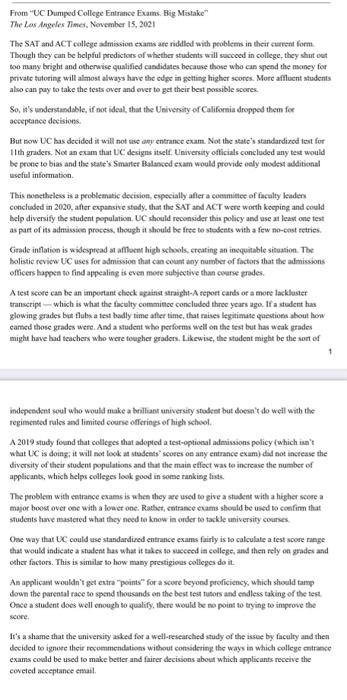
From "UC Dumped College Entrance Exams. Bigg Mistake" The Las Angrles Timer, November 15, 2021 The SAT and ACT college admassion exams are riddlbd with peoblems in their curent form. Though they can be helpful predictors of whether students will saccoed in college, they shut oet too muny bright and otherwise cualified castidates because those who can spend the msoncy for poivate tuloting will almost always have the edge in getting higher scorcs. More affluent students also can puy to take the tests over and ever to get their best possible scores. So, in's undertandable, if not ideal, that the Univensity of Califormia dropped them for acceptance decisions. But bow UC bas decided it will not ase avy entrance exam. Not the state's standardixed test for 11th griders. Not an exam that UC designs itself, University ofticials concluded any teat would be prone to bias and the sate's Smarter Balassed exam would provide oely modest abditional uscful information. This boetheless is a peoblemutic decivion, especially affer a soamittee of faculty keader: concluded in 2020, after expansive stady, that the SAT and ACT were worth keoping and could belp diversify the student population. UC should reconsider this policy and ase at leant one test as part of its admissiee process, though it should be free to stodents with a few no-eost tritres. Grade inflation is widespread at affocan high schools, creating an incquitable situation. Toe bolistic revicw UC uses for admission that can count any number of factars ahat the admissions officers happen to find appealing is even mote subjective than coarse grades. A test scoet can be an impotant check agains straight-A report cands of a mont lackluster transeript - which is what the faculty commitec concludod three years ago. If a stadent has glowing grades but fubs a test badly time after time, that raises leginimute questions sbout bow carned those gradss were. Aad a student whe performs well on the test but has weak grades might have bad teacherx who were teogher graders. Likewise, the student might be the sort of independent sout who would make a brilliant university stodeat but docsa't do well with the reginented nules and limited course offerings of high sehool. A 2019 study foend that collitges that adopted a test-optiosal admissions policy (which ias't what UC is doing; it will not look at students' scoses on any entrance exam) dad not inctease the diversity of their student populations and that the main effoct was to increase the number of applicants, which belps colleges look good in some ranking tists. The poblem with entrance exams is when they are used to give a stadent with a higher sever a major boos over che with a loact one. Rather, chtrance cuams should be used bo confirm that students have mastered what they need te know in order to tackle university courses. Ose way that UC could use standardized entrance exams fairly is to calculate a test score range. that would indicate a student has what it takes so meceed ia cellege, and then rely on grades and othar factors. This is similar to how many prestigions colleges do it. An applicaut wouldn't get ettra "points" for a swore beyood proficiency, which should tanp down the parental race to spend thousands en the best tes tusors and endless taking of the test. Osce a student does well enough so qualify, there would be no point to trying to improve the score. It's a shame that the university aked for a well-researched study of the issee by faculty and then decided to ignoee their recommendutions without considering the ways in which college cairance exams coeld be used to make betier and fairer decisions about which applicants receive the coveted acseptance email









 Study Help