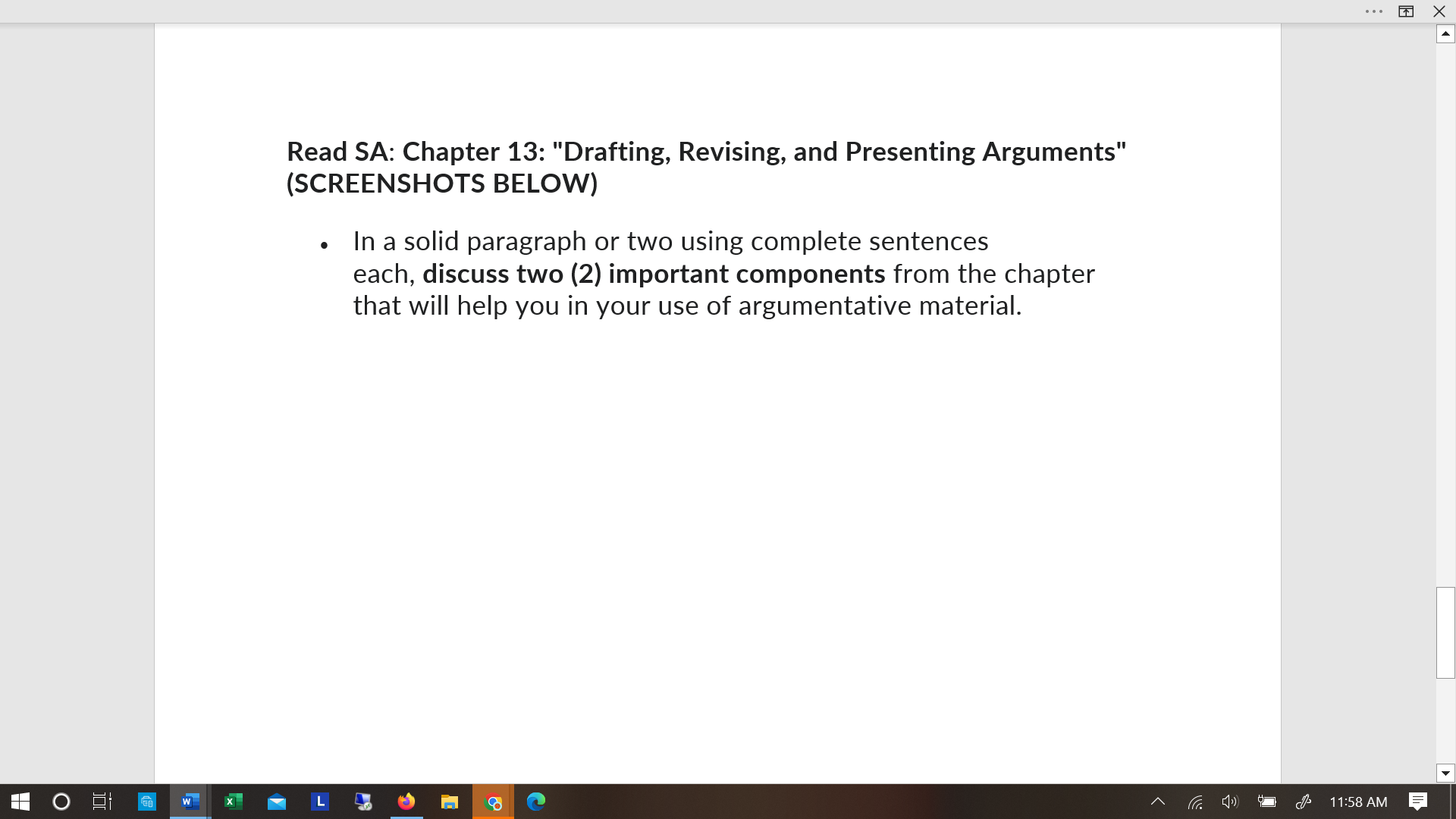
Question: PLEASE HELP . . . X Read SA: Chapter 13: Drafting, Revising, and Presenting Arguments (SCREENSHOTS BELOW) . In a solid paragraph or two using
PLEASE HELP
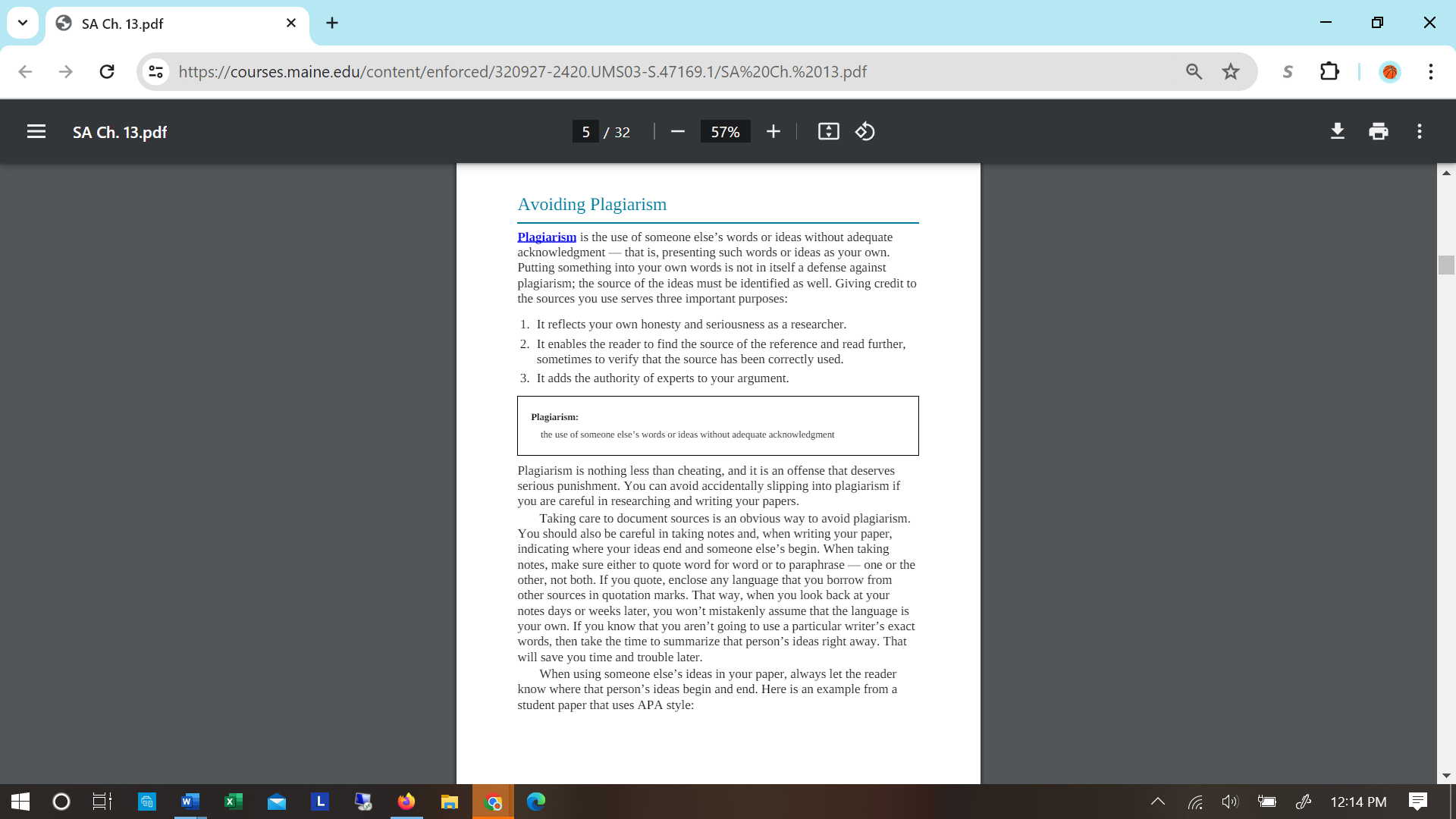
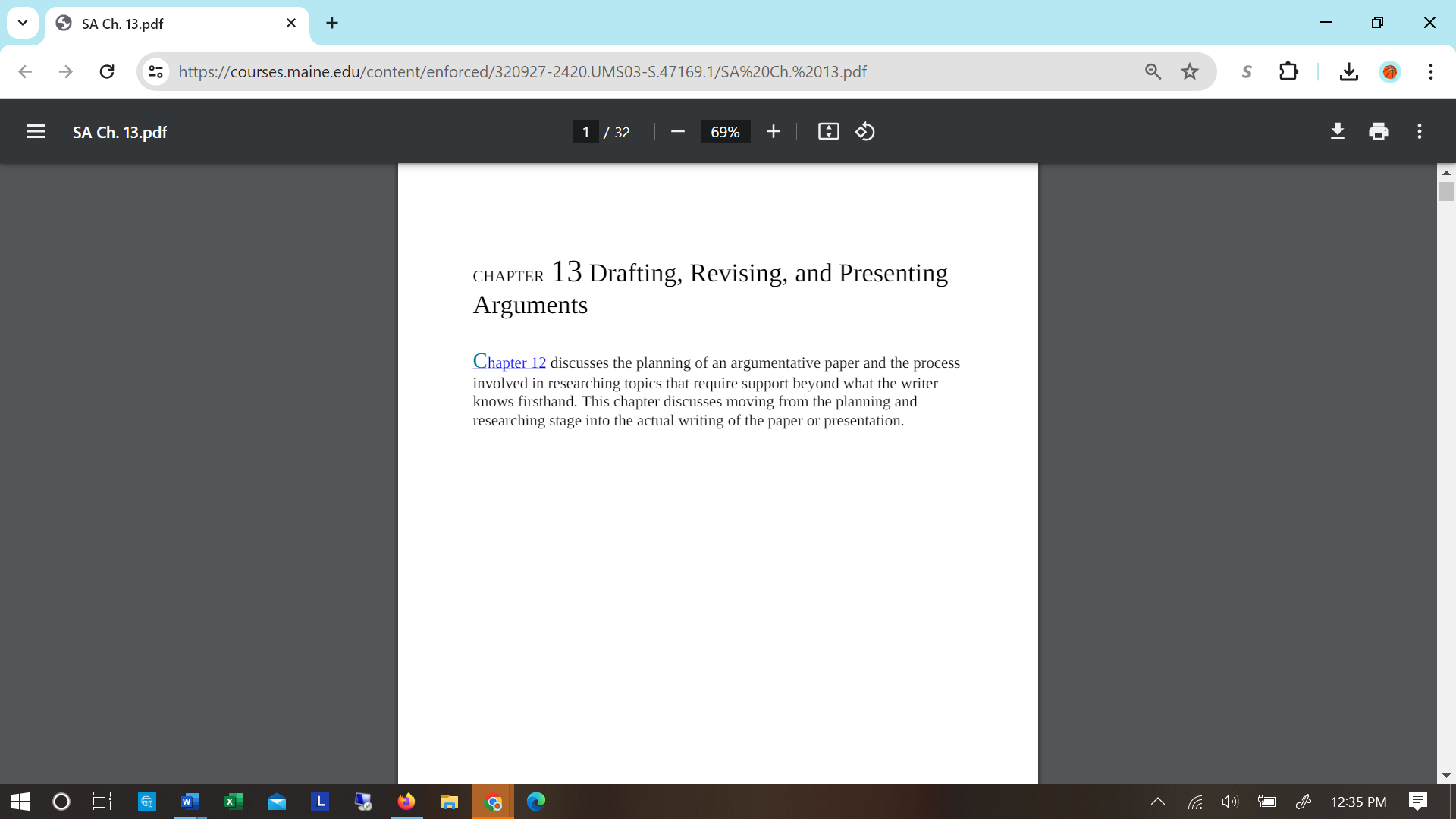
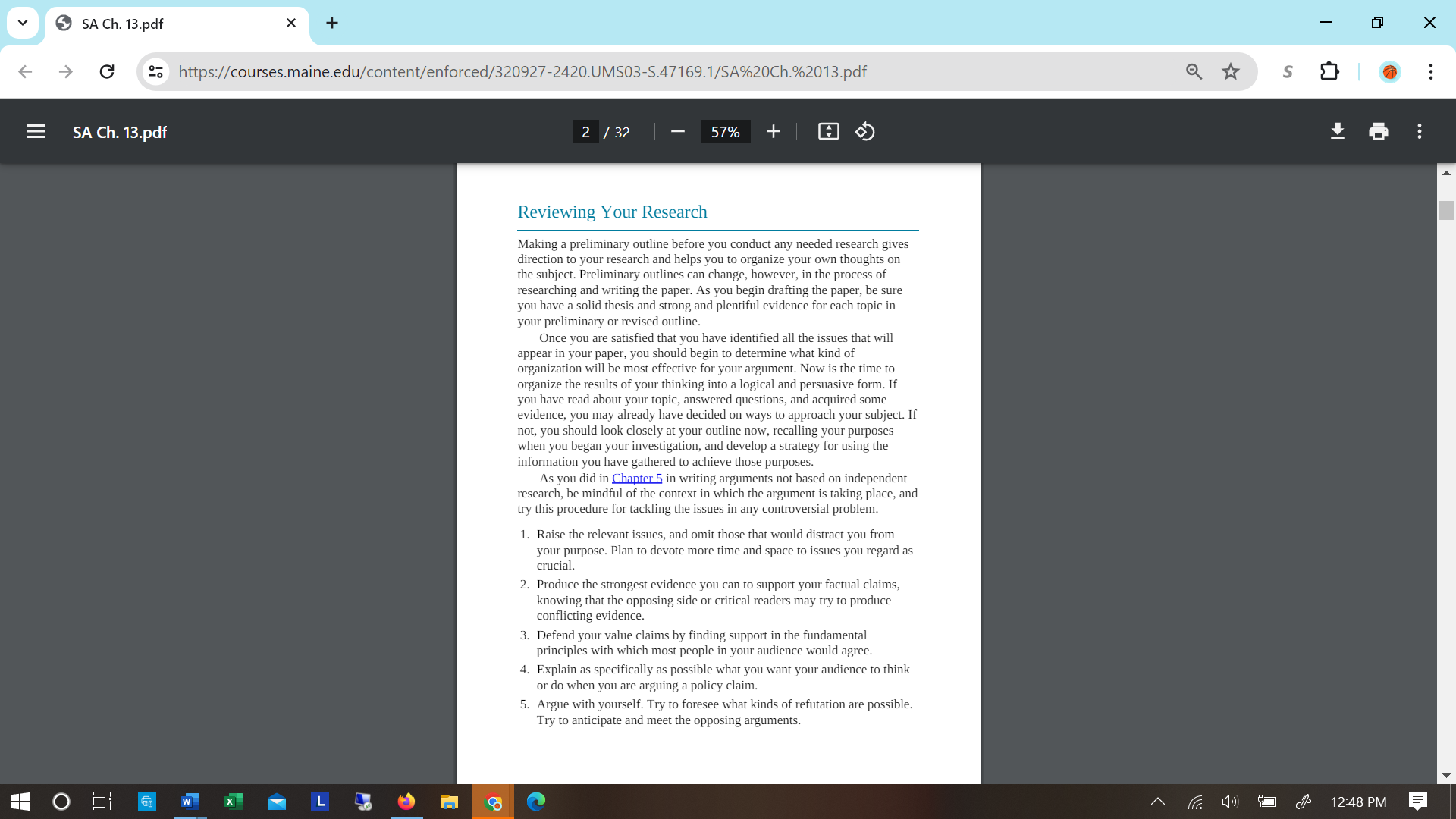
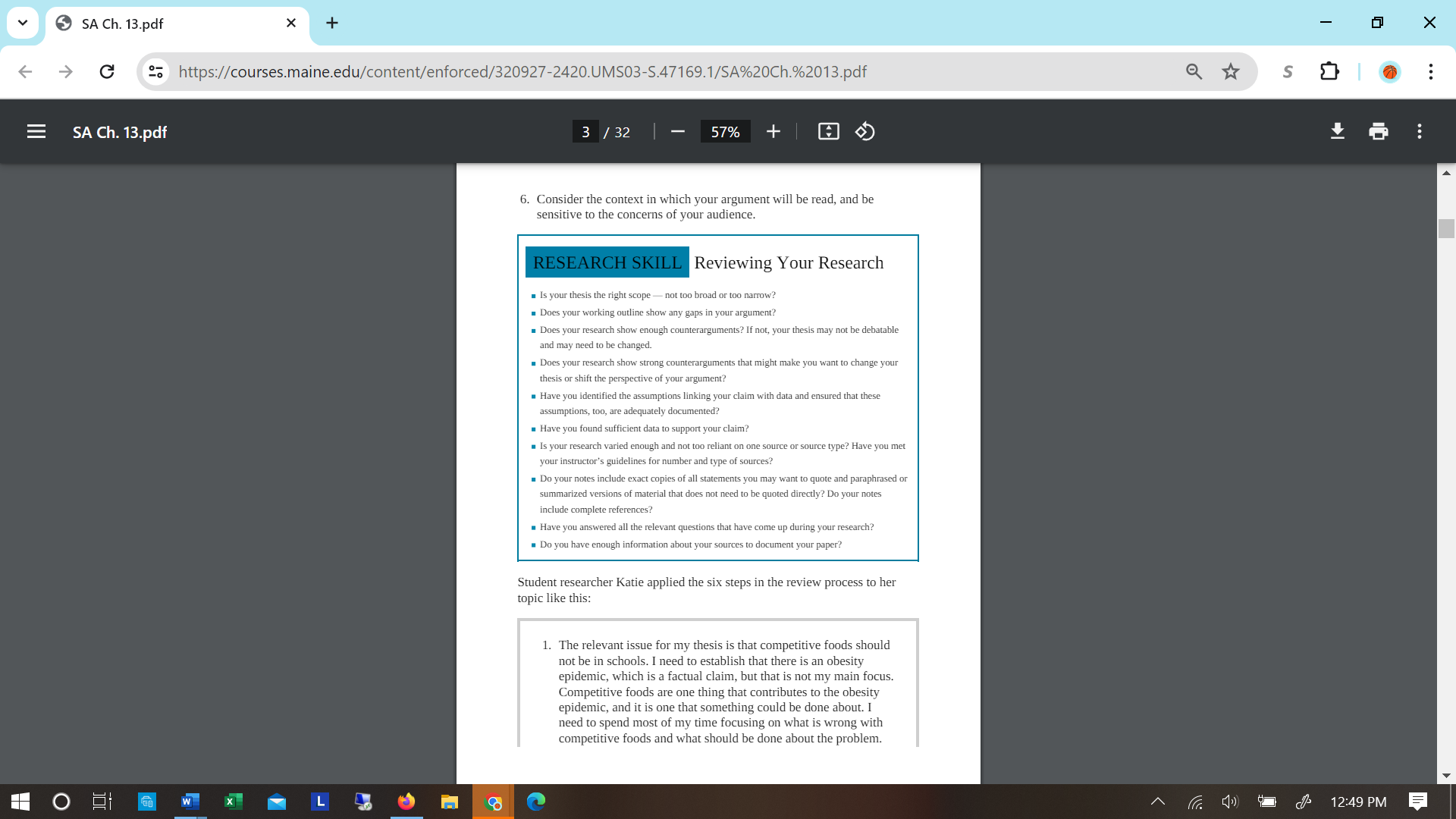
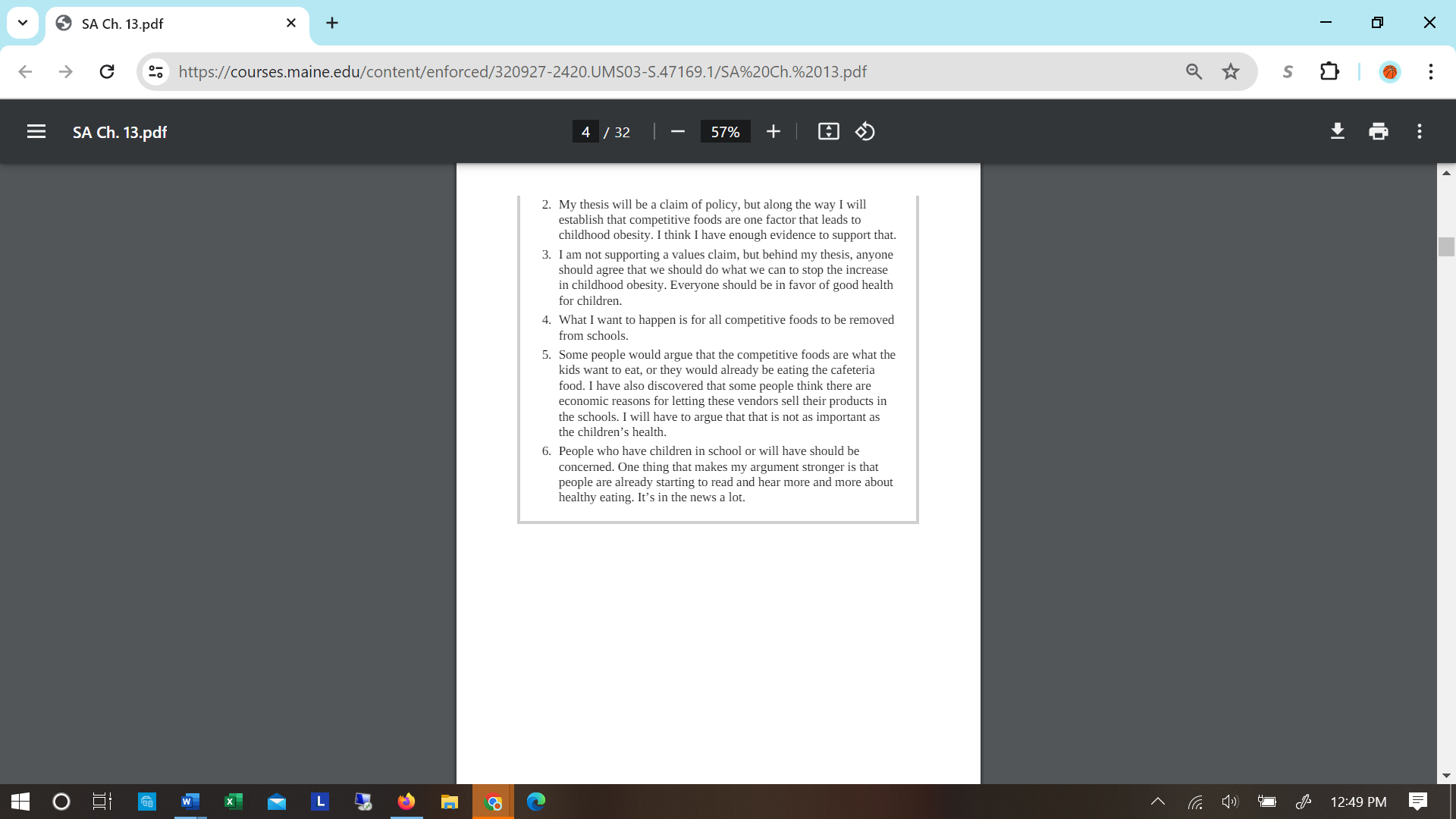
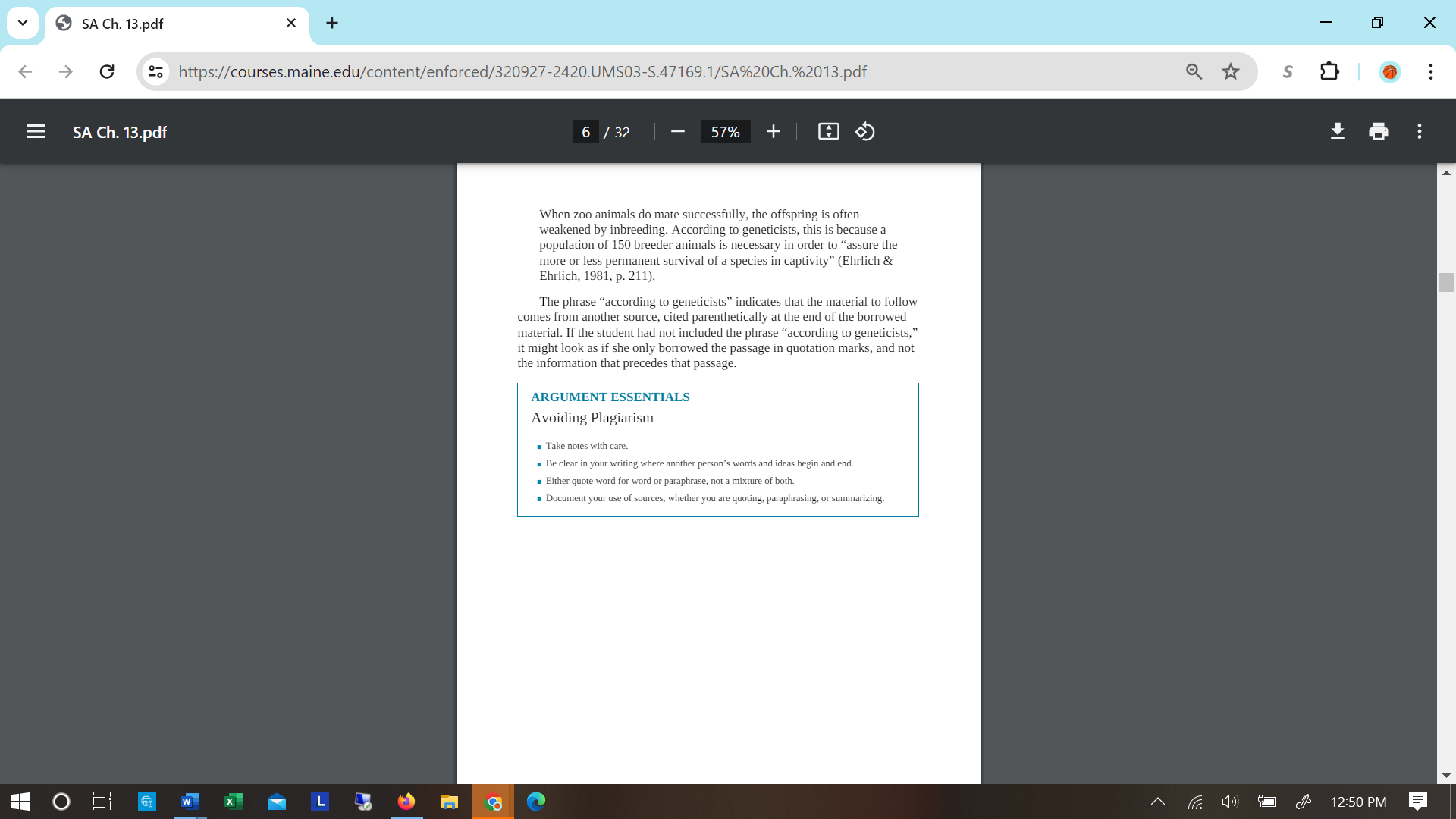
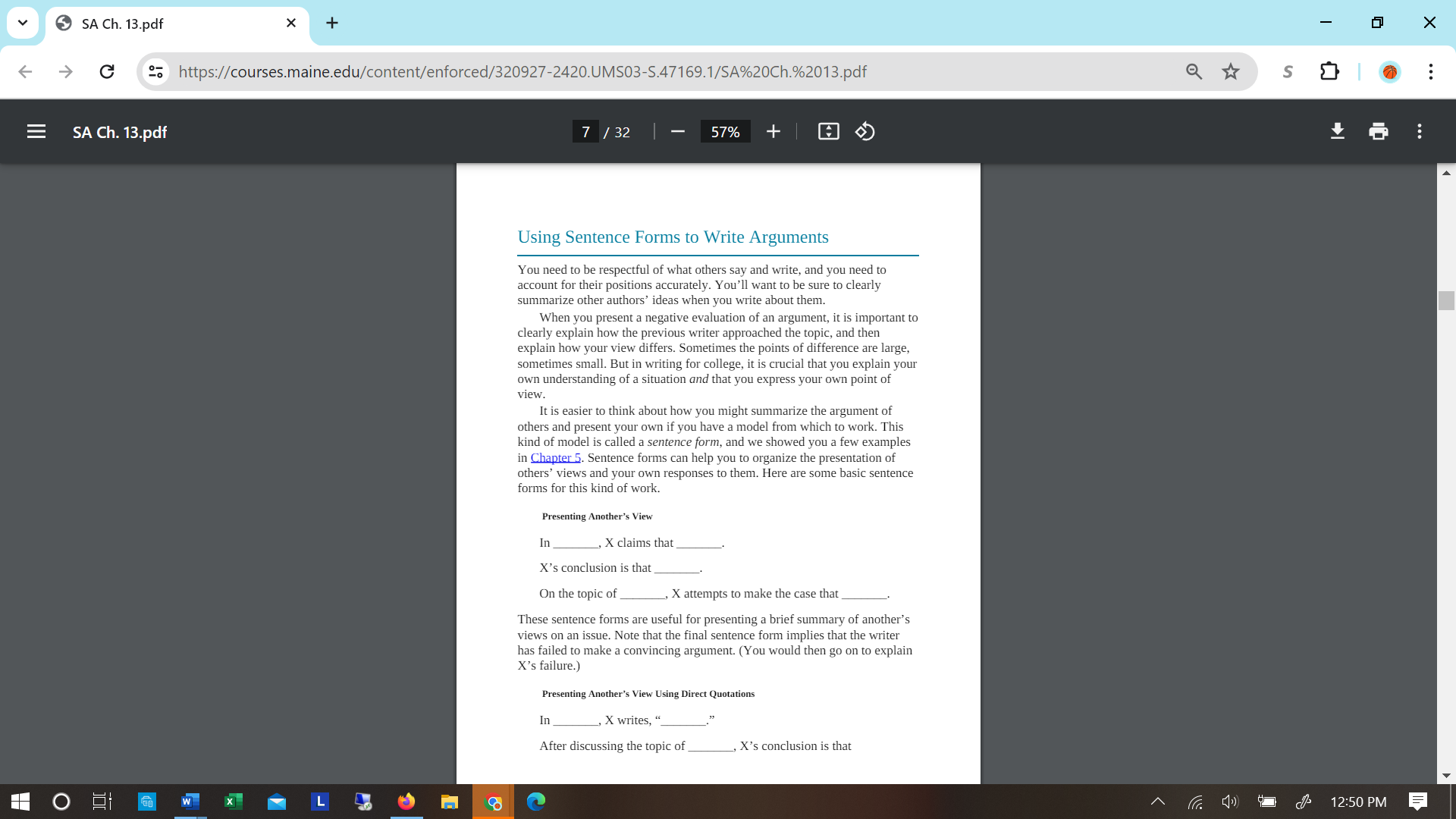
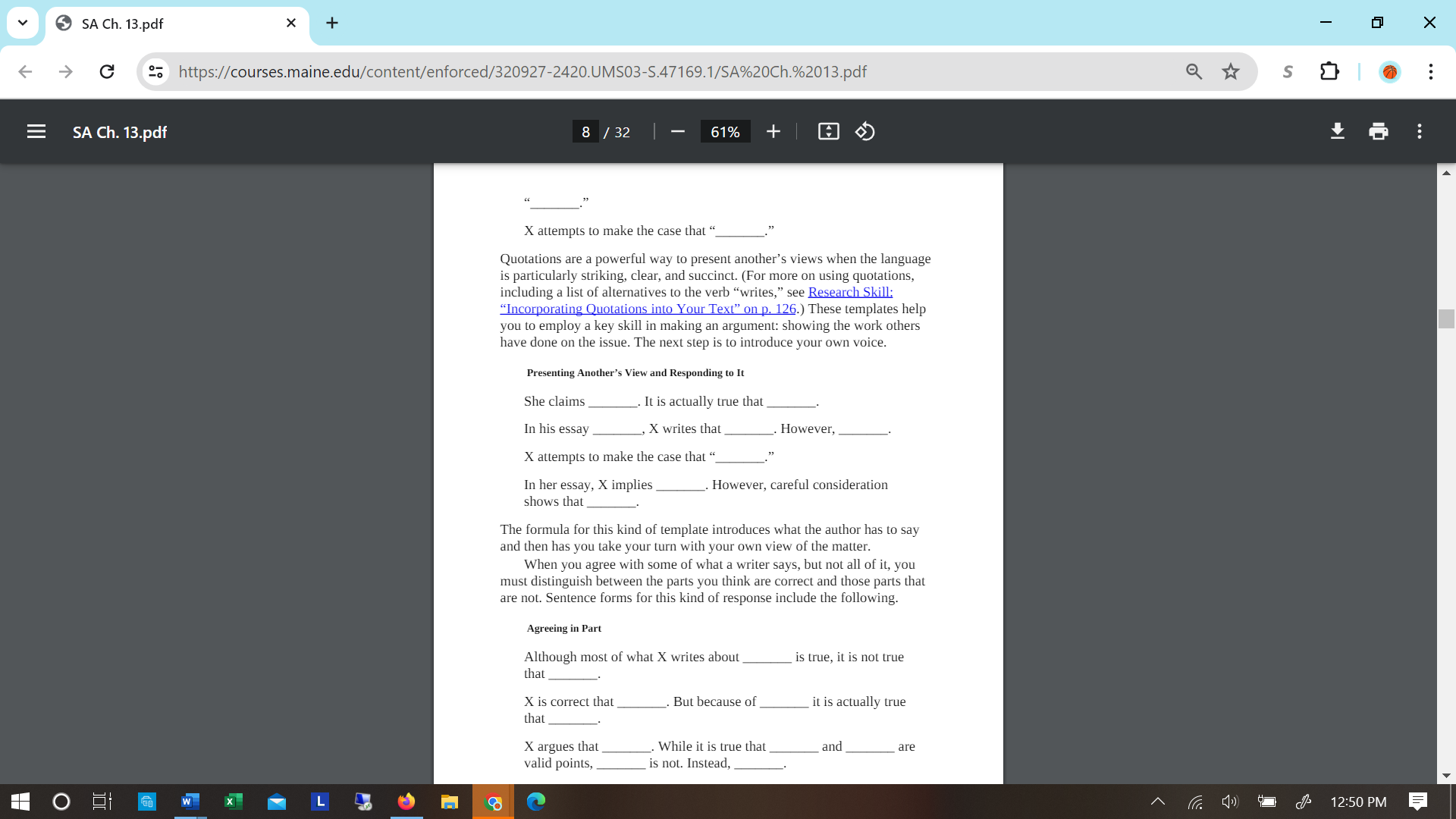
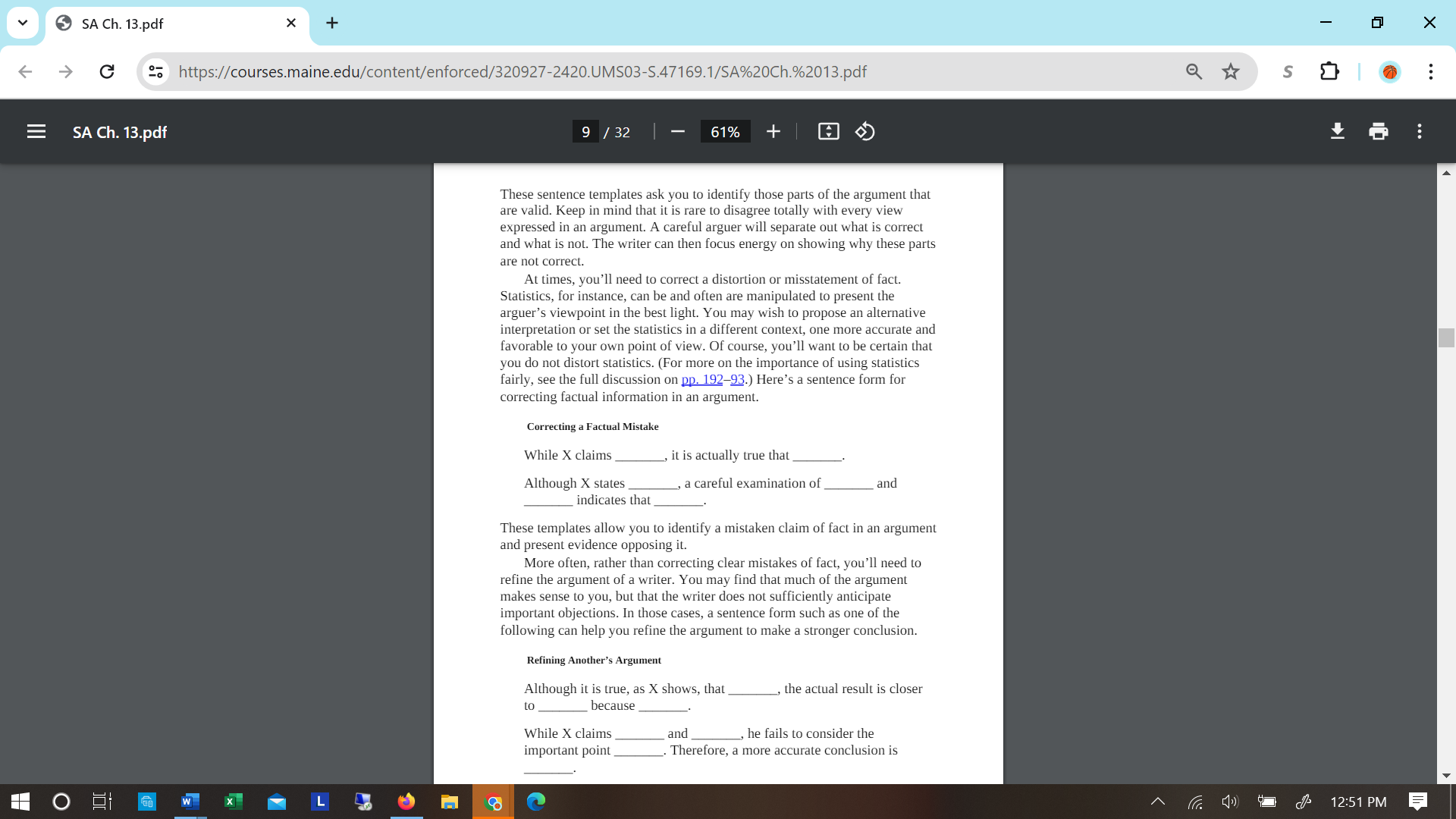
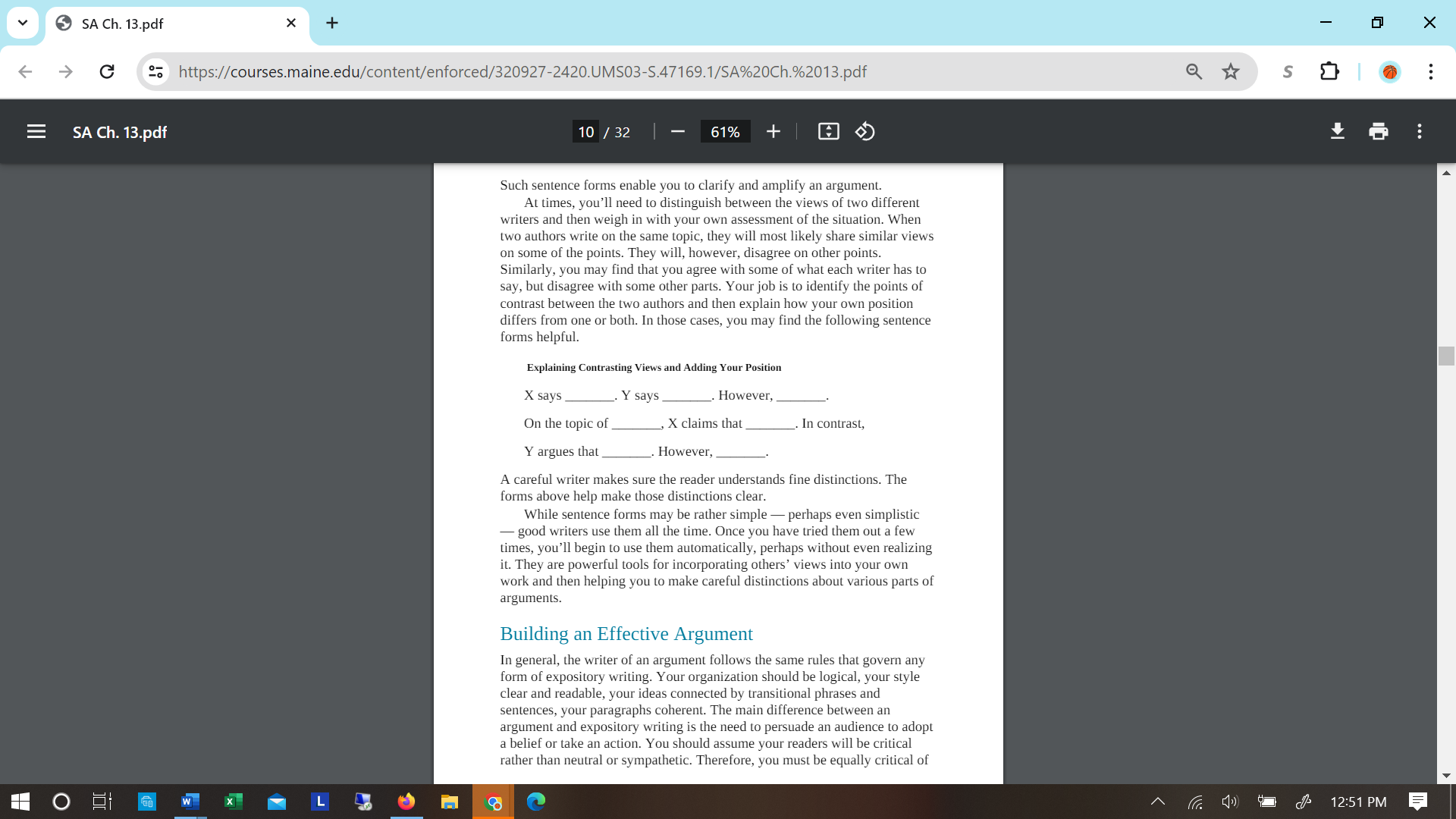
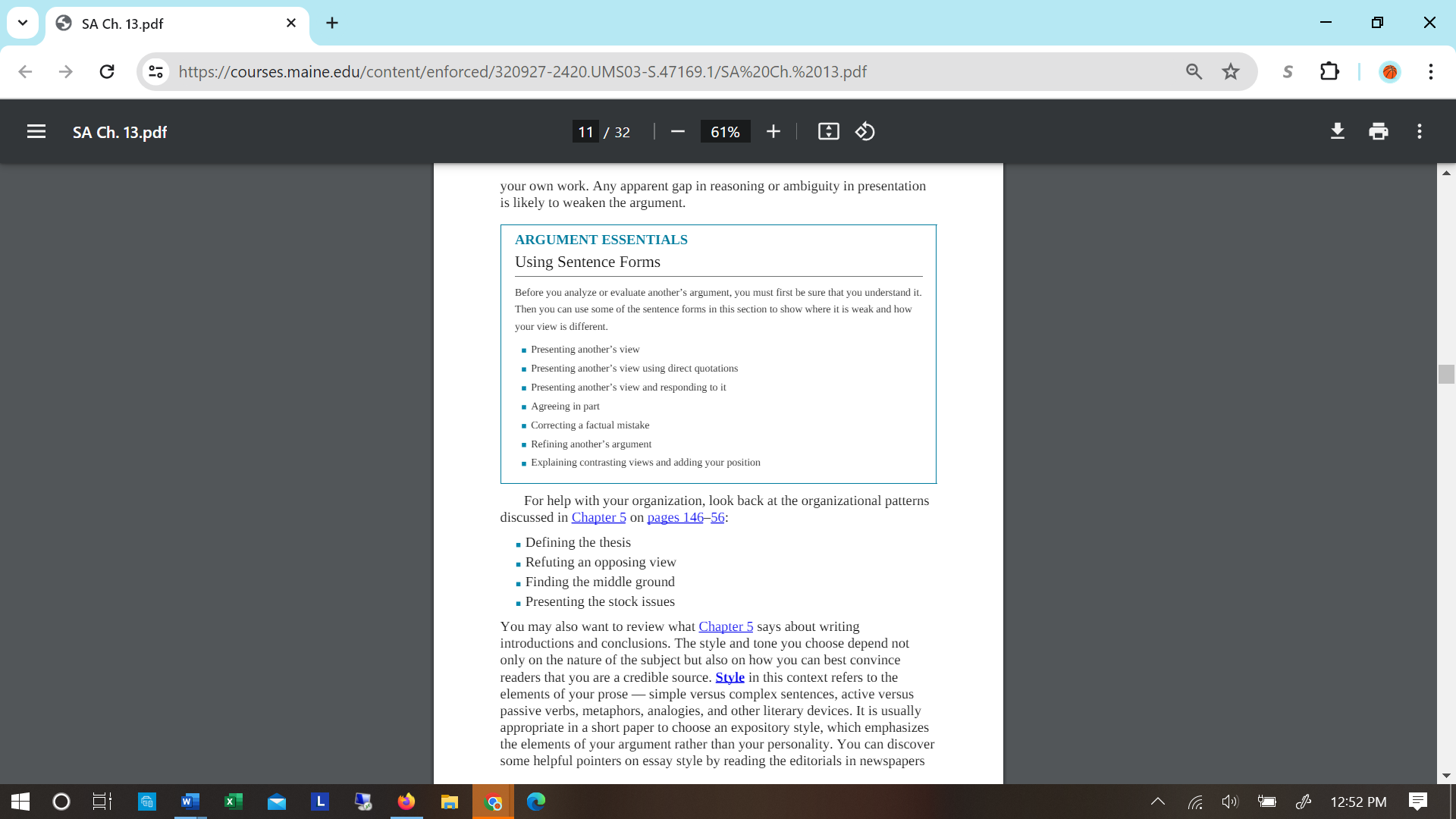
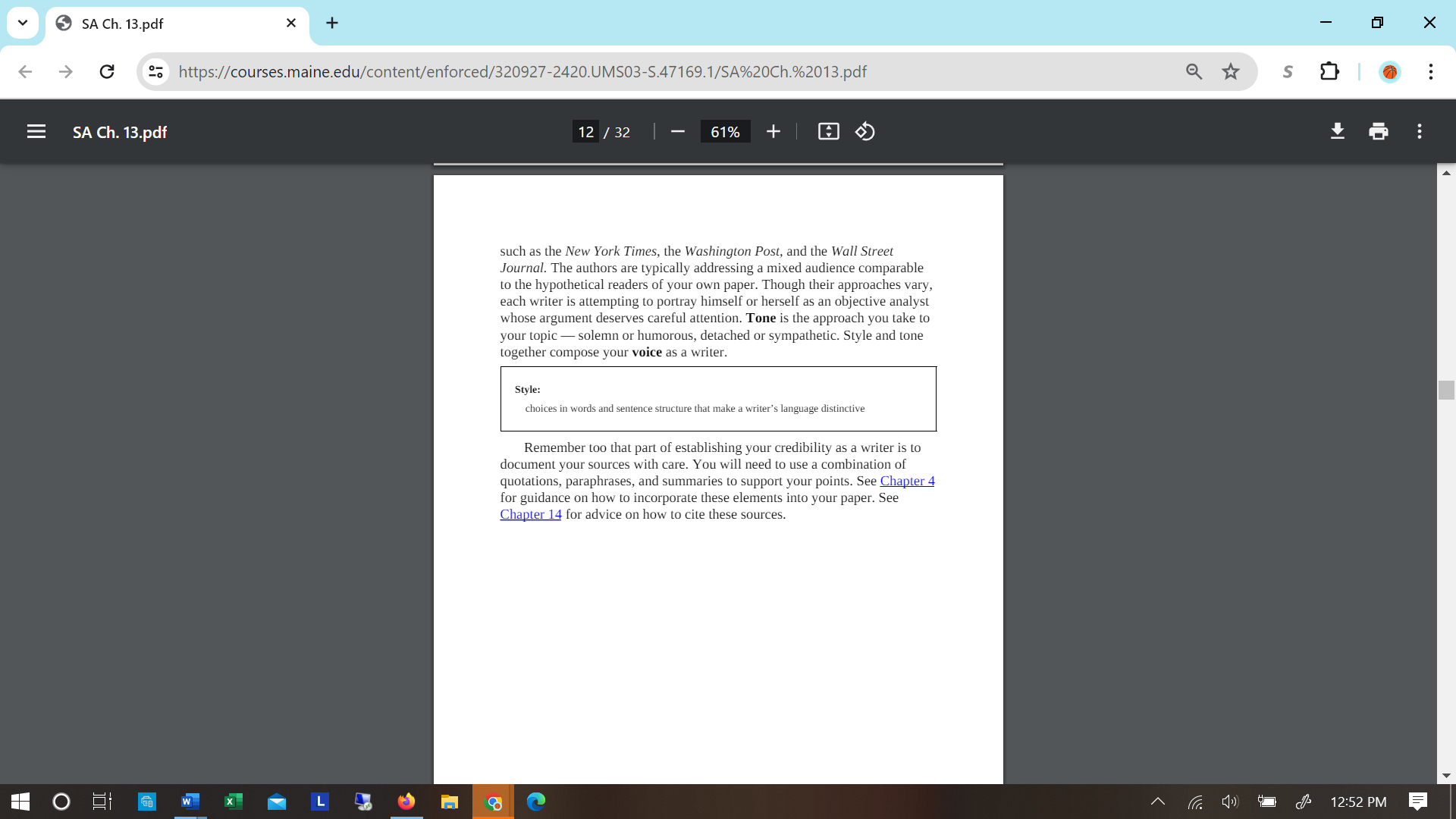
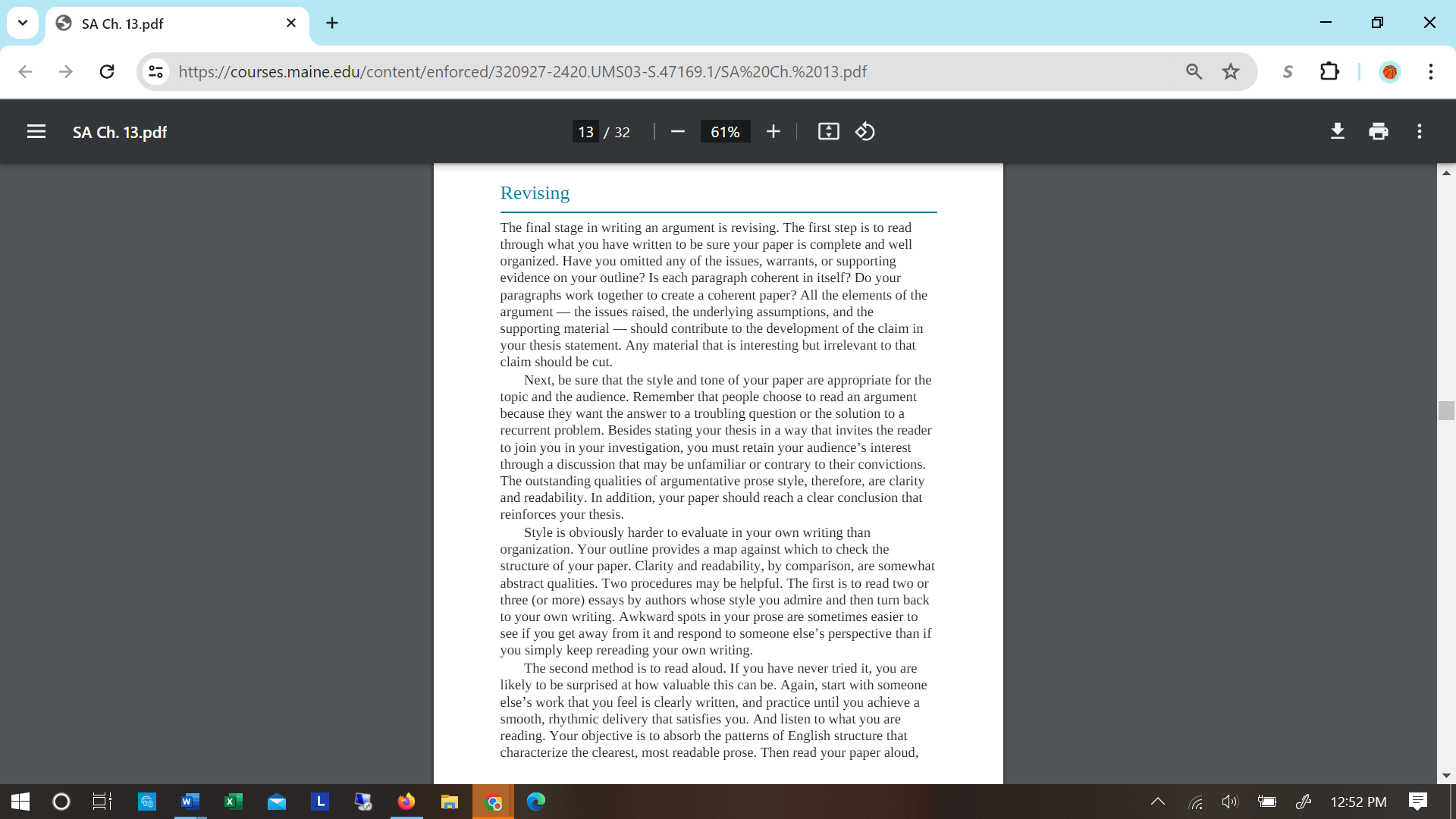
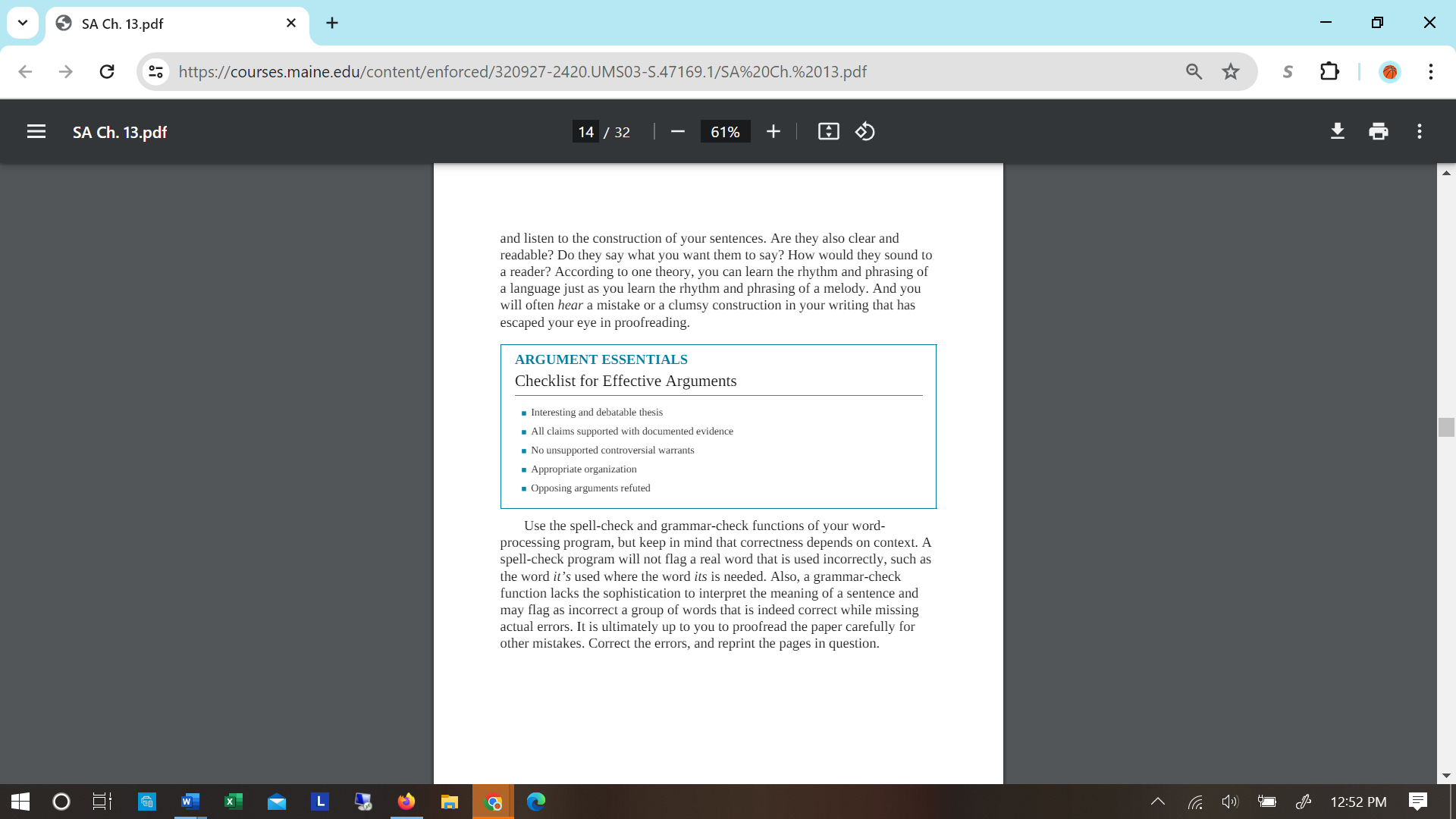
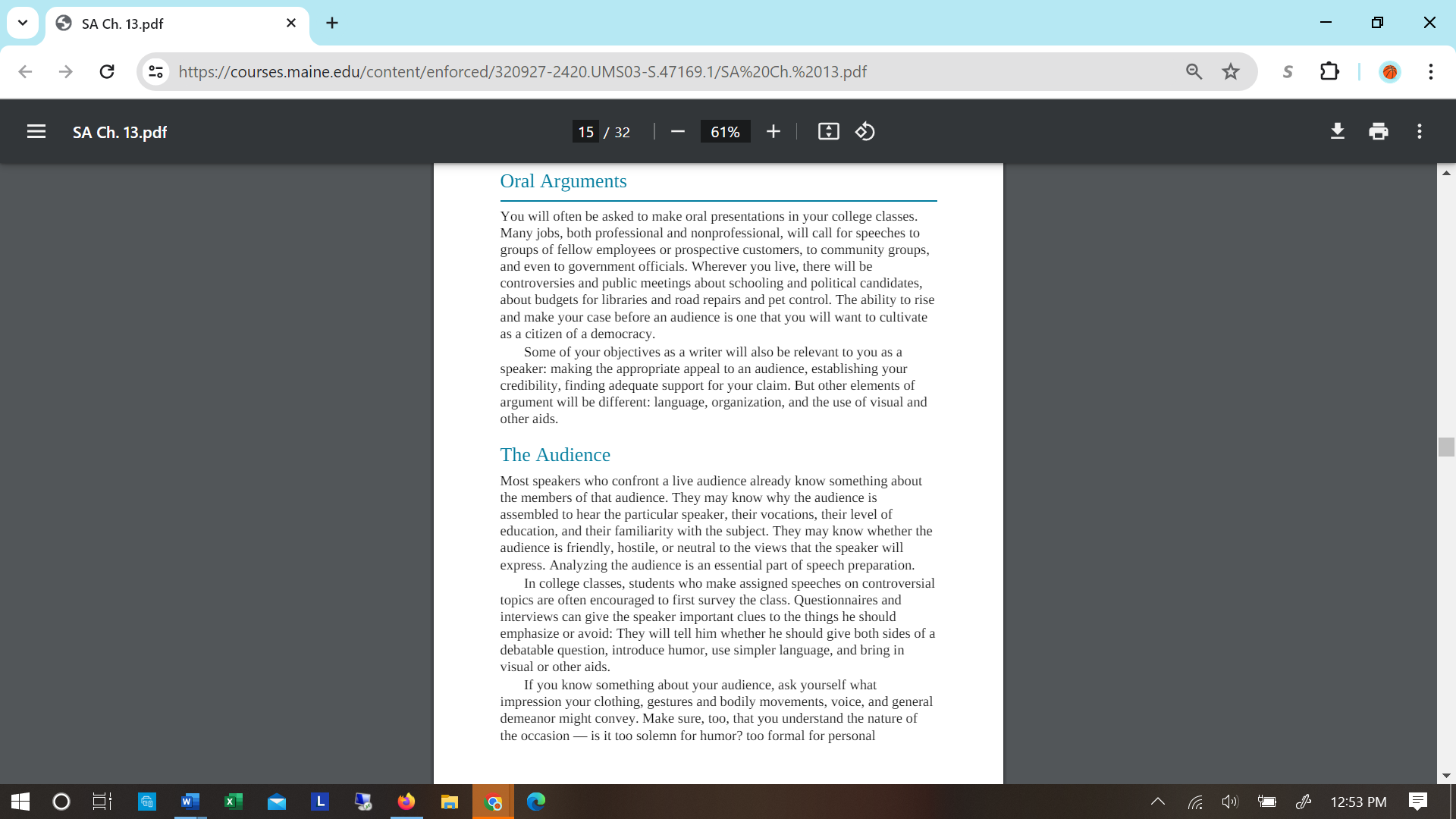
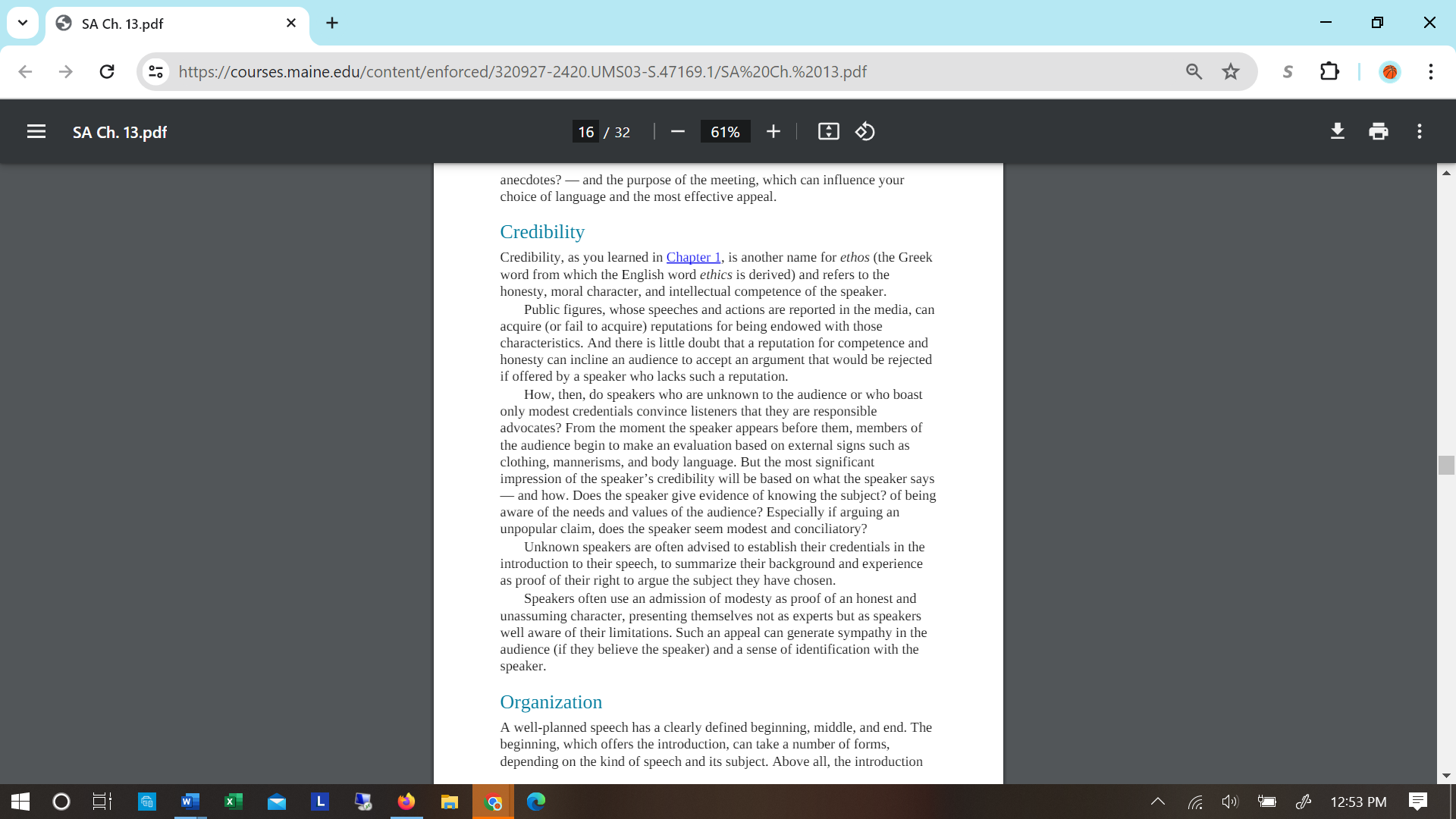
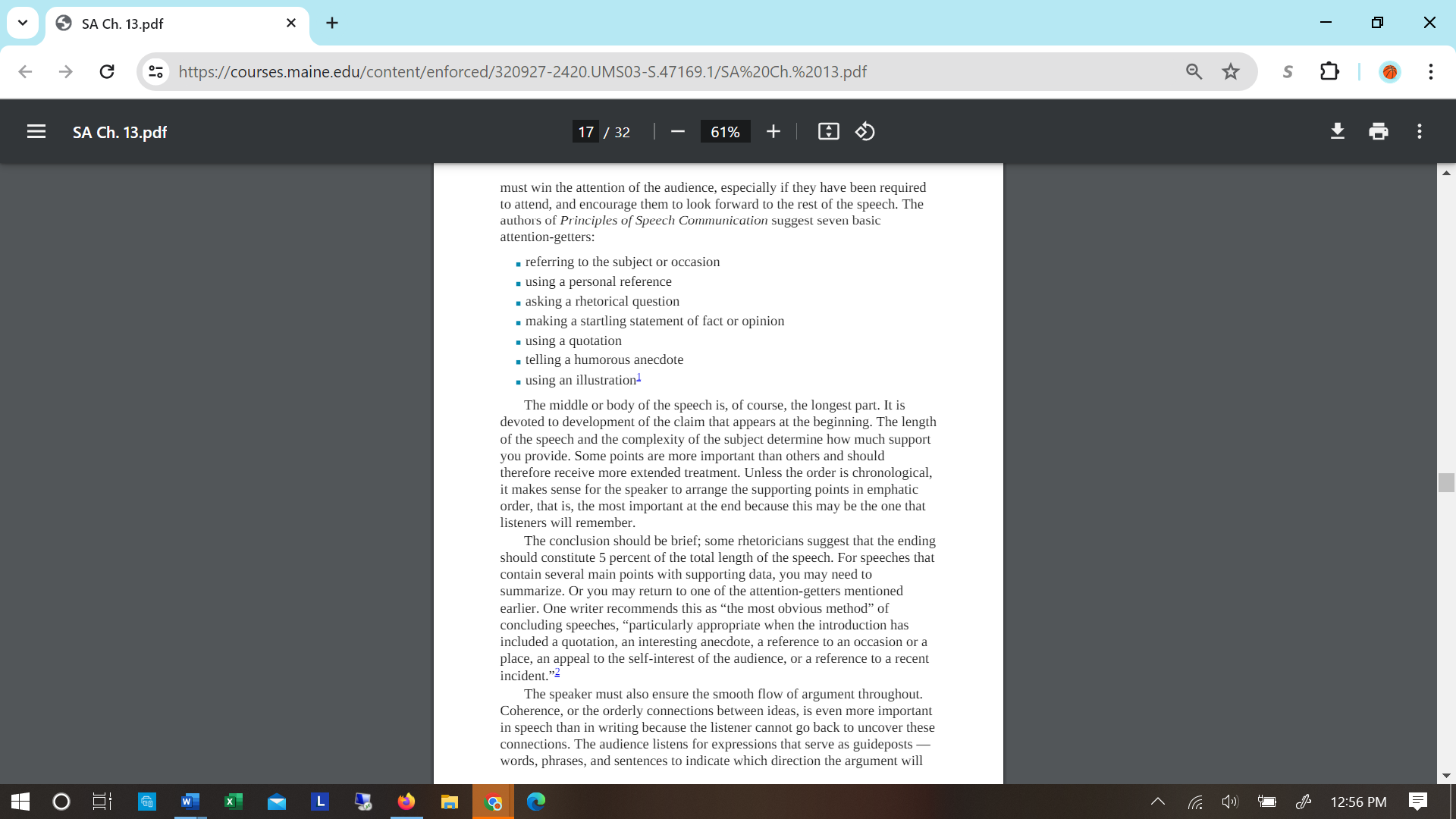
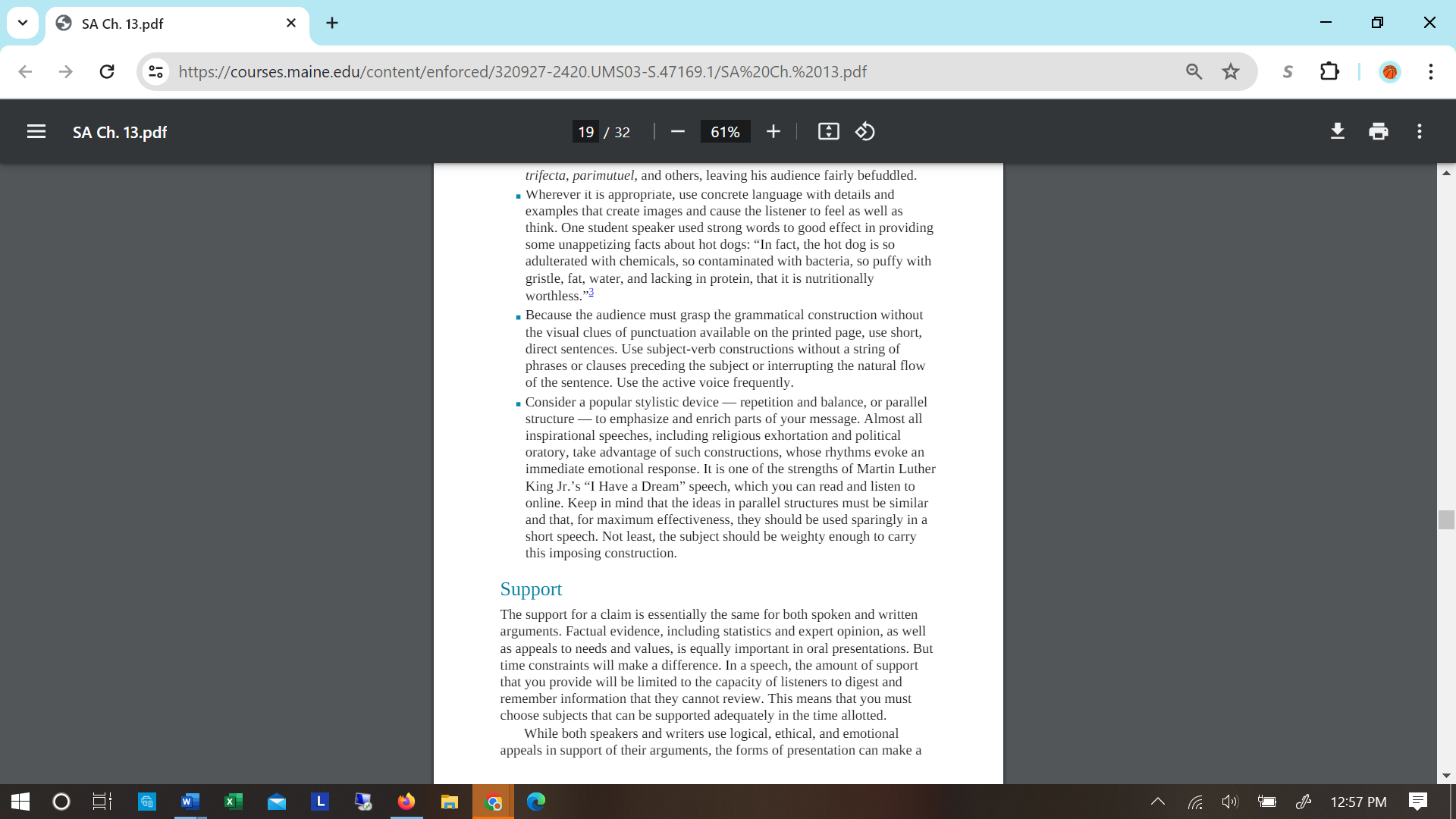
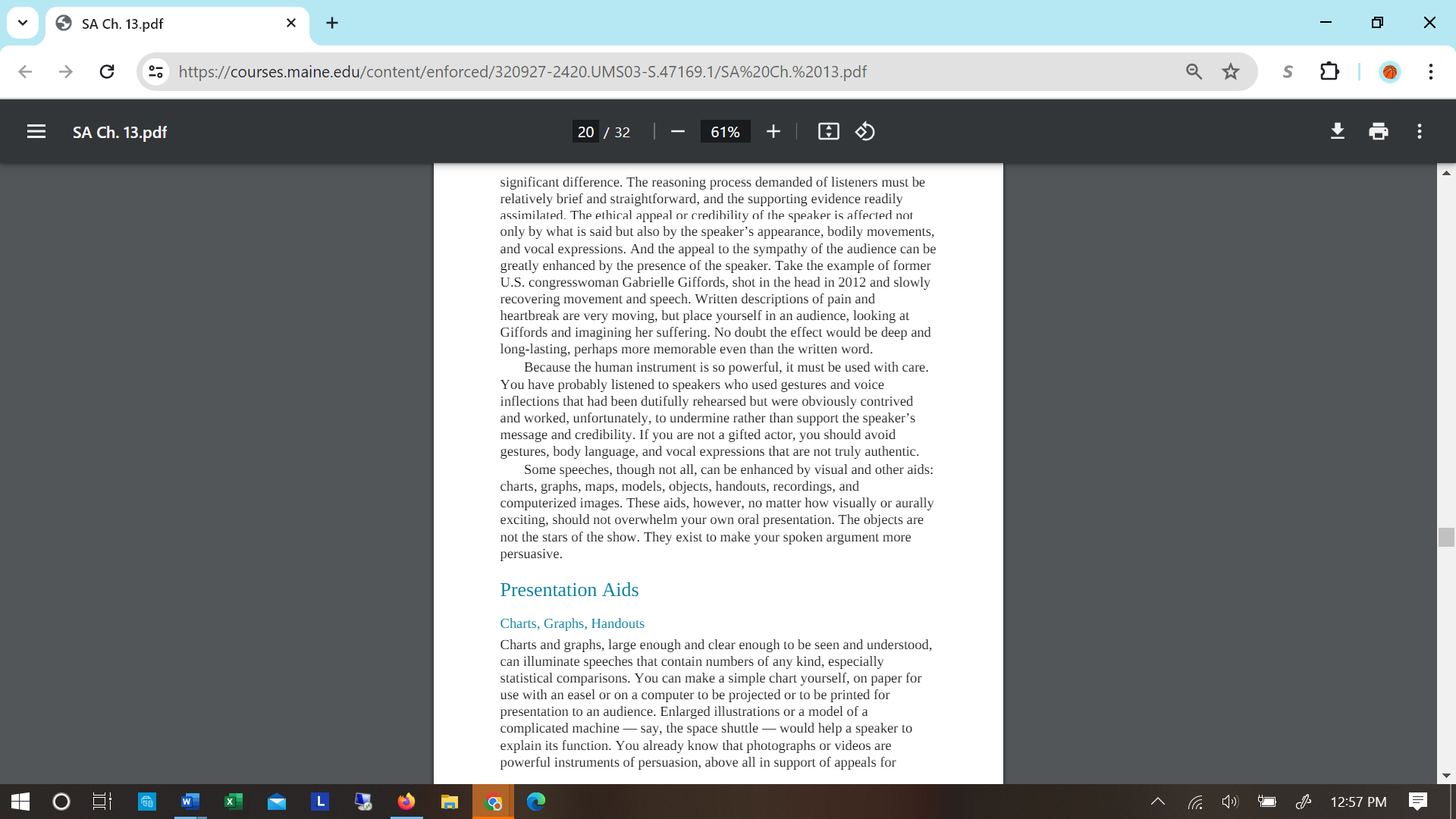
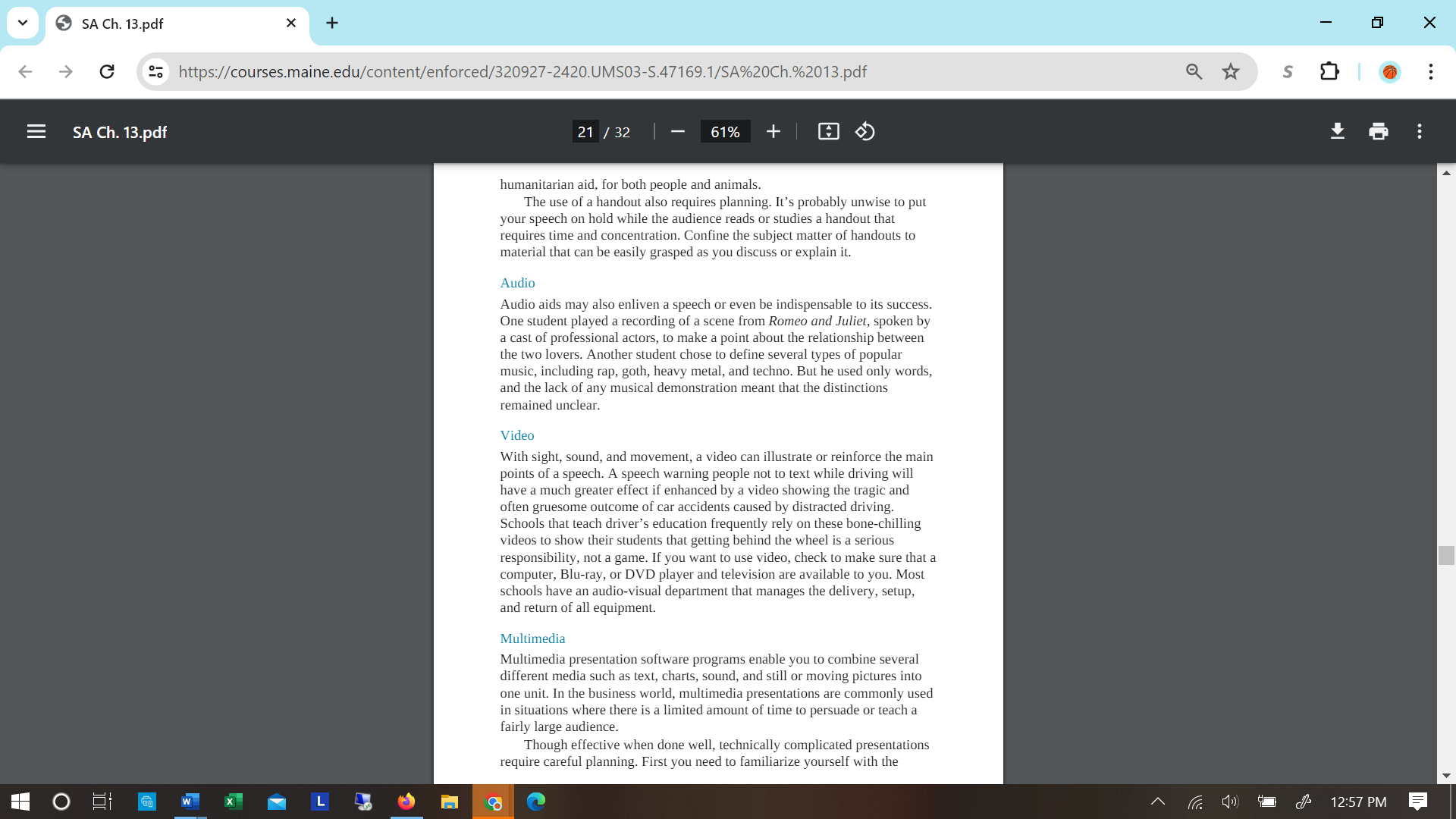
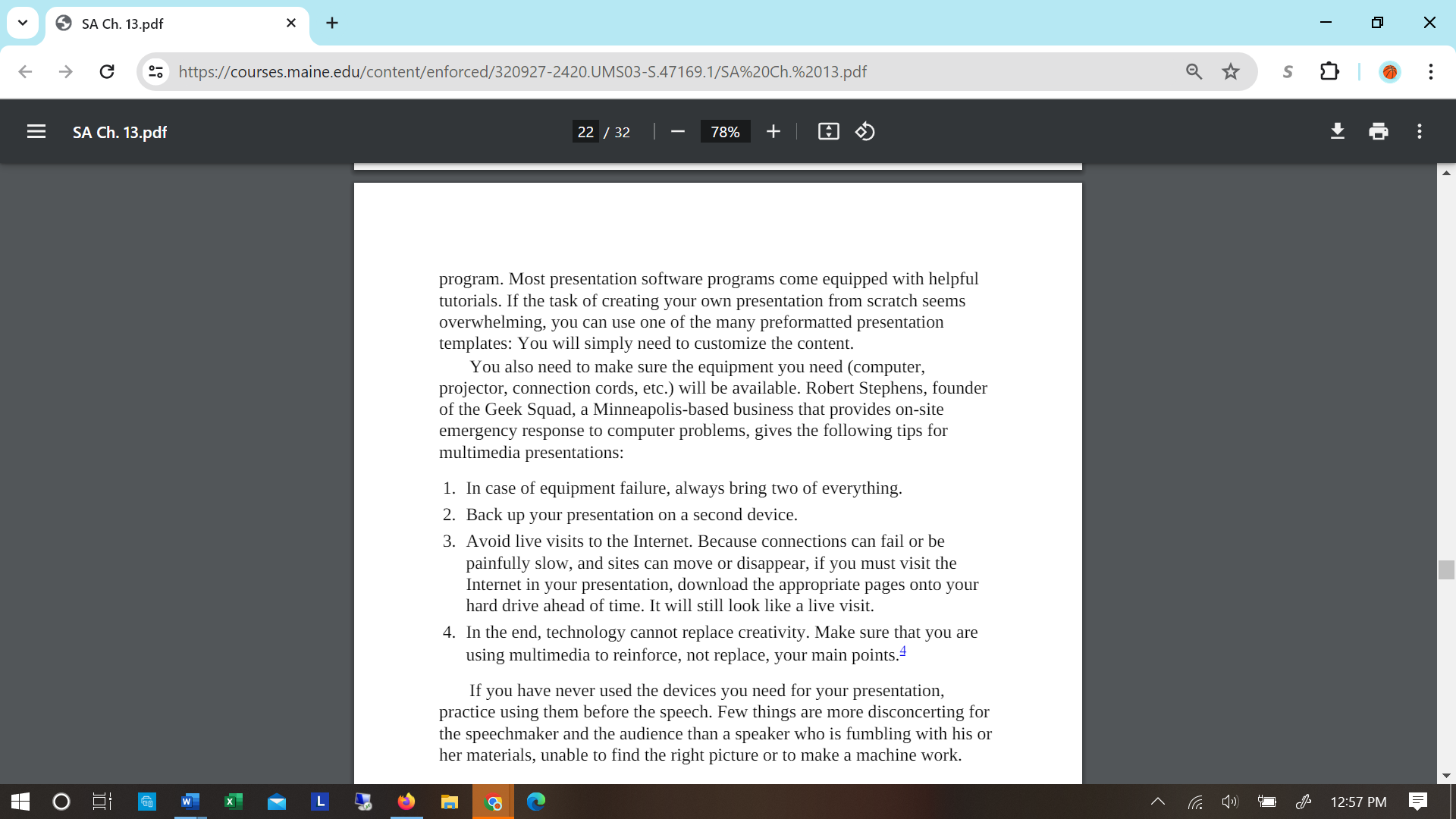
. . . X Read SA: Chapter 13: "Drafting, Revising, and Presenting Arguments" (SCREENSHOTS BELOW) . In a solid paragraph or two using complete sentences each, discuss two (2) important components from the chapter that will help you in your use of argumentative material. O W X LSOm 11:58 AMv @ SACh.13.pdf X |+ = X => C 25 https://courses.maine.edu/content/enforced/320927-2420.UMS03-S.47169.1/SA%20Ch.%2013.pdf Q Y s D D SA Ch. 13.pdf Avoiding Plagiarism Plagiarism is the use of someone else's words or ideas without adequate acknowledgment that is, presenting such words or ideas as your own. Putting something into your own words is not in itself a defense against plagiarism; the source of the ideas must be identified as well. Giving credit o the sources you use serves three important purposes: 1. Itreflects your own honesty and seriousness as a researcher. 2. It enables the reader to find the source of the reference and read further, sometimes to verify that the source has been correctly used. 3. It adds the authority of experts to your argument. Plagiarism: the use of someane else's words or ideas without adequate acknowledgment Plagiarism is nothing less than cheating, and it is an offense that deserves serious punishment. You can avoid accidentally slipping into plagiarism if you are careful in researching and writing your papers. Taking care to document sources is an obvious way to avoid plagiarism. You should also be careful in taking notes and, when writing your paper, indicating where your ideas end and someone else's begin. When taking notes, make sure either to quote word for word or to paraphrase one or the other, not both. If you quote, enclose any language that you borrow from other sources in quotation marks. That way, when you look back at your notes days or weeks later, you won't mistakenly assume that the language is your own. If you know that you aren't going to use a particular writer's exact words, then take the time to summarize that person's ideas right away. That will save you time and trouble later. When using someone else's ideas in your paper, always let the reader know where that person's ideas begin and end. Here is an example from a student paper that uses APA style: SSA Ch. 13.pdf X + X G https://courses.maine.edu/content/enforced/320927-2420.UMS03-S.47169.1/SA%20Ch.%2013.pdf . .. E SA Ch. 13.pdf 1 / 32 69% + HO ... CHAPTER 13 Drafting, Revising, and Presenting Arguments Chapter 12 discusses the planning of an argumentative paper and the process involved in researching topics that require support beyond what the writer knows firsthand. This chapter discusses moving from the planning and researching stage into the actual writing of the paper or presentation. O W X L 12:35 PMv @ SACh.13.pdf X |+ = X => C 25 https://courses.maine.edu/content/enforced/320927-2420.UMS03-S.47169.1/SA%20Ch.%2013.pdf Q Y s D D = SACh.13.pdf Reviewing Your Research Making a preliminary outline before you conduct any needed research gives direction to your research and helps you to organize your own thoughts on the subject. Preliminary outlines can change, however, in the process of researching and writing the paper. As you begin drafting the paper, be sure you have a solid thesis and strong and plentiful evidence for each topic in your preliminary or revised outline. Once you are satisfied that you have identified all the issues that will appear in your paper, you should begin to determine what kind of organization will be most effective for your argument. Now is the time to organize the results of your thinking into a logical and persuasive form. If you have read about your topic, answered questions, and acquired some evidence, you may already have decided on ways to approach your subject. If not, you should look closely at your outline now, recalling your purposes when you began your investigation, and develop a swrategy for using the information you have gathered to achieve those purposes. As you did in Chapter 5 in writing arguments not based on independent research, be mindful of the context in which the argument is taking place, and ry this procedure for tackling the issues in any controversial problem. 1. Raise the relevant issues, and omit those that would distract you from your purpose. Plan to devote more time and space to issues you regard as crucial. 2. Produce the strongest evidence you can to support your factual claims, knowing that the opposing side or critical readers may try to produce conflicting evidence. 3. Defend your value claims by finding support in the fundamental principles with which most people in your audience would agree. Explain as specifically as possible what you want your audience to think or do when you are arguing a policy claim. . Argue with yourself. Try to foresee what kinds of refutation are possible. Try to anticipate and meet the opposing arguments. ~ @ SACh.13.pdf x |+ = => C 25 https://courses.maine.edu/content/enforced/320927-2420.UMS03-S.47169.1/SA%20Ch.%2013.pdf Q Y 5 D @ : SA Ch. 13.pdf 6. Consider the context in which your argument will be read, and be sensitive to the concerns of your audience. _ Reviewing Your Research s your thesis the right scope not too broad or too narrow? Does your working outline show any gaps in your argument? Does your rescarch show enough counterarguments? If not, your thesis may not be debatable and may need to be changed. Does your rescarch show sirong. counterarguments that might make you want to change your thesis or shift the perspective of your argument? Have you identified the assumptions linking your claim with data and ensured that these assumptions, too, arc adequately documented? Have you found sufficient data to support your claim? Is your research varied enough and not too reliant on one source or source type? Have you met your instructor's guidelines for number and type of sources? Do your notes include exact capies of all statements you may want to quote and paraphrased or summarized versions of material that does not need to be quoted directly? Do your notes include complete references? Have you answered all the relevant questions that have come up during your research? Do you have enough information about your sources to-document your paper? Student researcher Katie applied the six steps in the review process to her topic like this: 1. The relevant issue for my thesis is that competitive foods should not be in schools. I need to establish that there is an obesity epidemic, which is a factual claim, but that is not my main focus. Competitive foods are one thing that contributes to the obesity epidemic, and it is one that something could be done about. I need to spend most of my time focusing on what is wrong with competitive foods and what should be done about the problem. v @ SACh.13.pdf X |+ = X => C 25 https://courses.maine.edu/content/enforced/320927-2420.UMS03-S.47169.1/SA%20Ch.%2013.pdf Q Y s D D = SACh.13.pdf . My thesis will be a claim of policy, but along the way I will establish that competitive foods are one factor that leads to childhood obesity. I think I have enough evidence to support that. . 1am not supporting a values claim, but behind my thesis, anyone should agree that we should do what we can to stop the increase in childhood obesity. Everyone should be in favor of good health for children. . What I want to happen is for all competitive foods to be removed from schools. . Some people would argue that the competitive foods are what the kids want to eat, or they would already be eating the cafeteria food. I have also discovered that some people think there are economic reasons for letting these vendors sell their products in the schools. 1 will have to argue that that is not as important as the children's health. 5. People who have children in school or will have should be concerned. One thing that makes my argument stronger is that people are already starting to read and hear more and more about healthy eating. It's in the news a lot. ~ @ SACh.13.pdf x |+ => C 25 https://courses.maine.edu/content/enforced/320927-2420.UMS03-S.47169.1/SA%20Ch.%2013.pdf Q Y s D D = SACh.13.pdf When zoo animals do mate successfully, the offspring is often weakened by inbreeding. According to geneticists, this is because a population of 150 breeder animals is necessary in order to \"assure the more or less permanent survival of a species in captivity\" (Ehrlich & Ehrlich, 1981, p. 211). The phrase \"according to geneticists\" indicates that the material to follow comes from another source, cited parenthetically at the end of the borrowed material. If the student had not included the phrase \"according to geneticists,\" it might look as if she only borrowed the passage in quotation marks, and not the information that precedes that passage ARGUMENT ESSENTIALS Avoiding Plagiarism = Take notes with care. = Beclear in your writing where anather person's words and ideas begin and end. = Either quote word for word or paraphrase, not a mixture of both. = Document your use of sources, whether you are quoting, paraphrasing, o summarizing. v @ SACh.13.pdf X |+ = X => C 25 https://courses.maine.edu/content/enforced/320927-2420.UMS03-S.47169.1/SA%20Ch.%2013.pdf Q Y s D D = SACh.13.pdf Using Sentence Forms to Write Arguments You need to be respectful of what others say and write, and you need to account for their positions accurately. You'll want to be sure to clearly summarize other authors' ideas when you write about them. When you present a negative evaluation of an argument, it is important to clearly explain how the previous writer approached the topic, and then explain how your view differs. Sometimes the points of difference are large, sometimes small. But in writing for college, it is crucial that you explain your own understanding of a situation and that you express your own point of view. It is easier to think about how you might summarize the argument of others and present your own if you have a model from which to work. This kind of model is called a sentence form, and we showed you a few examples in Chaprer 5. Sentence forms can help you to organize the presentation of others' views and your own responses to them. Here are some basic sentence forms for this kind of work. Presenting Another's View In , X claims that X's conclusion is that On the topic of . X attempts to make the case that These sentence forms are useful for presenting a brief summary of another's views on an issue. Note that the final sentence form implies that the writer has failed to make a convincing argument. (Y ou would then go on to explain X's failure.) Presenting Another's View Using Direct Quotations In , X writes, After discussing the topic of , X's conclusion is that v @ SACh.13.pdf X |+ = X => C 25 https://courses.maine.edu/content/enforced/320927-2420.UMS03-S.47169.1/SA%20Ch.%2013.pdf Q Y 5 D @ : = SACh.13.pdf X attempts 1o make the case that Quotations are a powerful way to present another's views when the language is particularly striking, clear, and succinct. (For more on using quotations, including a list of alternatives to the verb \"writes,\" see il \"Incorporating Quotations into Your Text\" on p. 126.) These templates help you to employ a key skill in making an argument: showing the work others have done on the issue. The next step is to introduce your own voice. Presenting Another's View and Responding to 1t She claims . Itis actually true that In his essay , X writes that . However, X attempts to make the case that In her essay, X implies . However, careful consideration shows that The formula for this kind of template introduces what the author has to say and then has you take your turn with your own view of the matter. When you agree with some of what a writer says, but not all of it, you must distinguish between the parts you think are correct and those parts that are not. Sentence forms for this kind of response include the following. Agreeing in Part Although most of what X writes about is true, it is not true that X is correct that . But because of it is actually true that X argues that . While it is true that and valid points, is not. Instead, ~ @ SACh.13.pdf x |+ = => C 25 https://courses.maine.edu/content/enforced/320927-2420.UMS03-S.47169.1/SA%20Ch.%2013.pdf Q Y s D D SA Ch. 13.pdf These sentence templates ask you (o identify those parts of the argument that are valid. Keep in mind that it is rare (o disagree totally with every view expressed in an argument. A careful arguer will separate out what is correct and what is not. The writer can then focus energy on showing why these parts are not correct. At times, you'll need to correct a distortion or misstatement of fact. Statistics, for instance, can be and often are manipulated to present the arguer's viewpoint in the best light. You may wish to propose an alternative interpretation or set the statistics in a different context, one more accurate and favorable Lo your own point of view. Of course, you'll want to be certain that you do not distort statistics. (For more on the importance of using statistics fairly, see the full discussion on pp. 192-93.) Here's a sentence form for correcting factual information in an argument. Correcting a Factual Mistake 'While X claims , it is actually true that Although X states , a careful examination of and indicates that . These templates allow you to identify a mistaken claim of fact in an argument and present evidence opposing iL. More often, rather than correcting clear mistakes of fact, you'll need to refine the argument of a writer. You may find that much of the argument makes sense to you, but that the writer does not sufficiently anticipate important objections. In those cases, a sentence form such as one of the following can help you refine the argument to make a stronger conclusion. Refining Another's Argument Although it is true, as X shows, that , the actual result is closer o because . While X claims and , he fails to consider the important point . Therefore, a more accurate conclusion is ~ @ SACh.13.pdf x |+ => C 25 https://courses.maine.edu/content/enforced/320927-2420.UMS03-S.47169.1/SA%20Ch.%2013.pdf Q Y s D D SA Ch. 13.pdf Such sentence forms enable you to clarify and amplify an argument. At times, you'll need to distinguish between the views of two different wrilers and then weigh in with your own assessment of the situation. When two authors write on the same topic, they will most likely share similar views on some of the points. They will, however, disagree on other points. Similarly, you may find that you agree with some of what each writer has to say, but disagree with some other parts. Your job is to identify the points of contrast between the two authors and then explain how your own position differs from one or both. In those cases, you may find the following sentence forms helpful. Explaining Contrasting Views and Adding Your Pasition X says - Y says . However, On the topic of , X claims that . In contrast, Y argues that - However, A careful writer makes sure the reader understands fine distinctions. The forms above help make those distinctions clear. While sentence forms may be rather simple perhaps even simplistic good writers use them all the time. Once you have tried them out a few times, you'll begin to use them automatically, perhaps without even realizing it. They are powerful tools for incorporating others' views into your own work and then helping you to make careful distinctions about various parts of arguments. Building an Effective Argument In general, the writer of an argument follows the same rules that govern any form of expository writing. Your organization should be logical, your style clear and readable, your ideas connected by transitional phrases and sentences, your paragraphs coherent. The main difference between an argument and expository writing is the need to persuade an audience to adopt a belief or take an action. You should assume your readers will be critical rather than neutral or sympathetic. Therefore, you must be equally critical of ~ @ SACh.13.pdf x |+ = => C 25 https://courses.maine.edu/content/enforced/320927-2420.UMS03-S.47169.1/SA%20Ch.%2013.pdf Q Y 5 D @ : SA Ch. 13.pdf your own work. Any apparent gap in reasoning or ambiguity in presentation is likely (o weaken the argument. ARGUMENT ESSENTIALS Using Sentence Forms Before you analyze or evaluate another's argument, you must first be sure that you understand it \"Then you can use some of the sentence forms in this section to show where it is weak and how your view is different = Presenting another's view u Presenting another's view using direct quotations & Presenting another's view and responding (0 it w Agreeing in part Correcting a factual mistake Refining another's argument Explaining contrasting views and adding your position For help with your organization, look back at the organizational patterns discussed in Chapler 5 on pages 146-56: = Defining the thesis = Refuting an opposing view Finding the middle ground = Presenting the stock issues You may also want to review what Chapter 5 says about writing introductions and conclusions. The style and tone you choose depend not only on the nature of the subject but also on how you can best convince readers that you are a credible source. Style in this context refers to the elements of your prose simple versus complex sentences, active versus passive verbs, metaphors, analogies, and other literary devices. It is usually appropriate in a short paper to choose an expository style, which emphasizes the elements of your argument rather than your personality. You can discover some helpful pointers on essay style by reading the editorials in newspapers v @ SACh.13.pdf X |+ = X => C 25 https://courses.maine.edu/content/enforced/320927-2420.UMS03-S.47169.1/SA%20Ch.%2013.pdf Q Y 5 D @ : = SACh.13.pdf such as the New York Times, the Washington Post, and the Wall Street Journal. The authors are typically addressing a mixed audience comparable to the hypothetical readers of your own paper. Though their approaches vary, each writer is attempting to portray himself or herself as an objective analyst whose argument deserves careful attention. Tone is the approach you take to your topic solemn or humorous, detached or sympathetic. Style and tone together compose your veice as a writer. Style: choices in words and sentence structure that make a writer's language distinctive Remember too that part of establishing your credibility as a writer is 1o document your sources with care. You will need to use a combination of quotations, paraphrases, and summaries Lo support your points. See Chapter 4 for guidance on how o incorporate these elements into your paper. See Chapter 14 for advice on how to cite these sources. ~ @ SACh.13.pdf x |+ = => C 25 https://courses.maine.edu/content/enforced/320927-2420.UMS03-S.47169.1/SA%20Ch.%2013.pdf Q Y 5 D @ : SA Ch. 13.pdf Revising The final stage in writing an argument is revising. The first step is to read through what you have written to be sure your paper is complete and well organized. Have you omitted any of the issues, warrants, or supporting evidence on your outline? Is each paragraph coherent in itself? Do your paragraphs work Logether to create a coherent paper? All the elements of the argument the issues raised, the underlying assumptions, and the supporting material should contribute to the development of the claim in your thesis statement. Any material that is interesting but irrelevant to that claim should be cut. NexL, be sure that the style and tone of your paper are appropriate for the topic and the audience. Remember that people choose to read an argument because they want the answer 10 a troubling question or the solution o a recurrent problem. Besides stating your thesis in a way thal invites the reader to join you in your investigation, you must retain your audience's interest through a discussion that may be unfamiliar or contrary to their convictions. The outstanding qualities of argumentative prose style, therefore, are clarity and readability. In addition, your paper should reach a clear conclusion that reinforces your thesis. Style is obviously harder Lo evaluate in your own writing than organization. Your outline provides a map against which to check the structure of your paper. Clarity and readability, by comparison, are somewhat abstract qualities. Two procedures may be helpful. The first is to read two or three (or more) essays by authors whose style you admire and then turn back 1o your own writing. Awkward spols in your prose are sometimes easier (0 see if you gel away from it and respond to someone else's perspective than if you simply keep rereading your own writing. The second method is to read aloud. If you have never tried it, you are likely to be surprised at how valuable this can be. Again, start with someone else's work that you [eel is clearly written, and practice until you achieve a smooth, rhythmic delivery that satisfies you. And listen to what you are reading. Your objective is Lo absorb the patterns of English structure that characterize the clearest, most readable prose. Then read your paper aloud, ~ @ SACh.13.pdf x |+ => C 25 https://courses.maine.edu/content/enforced/320927-2420.UMS03-S.47169.1/SA%20Ch.%2013.pdf Q Y s D D = SACh.13.pdf and listen to the construction of your sentences. Are they also clear and readable? Do they say what you want them to say? How would they sound to a reader? According to one theory, you can learn the rhythm and phrasing of a language just as you learn the rhythm and phrasing of a melody. And you will often hear a mistake or a clumsy construction in your writing that has escaped your eye in proofreading. ARGUMENT ESSENTIALS Checklist for Effective Arguments & Interesting and debatable thesis All claims supported with documented evidence No unsupported controversial warrants Appropriate organization Opposing arguments refuted Use the spell-check and grammar-check functions of your word- processing program, but keep in mind that correctness depends on context. A spell-check program will not flag a real word that is used incorrectly, such as the word it's used where the word its is needed. Also, a grammar-check function lacks the sophistication to interpret the meaning of a sentence and may flag as incorrect a group of words that is indeed correct while missing actual errors. It is ultimately up to you to proofread the paper carefully for other mistakes. Correct the errors, and reprint the pages in question. v @ SACh.13.pdf X |+ = X => C 25 https://courses.maine.edu/content/enforced/320927-2420.UMS03-S.47169.1/SA%20Ch.%2013.pdf Q Y s D D = SACh.13.pdf Oral Arguments You will often be asked to make oral presentations in your college classes. Many jobs, both professional and nonprofessional, will call for speeches to groups of fellow employees or prospective customers, 10 community groups, and even to government officials. Wherever you live, there will be controversies and public meetings about schooling and political candidates, about budgets for libraries and road repairs and pet control. The ability to rise and make your case before an audience is one that you will want to cultivate as a citizen of a democracy. Some of your objectives as a writer will also be relevant to you as a speaker: making the appropriate appeal to an audience, establishing your credibility, finding adequate support for your claim. But other elements of argument will be different: language, organization, and the use of visual and other aids. The Audience Most speakers who confront a live audience already know something about the members of that audience. They may know why the audience is assembled to hear the particular speaker, their vocations, their level of education, and their familiarity with the subject. They may know whether the audience is friendly, hostile, or neutral to the views that the speaker will express. Analyzing the audience is an essential part of speech preparation. In college classes, students who make assigned speeches on controversial topics are often encouraged to [irst survey the class. Questionnaires and interviews can give the speaker important clues to the things he should emphasize or avoid: They will tell him whether he should give both sides of a debatable question, introduce humor, use simpler language, and bring in visual or other aids. If you know something about your audience, ask yoursell what impression your clothing, gestures and bodily movements, voice, and general demeanor might convey. Make sure, (oo, that you understand the nature of the occasion is it too solemn for humor? too formal for personal 1253pM BR v @ SACh.13.pdf X |+ = X => C 25 https://courses.maine.edu/content/enforced/320927-2420.UMS03-S.47169.1/SA%20Ch.%2013.pdf Q Y s D D = SACh.13.pdf anecdotes? and the purpose of the meeting, which can influence your choice of language and the most effective appeal. Credibility Credibility, as you learned in Chapter 1, is another name for ethos (the Greek word from which the English word ethics is derived) and refers to the honesty, moral character, and intellectual competence of the speaker. Public figures, whose speeches and actions are reported in the media, can acquire (or fail to acquire) reputations for being endowed with those characteristics. And there is little doubt that a reputation for competence and honesty can incline an audience to accept an argument that would be rejected if offered by a speaker who lacks such a reputation. How, then, do speakers who are unknown to the audience or who boast only modest credentials convince listeners that they are responsible advocates? From the moment the speaker appears before them, members of the audience begin to make an evaluation based on external signs such as clothing, mannerisms, and body language. But the most significant impression of the speaker's credibility will be based on what the speaker says and how. Does the speaker give evidence of knowing the subject? of being aware of the needs and values of the audience? Especially if arguing an unpopular claim, does the speaker seem modest and conciliatory? Unknown speakers are often advised o establish their credentials in the introduction to their speech, to summarize their background and experience as proof of their right o argue the subject they have chosen. Speakers often use an admission of modesty as proof of an honest and unassuming character, presenting themselves not as experts but as speakers well aware of their limitations. Such an appeal can generate sympathy in the audience (if they believe the speaker) and a sense of identification with the speaker. Organization A well-planned speech has a clearly defined beginning, middle, and end. The beginning, which offers the introduction, can take a number of forms, depending on the kind of speech and its subject. Above all, the introduction 1253pM BR ~ @ SACh.13.pdf x |+ = => C 25 https://courses.maine.edu/content/enforced/320927-2420.UMS03-S.47169.1/SA%20Ch.%2013.pdf Q Y s D D SA Ch. 13.pdf must win the attention of the audience, especially if they have been required to attend, and encourage them to look forward to the rest of the speech. The authors of Principles of Speech Communication suggest seven basic altention-getters: = referring (o the subject or occasion = using a personal reference asking a rhetorical question making a startling statement of fact or opinion using a quotation telling a humorous anecdote using an illustration! The middle or body of the speech is, of course, the longest part. It is devoled to development of the claim that appears at the beginning. The length of the speech and the complexity of the subject determine how much support you provide. Some points are more important than others and should therefore receive more extended treatment. Unless the order is chronological, it makes sense for the speaker (o arrange the supporting points in emphatic order, that is, the most important at the end because this may be the one that listeners will remember. The conclusion should be brief; some rhetoricians suggest that the ending should constitute 5 percent of the total length of the speech. For speeches that contain several main points with supporting data, you may need to summarize. Or you may return (o one of the attention-getters mentioned earlier. One writer recommends this as \"the most obvious method\" of concluding speeches, \"particularly appropriate when the introduction has included a quotation, an interesting anecdote, a reference Lo an occasion or a place, an appeal to the self-interest of the audience, or a reference Lo a recent incident.\"? The speaker must also ensure the smooth flow of argument throughout. Coherence, or the orderly connections between ideas, is even more important in speech than in writing because the listener cannot go back to uncover these connections. The audience listens for expressions that serve as guideposts words, phrases, and sentences (o indicate which direction the argument will 1256PM B ~ @ SACh.13.pdf x |+ => C 25 https://courses.maine.edu/content/enforced/320927-2420.UMS03-S.47169.1/SA%20Ch.%2013.pdf Q Y 5 D @ : SA Ch. 13.pdf take. Words such as next, then, finally, here, first of all, whereas, in addition, second, in fact, now, and in conclusion can help the listener 1o follow the argument's development. Language It should be observed that each kind of rhetoric has its own appropriate style. That of written prose is not the same as that of spoken oratory. Aristotle In the end, your speech depends on the language you use. No matter how accurate your analysis of the audience, how appealing your presentation of sell, how deep your grasp of the material, if the language does not clearly and emphatically convey your argument, the speech will probably fail. Fortunately, the effectiveness of language does not depend on long words or complex sentence structure quite the contrary. Most speeches, especially those given by beginners to small audiences, are distinguished by an oral style that respects the rhythms of ordinary speech and sounds spontaneous. = Use words that both you and your listeners are familiar with, language that convinces the audience you are sharing your knowledge and opinions, neither speaking down to them nor talking over their heads. You never want o use language that makes the audience appear ignorant or unreasonable. = Make sure that the words you use will not be considered offensive by some members of your audience. Today we are all sensitive, somelimes hypersensitive, to terms that were once used [reely if not wisely. One word, improperly used, can cause some listeners to reject the whole speech. This is particularly true of terms that suggest bias based on gender, race, or sexual orientation. = Consider whether the subject is one that the particular audience you are addressing is not likely to be familiar with. If this is the case, then explain even the basic terms. In one class, a student who had chosen to discuss a subject about which he was extremely knowledgeable, betting on horse races, neglected to define clearly the words exacta, subfecta, APV = | @ SACh. 13.pdf x |+ - C 2% https://courses.maine.edu/content/enforced/320927-2420.UMS03-S.47169.1/SA%20Ch.%2013.pdf SA Ch. 13.pdf trifecta, parimutuel, and others, leaving his audience fairly befuddled. = Wherever it is appropriate, use concrete language with details and examples that create images and cause the listener to feel as well as think. One student speaker used strong words to good effect in providing some unappetizing facts about hot dogs: \"In fact, the hot dog is so adulterated with chemicals, so contaminated with bacteria, so puffy with gristle, fat, water, and lacking in protein, that it is nutritionally worthless.\" Because the audience must grasp the grammatical construction without the visual clues of punctuation available on the printed page, use short, direct sentences. Use subject-verb constructions without a string of phrases or clauses preceding the subject or interrupting the natural flow of the sentence. Use the active voice [requently. Consider a popular stylistic device repetition and balance, or parallel structure to emphasize and enrich parts of your message. Almost all inspirational speeches, including religious exhortation and political oralory, lake advantage of such constructions, whose rhythms evoke an immediate emotional response. It is one of the strengths of Martin Luther King Jr."s \"I Have a Dream\" speech, which you can read and listen to online. Keep in mind that the ideas in parallel structures must be similar and that, for maximum effectiveness, they should be used sparingly in a short speech. Not least, the subject should be weighty enough to carry this imposing construction. Support The support for a claim is essentially the same for both spoken and written arguments. Factual evidence, including statistics and expert opinion, as well as appeals Lo needs and values, is equally important in oral presentations. Butl time constraints will make a difference. In a speech, the amount of support that you provide will be limited to the capacity of listeners Lo digest and remember information that they cannot review. This means that you must choose subjects that can be supported adequately in the time allotted. While both speakers and writers use logical, ethical, and emotional appeals in support of their arguments, the forms of presentation can make a v @ SACh.13.pdf X |+ = X => C 25 https://courses.maine.edu/content/enforced/320927-2420.UMS03-S.47169.1/SA%20Ch.%2013.pdf Q Y s D D = SACh.13.pdf significant difference. The reasoning process demanded of listeners must be relatively brief and straightforward, and the supporting evidence readily assimilated. The ethical appeal or credihility of the speaker is affected not only by what is said but also by the speaker's appearance, bodily movements, and vocal expressions. And the appeal to the sympathy of the audience can be greatly enhanced by the presence of the speaker. Take the example of former U.S. congresswoman Gabrielle Giffords, shot in the head in 2012 and slowly recovering movement and speech. Written descriptions of pain and heartbreak are very moving, but place yourself in an audience, looking at Giffords and imagining her suffering. No doubt the effect would be deep and long-lasting, perhaps more memorable even than the written word. Because the human instrument is so powerful, it must be used with care. You have probably listened to speakers who used gestures and voice inflections that had been dutifully rehearsed but were obviously contrived and worked, unfortunately, to undermine rather than support the speaker's message and credibility. If you are not a gifted actor, you should avoid gestures, body language, and vocal expressions that are not truly authentic. Some speeches, though not all, can be enhanced by visual and other aids: charts, graphs, maps, models, objects, handouts, recordings, and computerized images. These aids, however, no matter how visually or aurally exciting, should not overwhelm your own oral presentation. The objects are not the stars of the show. They exist to make your spoken argument more persuasive. Presentation Aids Charts, Graphs, Handouts Charts and graphs, large enough and clear enough to be seen and understood, can illuminate speeches that contain numbers of any kind, especially statistical comparisons. You can make a simple chart yoursel, on paper for use with an easel or on a computer o be projected or to be printed for presentation to an audience. Enlarged illustrations or a model of a complicated machine say, the space shuttle would help a speaker to explain its function. You already know that photographs or videos are powerful instruments of persuasion, above all in support of appeals for v @ SACh.13.pdf X |+ = X => C 25 https://courses.maine.edu/content/enforced/320927-2420.UMS03-S.47169.1/SA%20Ch.%2013.pdf Q Y 5 D @ : SA Ch. 13.pdf humanitarian aid, for both people and animals. The use of a handout also requires planning. It's probably unwise to put your speech on hold while the audience reads or studies a handout that requires time and concentration. Confine the subject matter of handouts to material that can be easily grasped as you discuss or explain it. Audio Audio aids may also enliven a speech or even be indispensable (o its success. One student played a recording of a scene from Romeo and Juliet, spoken by a cast of professional actors, o make a point about the relationship between the two lovers. Another student chose (o define several types of popular music, including rap, goth, heavy melal, and techno. But he used only words, and the lack of any musical demonstration meant that the distinctions remained unclear. Video 'With sight, sound, and movement, a video can illustrate or reinforce the main points of a speech. A speech warning people not o text while driving will have a much greater effect if enhanced by a video showing the tragic and often gruesome outcome of car accidents caused by distracted driving. Schools that teach driver's education frequently rely on these bone-chilling videos to show their students that getting behind the wheel is a serious responsibility, not a game. If you want to use video, check o make sure that a computer, Blu-ray, or DVD player and television are available to you. Most schools have an audio-visual department that manages the delivery, setup, and return of all equipment. Multimedia Multimedia presentation software programs enable you to combine several different media such as text, charts, sound, and still or moving pictures into one unit. In the business world, multimedia presentations are commonly used in situations where there is a limited amount of time to persuade or teach a fairly large audience. Though effective when done well, technically complicated presentations require careful planning. First you need to familiarize yourself with the v @ SACh.13.pdf X |+ = X > C 25 https://courses.maine.edu/content/enforced/320927-2420.UMS03-S.47169.1/SA%20Ch.%2013.pdf aQ s 9 D SA Ch. 13.pdf program. Most presentation software programs come equipped with helpful tutorials. If the task of creating your own presentation from scratch seems overwhelming, you can use one of the many preformatted presentation templates: You will simply need to customize the content. You also need to make sure the equipment you need (computer, projector, connection cords, etc.) will be available. Robert Stephens, founder of the Geek Squad, a Minneapolis-based business that provides on-site emergency response to computer problems, gives the following tips for multimedia presentations: 1. In case of equipment failure, always bring two of everything. . Back up your presentation on a second device. 3. Avoid live visits to the Internet. Because connections can fail or be painfully slow, and sites can move or disappear, if you must visit the Internet in your presentation, download the appropriate pages onto your hard drive ahead of time. It will still look like a live visit. . In the end, technology cannot replace creativity. Make sure that you are using multimedia to reinforce, not replace, your main points.# 1f you have never used the devices you need for your presentation, practice using them before the speech. Few things are more disconcerting for the speechmaker and the audience than a speaker who is fumbling with his or her materials, unable to find the right picture or to make a machine work
Step by Step Solution
There are 3 Steps involved in it
1 Expert Approved Answer
Step: 1 Unlock
Question Has Been Solved by an Expert!
Get step-by-step solutions from verified subject matter experts
Step: 2 Unlock
Step: 3 Unlock
Students Have Also Explored These Related Business Writing Questions!










 Study Help