







Question: 1. Identify the parent function and the sequence of transformations represented by: g(:1:) = /m 3 + 5. Student's Solution: Use the parent function f
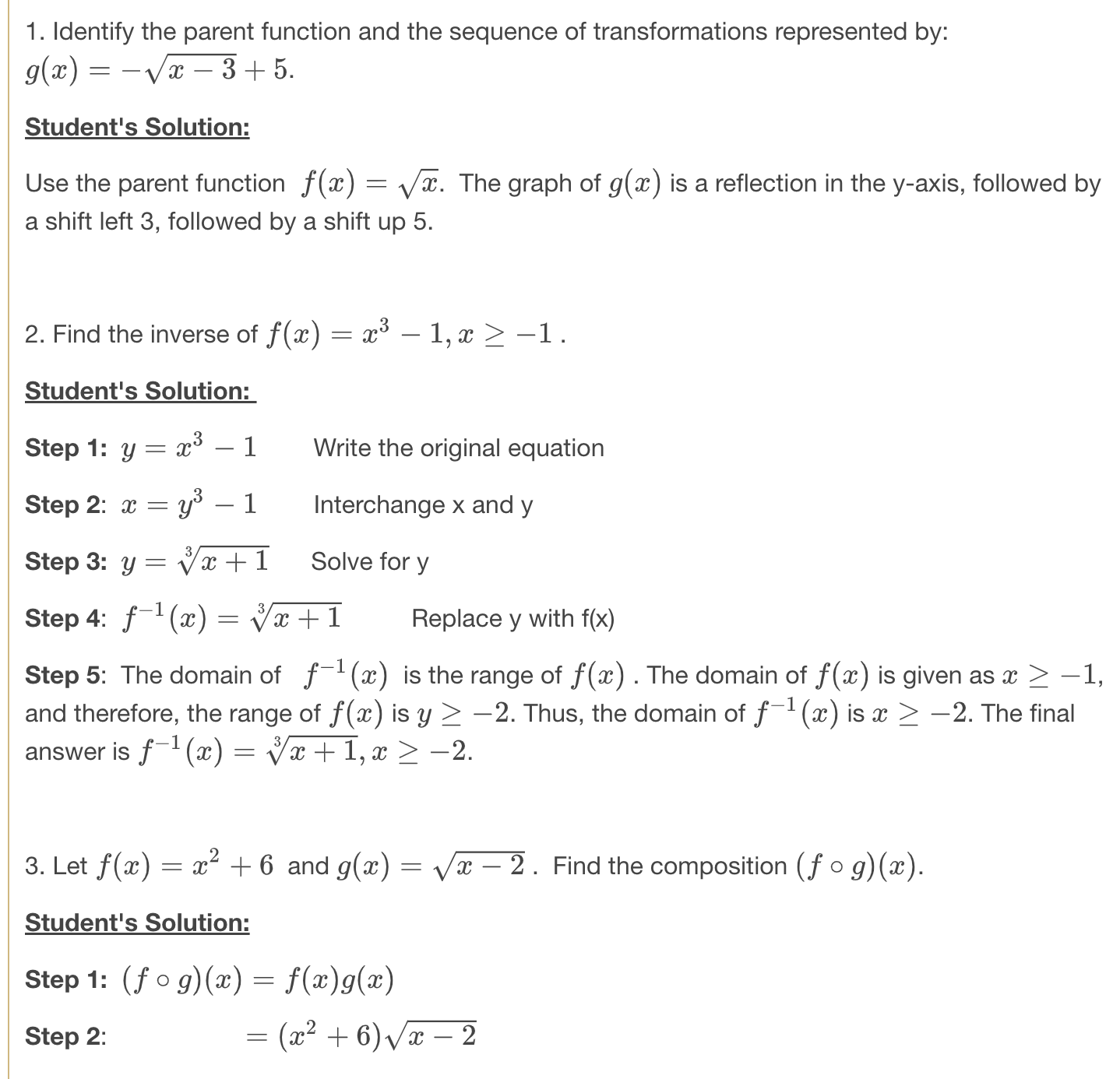
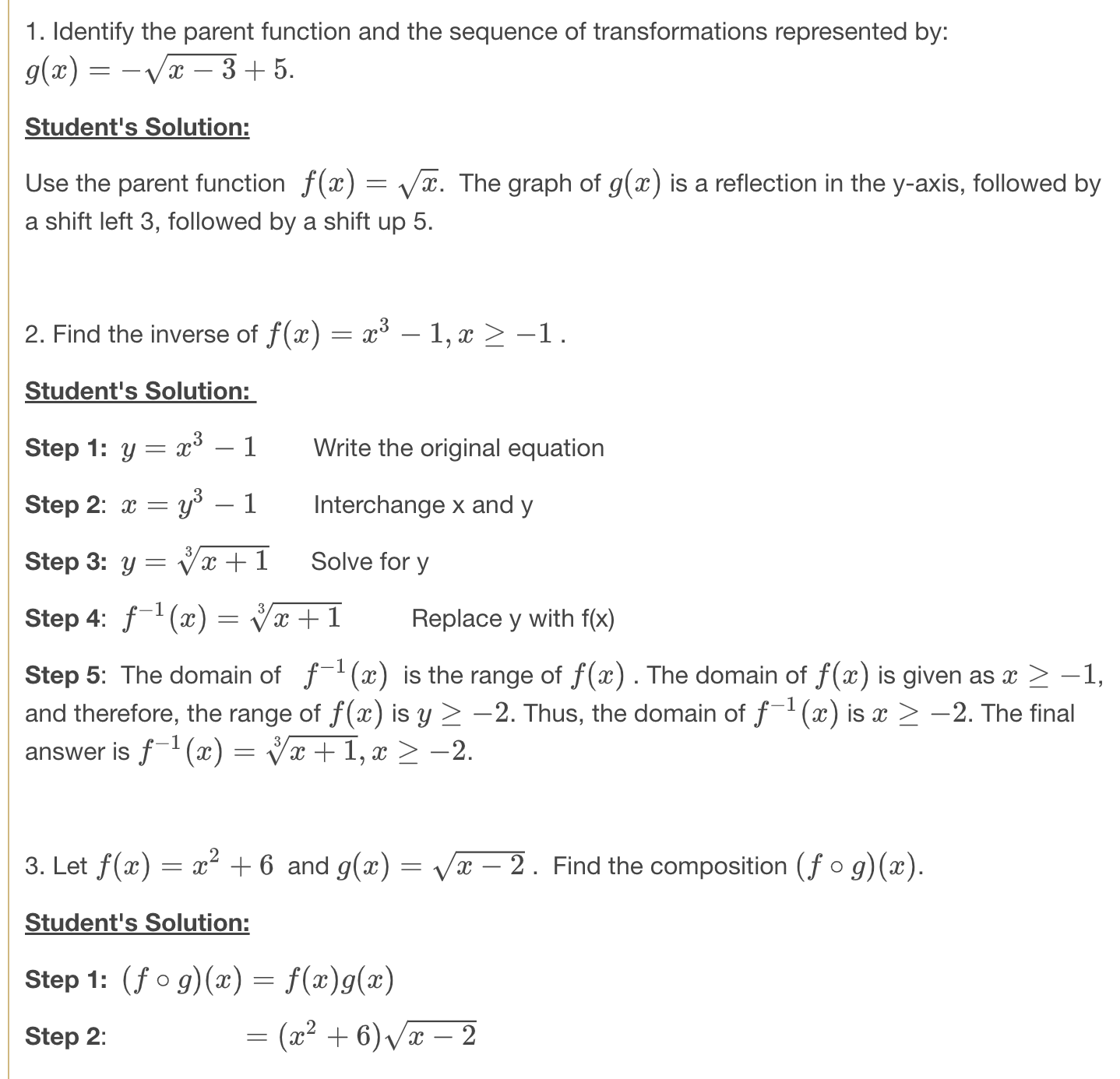
1. Identify the parent function and the sequence of transformations represented by: g(:1:) = \\/m 3 + 5. Student's Solution: Use the parent function f (as) = . The graph of g(:t:) is a reflection in the y-axis, followed by a shift left 3, followed by a shift up 5. 2. Find the inverse of f(m) = 3:3 1, a: 2 l. Student's Solution: Step 1: y = m3 1 Write the original equation Step 2: a: = y3 1 Interchange x and y Step 3: y = W Solve for y Step 4: f_1(a:) = {n+1 Replace y with f(x) Step 5: The domain of f_1(m) is the range of m) . The domain of f(:L') is given as :1: Z 1, and therefore, the range of f(:L') is y 2 2. Thus, the domain of f_1(:c) is a: 2 2. The final answer is f_1(a:) = 3/33 -l- 1,3; 2 2. 3. Let f(:1:) = 11:2 + 6 and 9(3) = E. Find the composition (f o g)(:13). Student's Solution: Step 1= (f O 9)(m) = f(=r)g(m) Step 2: = (3:2 i @ij
Step by Step Solution
There are 3 Steps involved in it

Get step-by-step solutions from verified subject matter experts
 Study Help