



Question: 1. If a hacker gained access to an IMD, what potential issue might arise? 2. If the removal of WIFI features reduces the potential patient
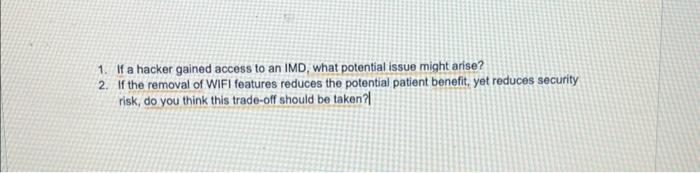
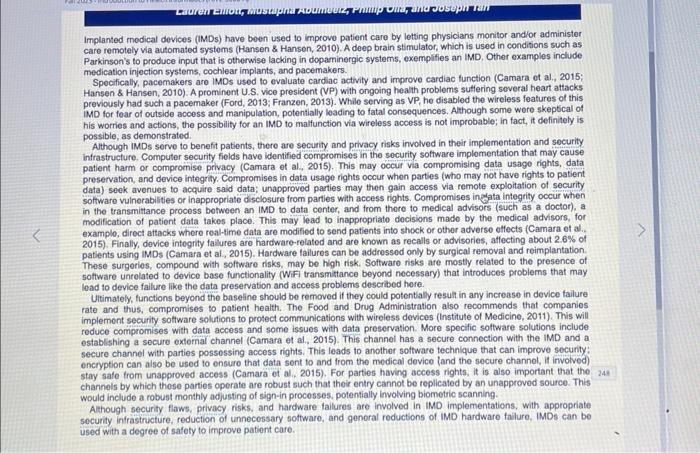
1. If a hacker gained access to an IMD, what potential issue might arise? 2. If the removal of WIFI features reduces the potential patient benefit, yet reduces security risk, do you think this trade-off should be taken? Implanted modical devices (IMDs) have been used to improve patient care by letting physicians monitor andior administer care remotely via automated systems (Hansen \&. Hansen, 2010). A deep brain stimulator, which is used in conditions such as Parkinson's to produce input that is otherwise lacking in dopaminergic systems, exemplifies an IMD, Other examples include medication injection systems, cochlear implants, and pacemakers. Specifically, pacemakers are IMDs used to evaluate cardiac activity and improve cardiac function (Camara ot al., 2015; Hansen \& Hansen, 2010). A prominent U.S. vice president (VP) with ongoing health problems sutfering soveral heart attacks previously had such a pacemaker (Ford, 2013; Franzen, 2013). While serving as VP, he disabled the wireless features of this IMD for fear of outside access and manipulation, potentially loading to fatal consequences. Although some wore skeptical of his worries and actions, the possibility for an IMO to malfunction via wireless access is not improbable; in fact, it definitely is possible, as demonstrated. Although IMDs serve to benefit patients, there are security and privacy risks involved in their implementation and security infrastructure. Computer security fields have identified compromises in the security software implementation that may cause patient harm or compromise privacy (Camara et al,, 2015). This may occur via compromising data usage rights, data preservation, and device integrity. Compromises in data usage rights occur when parties (who may not have rights to patient data) seek avenues to acquire said data; unapproved parties may then gain access via remote exploitation of security software vulnerabilities or inappropriate disclosure from parties with access rights. Compromises injata integrity occur when in the transmittance process botween an IMD to data center, and from thore to medical advisors (such as a doctor), a modification of patient data takes place. This may lead to inappropriato decisions mado by the medical advisors, for examplo, direct attacks where real-time data are modified to send patients into shock or other adverso effects (Camara of al. 2015). Finally, device integrity falures are hardware-related and are known as recalls or advisories, affecting about 2.6% of patients using IMDs (Camara et al, 2015). Hardware tailures can be addressed only by surgical removal and reimplantation. These surgeries, compound with soffware risks, may be high risk. Software risks are mostly related to the presence of software unrelated to device base functionality (WiF transmitance beyond necessary) that introduces problerns that may load to device failure like the data preservation and access problems doscribed hore. Uitimalely, functions beyond the baseline should be removed if they could potentially result in any increase in device failure rate and thus, compromises to patient health. The Food and Drug Administration atso recommends that companies implement security soltware solutions to protect communications with wireless devices (Institute of Medicine, 2011). This will reduce compromises with data access and some issues with data preservation. More specific software solutions include establishing a secure extemal channel (Camara et at., 2015). This channel has a secure connection with the IMD and a secure channel with parties possessing access rights. This leads to another sottware technique that can improve secunity: encryption can also be used to ensure that data sont to and from the medical device (and the secure channol, if involved) stay safe trom unapproved access (Camara of al, 2015). For parties having access rights, it is also important that the charnels by which those parties operate are robust such that their entry cannot be replicated by an unapproved source. This would include a robust monthly adjusting of sign-in procosses. potentially involving biometric scanning. Athough security flaws, privacy risks, and hardware failures are involved in IMD implementations, with appropriate security infrastructure, reduction of unnecessary sottwaro, and general reductions of IMD hardware falure, IMDs can be used with a degree of safety to improve patient care
Step by Step Solution
There are 3 Steps involved in it

Get step-by-step solutions from verified subject matter experts