







Question: 1. In class we derived selection rules fice tratvitions between electruaie states of the hydrogen atom. In doing io, we sad a limte known known
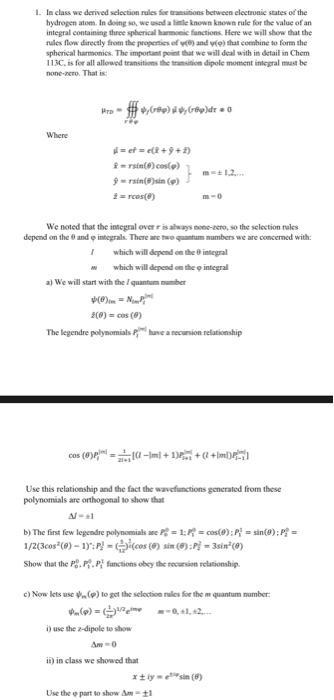
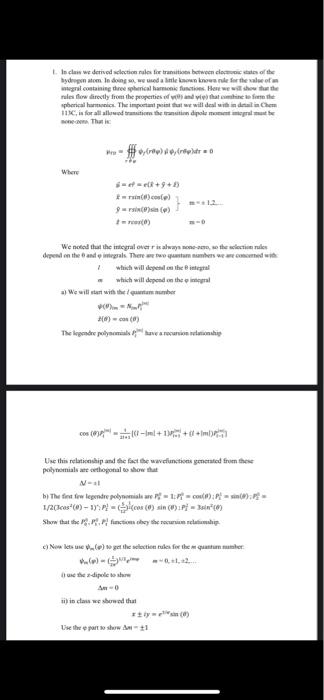
1. In class we derived selection rules fice tratvitions between electruaie states of the hydrogen atom. In doing io, we sad a limte known known rule for the value of an integral containeng duree spherical larmoeic fanctions. Here we will show that the fules flare difectly from the properties of ve(p) ant vi(p) that coenhine to form the spherieal harmotics. The important peint that we will deal with is detail in Chem 113Cs is for all allerwed transitions the trensifice dipole monent integgal mas be nonc-acro. That is: rw=rpp(rfp)y(r)dr=0 Whene =ef=e(x+y+i)i=rsin()cos(p)y=ran()sin(p),in=1.2. We noted that the inteytal over r is always boos-etro, so the selection rules depend on the 9 and e integrals. There are tace quatum numbers we are concerncd with: I which will dopend en the integral w which will depend on the integral a) We will start with the I quanfum nember ()i==NimpilntL()=cos(). The legendre polynomials P;iff has a tecursion relaticenship Use this relationship and the fact the wavdlunctions generated from these polynomials are athogonal to shenv that =+1 1/2(3cos2()1)2+P2l=(x1)2(cos()sin()=Pi2=3sin2() Show that the Po0+Pf4. Pt2 fanctions obvy the reservion telutionshig. c) Non lets use m() to get the seloction rules fier the m quanfum number: m(q)=(2n1)1/2cinpm=0,+1,+2, i) use the z-dipole to show m=0 ii) in class we showed that xiy=etimsin() Use the of part so show Am=1 1. In class we derived seloction nules fir tranutbes berween clopavic sates of the ppherical hantwonica. The inperati poiat that we will deal with in detail in Chem moveren that is: Fne=T=r(repe)1(reph)dr=0 Where B=rf=r(t+y+d)t=tin()n=0 We noted that the inikgral over r is always none-quse, wo the shlection rules 1. Which will depead on the B ietingral a wich will depend on the p imperal a) We will nast with the d equentansaumher v(vhim=Nimppetd()=cos(a) Wse this relricaihip and the fact the wavefinctions grnerated frum these polynimials ate akthogonal wo show that m(p)=(n)veeenm0+tn+2.. at aie the x-dipole to sher n=0 ii) is clas we sherend that xby=e1irsan(t) Vise the \& part bo shew Awi =1 1. In class we derived selection rules fice tratvitions between electruaie states of the hydrogen atom. In doing io, we sad a limte known known rule for the value of an integral containeng duree spherical larmoeic fanctions. Here we will show that the fules flare difectly from the properties of ve(p) ant vi(p) that coenhine to form the spherieal harmotics. The important peint that we will deal with is detail in Chem 113Cs is for all allerwed transitions the trensifice dipole monent integgal mas be nonc-acro. That is: rw=rpp(rfp)y(r)dr=0 Whene =ef=e(x+y+i)i=rsin()cos(p)y=ran()sin(p),in=1.2. We noted that the inteytal over r is always boos-etro, so the selection rules depend on the 9 and e integrals. There are tace quatum numbers we are concerncd with: I which will dopend en the integral w which will depend on the integral a) We will start with the I quanfum nember ()i==NimpilntL()=cos(). The legendre polynomials P;iff has a tecursion relaticenship Use this relationship and the fact the wavdlunctions generated from these polynomials are athogonal to shenv that =+1 1/2(3cos2()1)2+P2l=(x1)2(cos()sin()=Pi2=3sin2() Show that the Po0+Pf4. Pt2 fanctions obvy the reservion telutionshig. c) Non lets use m() to get the seloction rules fier the m quanfum number: m(q)=(2n1)1/2cinpm=0,+1,+2, i) use the z-dipole to show m=0 ii) in class we showed that xiy=etimsin() Use the of part so show Am=1 1. In class we derived seloction nules fir tranutbes berween clopavic sates of the ppherical hantwonica. The inperati poiat that we will deal with in detail in Chem moveren that is: Fne=T=r(repe)1(reph)dr=0 Where B=rf=r(t+y+d)t=tin()n=0 We noted that the inikgral over r is always none-quse, wo the shlection rules 1. Which will depead on the B ietingral a wich will depend on the p imperal a) We will nast with the d equentansaumher v(vhim=Nimppetd()=cos(a) Wse this relricaihip and the fact the wavefinctions grnerated frum these polynimials ate akthogonal wo show that m(p)=(n)veeenm0+tn+2.. at aie the x-dipole to sher n=0 ii) is clas we sherend that xby=e1irsan(t) Vise the \& part bo shew Awi =1
Step by Step Solution
There are 3 Steps involved in it

Get step-by-step solutions from verified subject matter experts
 Study Help