







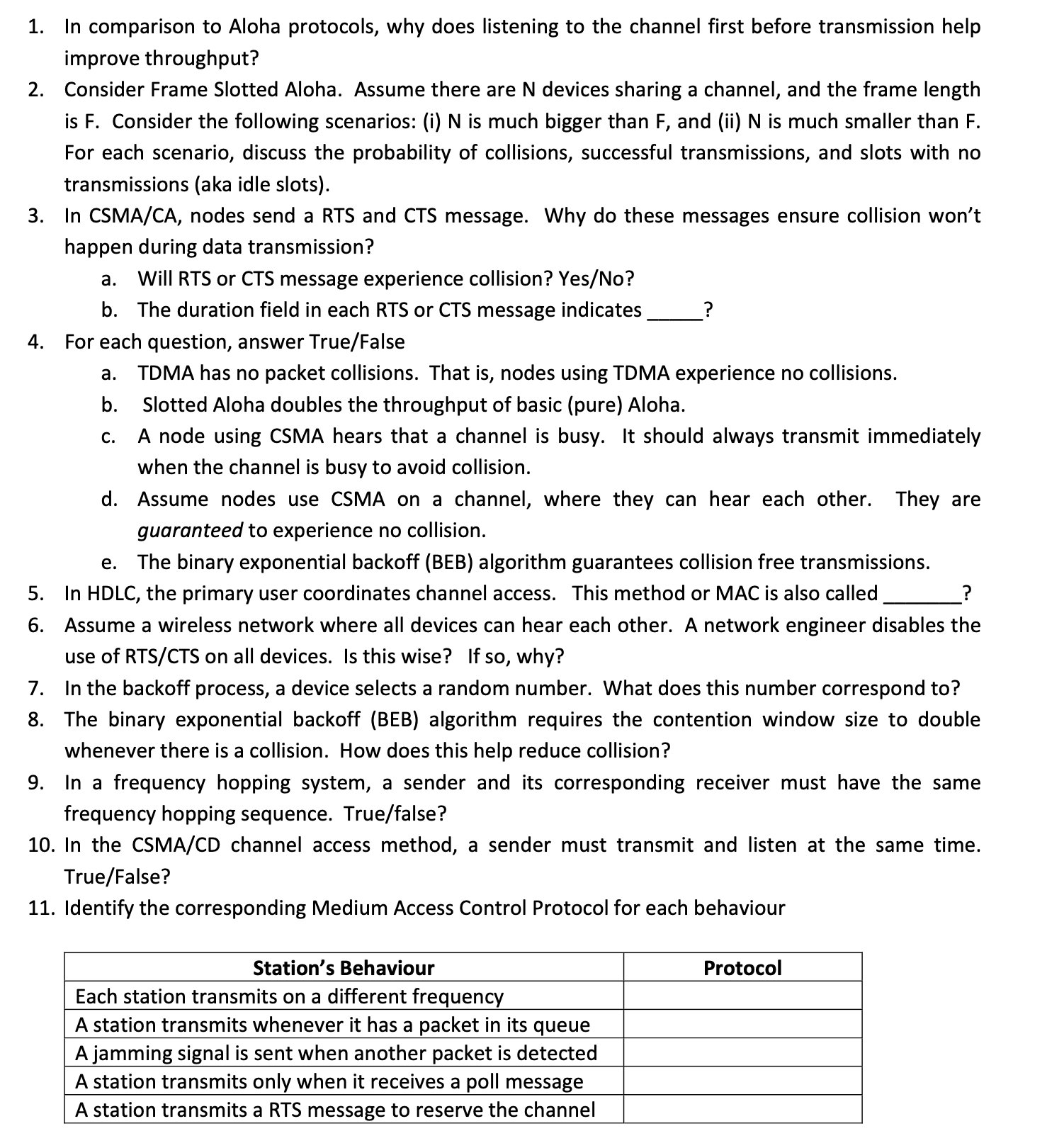
Question: 1 . In comparison to Aloha protocols, why does listening to the channel first before transmission help improve throughput? 2 . Consider Frame Slotted Aloha.
In comparison to Aloha protocols, why does listening to the channel first before transmission help improve throughput?
Consider Frame Slotted Aloha. Assume there are N devices sharing a channel, and the frame length is F Consider the following scenarios: i N is much bigger than F and ii N is much smaller than F For each scenario, discuss the probability of collisions, successful transmissions, and slots with no transmissions aka idle slots
In CSMACA nodes send a RTS and CTS message. Why do these messages ensure collision wont happen during data transmission?
a Will RTS or CTS message experience collision? YesNo
b The duration field in each RTS or CTS message indicates
For each question, answer TrueFalse
a TDMA has no packet collisions. That is nodes using TDMA experience no collisions.
b Slotted Aloha doubles the throughput of basic pure Aloha.
c A node using CSMA hears that a channel is busy. It should always transmit immediately
when the channel is busy to avoid collision.
d Assume nodes use CSMA on a channel, where they can hear each other. They are
guaranteed to experience no collision.
e The binary exponential backoff BEB algorithm guarantees collision free transmissions.
In HDLC the primary user coordinates channel access. This method or MAC is also called
Assume a wireless network where all devices can hear each other. A network engineer disables the
use of RTSCTS on all devices. Is this wise? If so why?
In the backoff process, a device selects a random number. What does this number correspond to
The binary exponential backoff BEB algorithm requires the contention window size to double
whenever there is a collision. How does this help reduce collision?
In a frequency hopping system, a sender and its corresponding receiver must have the same
frequency hopping sequence. Truefalse
In the CSMACD channel access method, a sender must transmit and listen at the same time.
TrueFalse
Identify the corresponding Medium Access Control Protocol for each behaviour
Step by Step Solution
There are 3 Steps involved in it
1 Expert Approved Answer
Step: 1 Unlock

Question Has Been Solved by an Expert!
Get step-by-step solutions from verified subject matter experts
Step: 2 Unlock
Step: 3 Unlock
 Study Help