





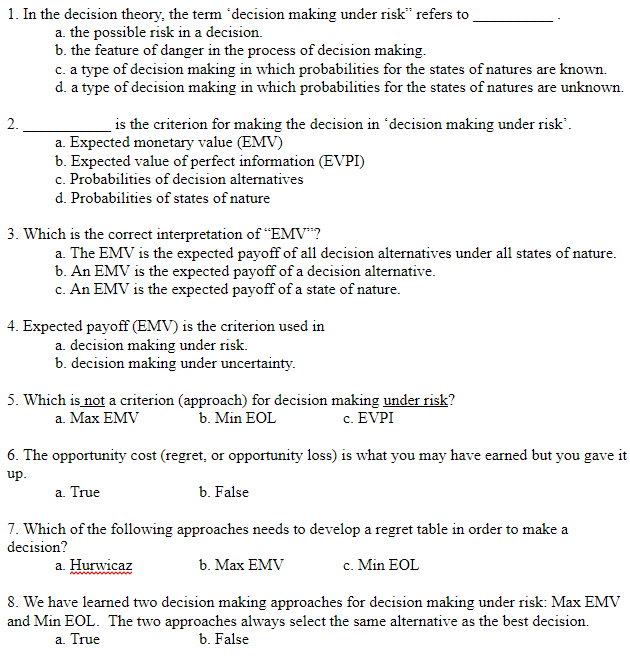
Question: . 1. In the decision theory, the term 'decision making under risk refers to a. the possible risk in a decision. b. the feature of
. 1. In the decision theory, the term 'decision. 1. In the decision theory, the term 'decision

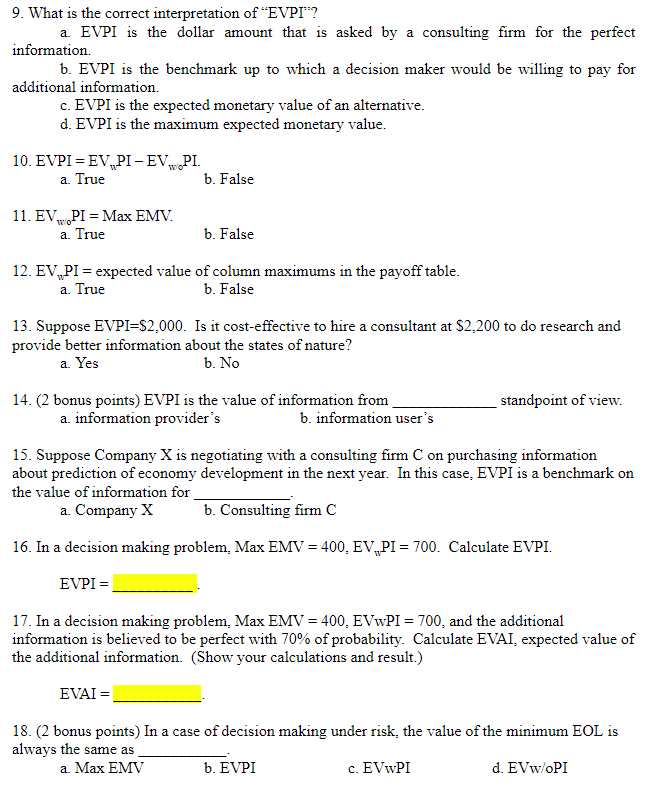
. 1. In the decision theory, the term 'decision making under risk refers to a. the possible risk in a decision. b. the feature of danger in the process of decision making. c. a type of decision making in which probabilities for the states of natures are known. d. a type of decision making in which probabilities for the states of natures are unknown. 2. is the criterion for making the decision in 'decision making under risk. a. Expected monetary value (EMV) b. Expected value of perfect information (EVPI) c. Probabilities of decision alternatives d. Probabilities of states of nature 3. Which is the correct interpretation of EMV"? a. The EMV is the expected payoff of all decision alternatives under all states of nature. b. An EMV is the expected payoff of a decision alternative. c. An EMV is the expected payoff of a state of nature. 4. Expected payoff (EMV) is the criterion used in a decision making under risk. b. decision making under uncertainty. 5. Which is not a criterion (approach) for decision making under risk? a. Max EMV b. Min EOL c. EVPI 6. The opportunity cost (regret, or opportunity loss) is what you may have earned but you gave it up. a. True b. False 7. Which of the following approaches needs to develop a regret table in order to make a decision? a. Hurwicaz b. Max EMV c. Min EOL 8. We have learned two decision making approaches for decision making under risk: Max EMV and Min EOL. The two approaches always select the same alternative as the best decision. b. False a. True 9. What is the correct interpretation of EVPI"? a. EVPI is the dollar amount that is asked by a consulting firm for the perfect information. b. EVPI is the benchmark up to which a decision maker would be willing to pay for additional information. c. EVPI is the expected monetary value of an alternative. d. EVPI is the maximum expected monetary value. 10. EVPI = EV PI - EVPI. a. True b. False 11. EVOPI = Max EMV. a. True b. False 12. EV PI = expected value of column maximums in the payoff table. a. True b. False 13. Suppose EVPI=S2,000. Is it cost-effective to hire a consultant at $2,200 to do research and provide better information about the states of nature? a. Yes b. No standpoint of view. 14. (2 bonus points) EVPI is the value of information from a. information provider's b. information user's 15. Suppose Company X is negotiating with a consulting firm C on purchasing information about prediction of economy development in the next year. In this case. EVPI is a benchmark on the value of information for a. Company X b. Consulting firm C 16. In a decision making problem. Max EMV = 400. EV,PI = 700. Calculate EVPI. EVPI = 17. In a decision making problem. Max EMV = 400, EVwPI = 700, and the additional information is believed to be perfect with 70% of probability. Calculate EVAI, expected value of the additional information. (Show your calculations and result.) EVAI = 18. (2 bonus points) In a case of decision making under risk, the value of the minimum EOL is always the same as a. Max EMV b. EVPI c. EVwPI d. EVw/OPI

Step by Step Solution

There are 3 Steps involved in it

1 Expert Approved Answer
Step: 1 Unlock blur-text-image

Question Has Been Solved by an Expert!

Get step-by-step solutions from verified subject matter experts

Step: 2 Unlock
Step: 3 Unlock

Students Have Also Explored These Related General Management Questions!