



Question: I. (26** pts in total) Multiple choice /short answer questions (highlight your answer): 1. The process of decision making is the process of selecting the
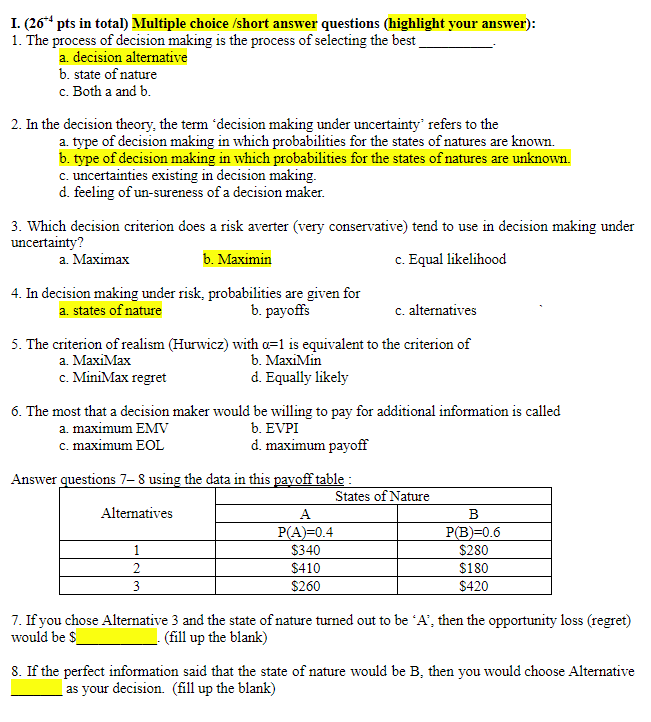
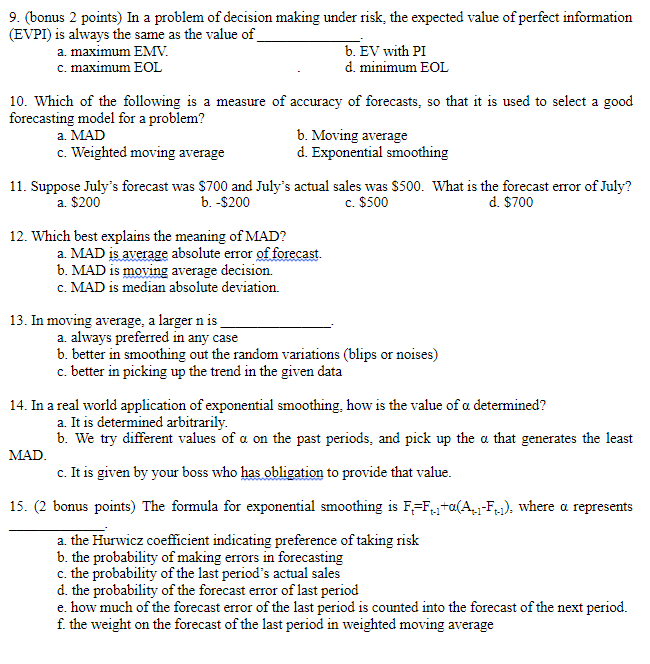
I. (26** pts in total) Multiple choice /short answer questions (highlight your answer): 1. The process of decision making is the process of selecting the best a. decision alternative b. state of nature c. Both a and b. 2. In the decision theory, the term 'decision making under uncertainty refers to the a. type of decision making in which probabilities for the states of natures are known. b. type of decision making in which probabilities for the states of natures are unknown. c. uncertainties existing in decision making. d. feeling of un-sureness of a decision maker. 3. Which decision criterion does a risk averter (very conservative) tend to use in decision making under uncertainty? a. Maximax b. Maximin c. Equal likelihood 4. In decision making under risk, probabilities are given for a. states of nature b. payoffs c. alternatives 5. The criterion of realism (Hurwicz) with a=1 is equivalent to the criterion of a. MaxiMax b. MaxiMin c. MiniMax regret d. Equally likely 6. The most that a decision maker would be willing to pay for additional information is called a. maximum EMV 6. EVPI c. maximum EOL d. maximum payoff Answer questions 7-8 using the data in this payoff table : States of Nature Alternatives A P(A)=0.4 1 $340 2 $410 3 $260 B P(B=0.6 $280 $180 $420 7. If you chose Alternative 3 and the state of nature turned out to be 'A', then the opportunity loss (regret) would be $ (fill up the blank) 8. If the perfect information said that the state of nature would be B, then you would choose Alternative as your decision. (fill up the blank) 9. (bonus 2 points) In a problem of decision making under risk, the expected value of perfect information (EVPI) is always the same as the value of a. maximum EMV. b. EV with PI c. maximum EOL d. minimum EOL 10. Which of the following is a measure of accuracy of forecasts, so that it is used to select a good forecasting model for a problem? a. MAD b. Moving average c. Weighted moving average d. Exponential smoothing 11. Suppose July's forecast was $700 and July's actual sales was $500. What is the forecast error of July? a. $200 b. -$200 c. $500 d. $700 12. Which best explains the meaning of MAD? a. MAD is average absolute error of forecast. b. MAD is moving average decision. C. MAD is median absolute deviation. 13. In moving average, a larger n is a. always preferred in any case b. better in smoothing out the random variations (blips or noises) c. better in picking up the trend in the given data 14. In a real world application of exponential smoothing, how is the value of a determined? a. It is determined arbitrarily. b. We try different values of a on the past periods, and pick up the a that generates the least MAD c. It is given by your boss who has obligation to provide that value. 15. (2 bonus points) The formula for exponential smoothing is F=F, +(A.-F), where a represents a the Hurwicz coefficient indicating preference of taking risk b. the probability of making errors in forecasting c. the probability of the last period's actual sales d. the probability of the forecast error of last period e. how much of the forecast error of the last period is counted into the forecast of the next period. f. the weight on the forecast of the last period in weighted moving average
Step by Step Solution
There are 3 Steps involved in it
1 Expert Approved Answer
Step: 1 Unlock

Question Has Been Solved by an Expert!
Get step-by-step solutions from verified subject matter experts
Step: 2 Unlock
Step: 3 Unlock