



Question: 1.) It is not important for a CSM to understand fire codes. a.) True b.) False - 2.) What is one example of activities that

1.) It is not important for a CSM to understand fire codes.
a.) True
b.) False
-
2.) What is one example of activities that would need access to a front drive entrance area for a convention center?
a.) Shuttles
b.) Hotel check-in
c.) Security for airport baggage
d.) None of the above.
-
3.) A CSM should do additional research if an event has never booked at the convention center. Where could one research the history of an event or find additional information about the event that has just been contracted?
a.) Contacting the CSM at the last location the event was held
b.) Questions could be asked of the events contact about issues at the previous facility including the following: what went well, what did not go well, actual attendance, concession history, what other options were available in the area for guests to eat, the clients hot buttons, did the client use all their contracted space, and any security concerns.
c.) The CSM can find additional information about their assigned event by reviewing the clients website and contacting the previous locations used by the client.
d.) All of the above.
-
4.) It is important to know the authorized signers for an event.
a.) True
b.) False
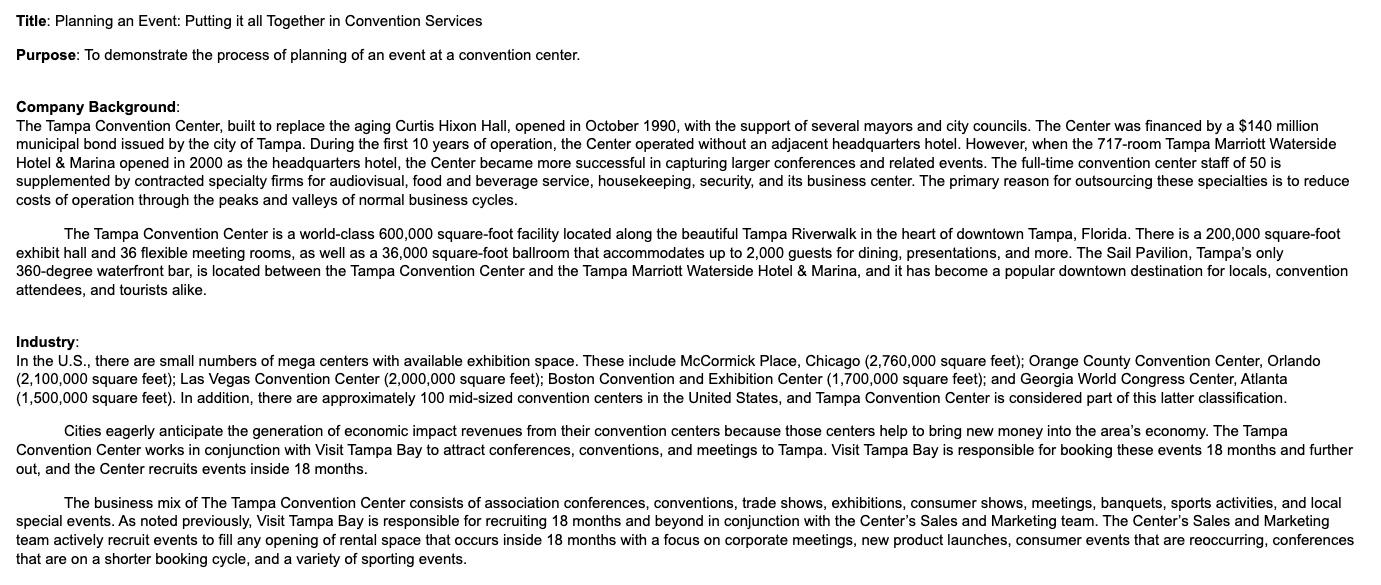
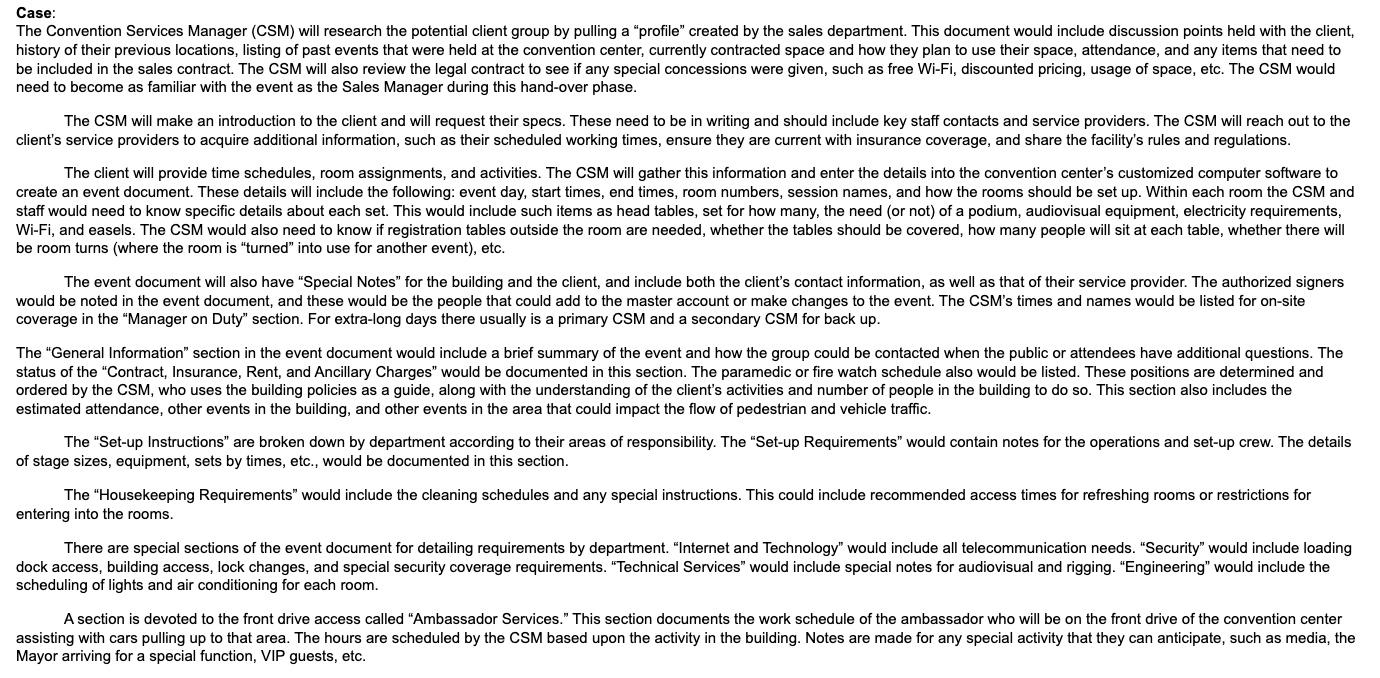
Title: Planning an Event: Putting it all Together in Convention Services Purpose: To demonstrate the process of planning of an event at a convention center. Company Background: The Tampa Convention Center, built to replace the aging Curtis Hixon Hall, opened in October 1990, with the support of several mayors and city councils. The Center was financed by a $140 million municipal bond issued by the city of Tampa. During the first 10 years of operation, the Center operated without an adjacent headquarters hotel. However, when the 717-room Tampa Marriott Waterside Hotel & Marina opened in 2000 as the headquarters hotel, the Center became more successful in capturing larger conferences and related events. The full-time convention center staff of 50 is supplemented by contracted specialty firms for audiovisual, food and beverage service, housekeeping, security, and its business center. The primary reason for outsourcing these specialties is to reduce costs of operation through the peaks and valleys of normal business cycles. The Tampa Convention Center is a world-class 600,000 square-foot facility located along the beautiful Tampa Riverwalk in the heart of downtown Tampa, Florida. There is a 200,000 square-foot exhibit hall and 36 flexible meeting rooms, as well as a 36,000 square-foot ballroom that accommodates up to 2,000 guests for dining, presentations, and more. The Sail Pavilion, Tampa's only 360-degree waterfront bar, is located between the Tampa Convention Center and the Tampa Marriott Waterside Hotel & Marina, and it has become a popular downtown destination for locals, convention attendees, and tourists alike. Industry: In the U.S., there are small numbers of mega centers with available exhibition space. These include McCormick Place, Chicago (2,760,000 square feet); Orange County Convention Center, Orlando (2,100,000 square feet); Las Vegas Convention Center (2,000,000 square feet); Boston Convention and Exhibition Center (1,700,000 square feet); and Georgia World Congress Center, Atlanta (1,500,000 square feet). In addition, there are approximately 100 mid-sized convention centers in the United States, and Tampa Convention Center is considered part of this latter classification. Cities eagerly anticipate the generation of economic impact revenues from their convention centers because those centers help to bring new money into the area's economy. The Tampa Convention Center works in conjunction with Visit Tampa Bay to attract conferences, conventions, and meetings to Tampa. Visit Tampa Bay is responsible for booking these events 18 months and further out, and the Center recruits events inside 18 months. The business mix of The Tampa Convention Center consists of association conferences, conventions, trade shows, exhibitions, consumer shows, meetings, banquets, sports activities, and local special events. As noted previously, Visit Tampa Bay is responsible for recruiting 18 months and beyond in conjunction with the Center's Sales and Marketing team. The Center's Sales and Marketing team actively recruit events to fill any opening of rental space that occurs inside 18 months with a focus on corporate meetings, new product launches, consumer events that are reoccurring, conferences that are on shorter booking cycle, and a variety of sporting events. Case: The Convention Services Manager (CSM) will research the potential client group by pulling a "profile" created by the sales department. This document would include discussion points held with the client, history of their previous locations, listing of past events that were held at the convention center, currently contracted space and how they plan to use their space, attendance, and any items that need to be included in the sales contract. The CSM will also review the legal contract to see if any special concessions were given, such as free Wi-Fi, discounted pricing, usage of space, etc. The CSM would need to become as familiar with the event as the Sales Manager during this hand-over phase. The CSM will make an introduction to the client and will request their specs. These need to be in writing and should include key staff contacts and service providers. The CSM will reach out to the client's service providers to acquire additional information, such as their scheduled working times, ensure they are current with insurance coverage, and share the facility's rules and regulations. The client will provide time schedules, room assignments, and activities. The CSM will gather this information and enter the details into the convention center's customized computer software to create an event document. These details will include the following: event day, start times, end times, room numbers, session names, and how the rooms should be set up. Within each room the CSM and staff would need to know specific details about each set. This would include such items as head tables, set for how many, the need (or not) of a podium, audiovisual equipment, electricity requirements, Wi-Fi, and easels. The CSM would also need to know if registration tables outside the room are needed, whether the tables should be covered, how many people will sit at each table, whether there will be room turns (where the room is "turned" into use for another event), etc. The event document will also have "Special Notes" for the building and the client, and include both the client's contact information, as well as that of their service provider. The authorized signers would be noted in the event document, and these would be the people that could add to the master account or make changes to the event. The CSM's times and names would be listed for on-site coverage in the "Manager on Duty" section. For extra-long days there usually is a primary CSM and a secondary CSM for back up. The "General Information" section in the event document would include a brief summary of the event and how the group could be contacted when the public or attendees have additional questions. The status of the "Contract, Insurance, Rent, and Ancillary Charges" would be documented in this section. The paramedic or fire watch schedule also would be listed. These positions are determined and ordered by the CSM, who uses the building policies as a guide, along with the understanding of the client's activities and number of people in the building to do so. This section also includes the estimated attendance, other events in the building, and other events in the area that could impact the flow of pedestrian and vehicle traffic. The "Set-up Instructions" are broken down by department according to their areas of responsibility. The "Set-up Requirements" would contain notes for the operations and set-up crew. The details of sta sizes, equipment, sets times, etc., would be documented in this section. The "Housekeeping Requirements" would include the cleaning schedules and any special instructions. This could include recommended access times for refreshing rooms or restrictions for entering into the rooms. There are special sections of the event document for detailing requirements by department. "Internet and Technology" would include all telecommunication needs. "Security" would include loading dock access, building access, lock changes, and special security coverage requirements. "Technical Services" would include special notes for audiovisual and rigging. "Engineering" would include the scheduling of lights and air conditioning for each room. A section is devoted to the front drive access called "Ambassador Services." This section documents the work schedule of the ambassador who will be on the front drive of the convention center assisting with cars pulling up to that area. The hours are scheduled by the CSM based upon the activity in the building. Notes are made for any special activity that they can anticipate, such as media, the Mayor arriving for a special function, VIP guests, etc. The subcontractor that has an exclusive contract with the center for all food and beverage will create their own detailed BEO (Banquet Event Order) for the client. A section in the event document highlights any other special comments that the building may need from catering, such as times to set the head table, table cloths, when to provide podium water, etc. The CSM will take all the detailed information and determine the additional expenses (called ancillary expenses), excluding the rent. This would include the electric, paramedic, fire watch, etc. charges. These additional fees would be due to the center prior to the client arriving. The CSM would draw the floor plans on a software package, such as AutoCAD. When the client contracts a decorator, the decorator usually provides the exhibit hall floor plans. These floor plans would be reviewed by the CSM to ensure fire code guidelines are being met and then submit them for the fire marshal's approval. The CSM brings all this information together in a complete, condensed package of schedules, fees, and room drawings to be used by all departments in the center. This is sent to the client for review and approval. There are usually updates and changes, and it is a continual work in progress until the client arrives. Changes may still continue during the event due to unexpected issues while onsite. The CSM is in the building providing support during the entire event. The CSM is the point person for the client throughout the event, and the CSM will communicate the client's requests for adjustments or service for action to all other departments. When the event is over, the final event settlement is prepared for the client. The goal of the CSM is to make sure they handled the client to the best of their ability and that the client will rebook in future years. Title: Planning an Event: Putting it all Together in Convention Services Purpose: To demonstrate the process of planning of an event at a convention center. Company Background: The Tampa Convention Center, built to replace the aging Curtis Hixon Hall, opened in October 1990, with the support of several mayors and city councils. The Center was financed by a $140 million municipal bond issued by the city of Tampa. During the first 10 years of operation, the Center operated without an adjacent headquarters hotel. However, when the 717-room Tampa Marriott Waterside Hotel & Marina opened in 2000 as the headquarters hotel, the Center became more successful in capturing larger conferences and related events. The full-time convention center staff of 50 is supplemented by contracted specialty firms for audiovisual, food and beverage service, housekeeping, security, and its business center. The primary reason for outsourcing these specialties is to reduce costs of operation through the peaks and valleys of normal business cycles. The Tampa Convention Center is a world-class 600,000 square-foot facility located along the beautiful Tampa Riverwalk in the heart of downtown Tampa, Florida. There is a 200,000 square-foot exhibit hall and 36 flexible meeting rooms, as well as a 36,000 square-foot ballroom that accommodates up to 2,000 guests for dining, presentations, and more. The Sail Pavilion, Tampa's only 360-degree waterfront bar, is located between the Tampa Convention Center and the Tampa Marriott Waterside Hotel & Marina, and it has become a popular downtown destination for locals, convention attendees, and tourists alike. Industry: In the U.S., there are small numbers of mega centers with available exhibition space. These include McCormick Place, Chicago (2,760,000 square feet); Orange County Convention Center, Orlando (2,100,000 square feet); Las Vegas Convention Center (2,000,000 square feet); Boston Convention and Exhibition Center (1,700,000 square feet); and Georgia World Congress Center, Atlanta (1,500,000 square feet). In addition, there are approximately 100 mid-sized convention centers in the United States, and Tampa Convention Center is considered part of this latter classification. Cities eagerly anticipate the generation of economic impact revenues from their convention centers because those centers help to bring new money into the area's economy. The Tampa Convention Center works in conjunction with Visit Tampa Bay to attract conferences, conventions, and meetings to Tampa. Visit Tampa Bay is responsible for booking these events 18 months and further out, and the Center recruits events inside 18 months. The business mix of The Tampa Convention Center consists of association conferences, conventions, trade shows, exhibitions, consumer shows, meetings, banquets, sports activities, and local special events. As noted previously, Visit Tampa Bay is responsible for recruiting 18 months and beyond in conjunction with the Center's Sales and Marketing team. The Center's Sales and Marketing team actively recruit events to fill any opening of rental space that occurs inside 18 months with a focus on corporate meetings, new product launches, consumer events that are reoccurring, conferences that are on shorter booking cycle, and a variety of sporting events. Case: The Convention Services Manager (CSM) will research the potential client group by pulling a "profile" created by the sales department. This document would include discussion points held with the client, history of their previous locations, listing of past events that were held at the convention center, currently contracted space and how they plan to use their space, attendance, and any items that need to be included in the sales contract. The CSM will also review the legal contract to see if any special concessions were given, such as free Wi-Fi, discounted pricing, usage of space, etc. The CSM would need to become as familiar with the event as the Sales Manager during this hand-over phase. The CSM will make an introduction to the client and will request their specs. These need to be in writing and should include key staff contacts and service providers. The CSM will reach out to the client's service providers to acquire additional information, such as their scheduled working times, ensure they are current with insurance coverage, and share the facility's rules and regulations. The client will provide time schedules, room assignments, and activities. The CSM will gather this information and enter the details into the convention center's customized computer software to create an event document. These details will include the following: event day, start times, end times, room numbers, session names, and how the rooms should be set up. Within each room the CSM and staff would need to know specific details about each set. This would include such items as head tables, set for how many, the need (or not) of a podium, audiovisual equipment, electricity requirements, Wi-Fi, and easels. The CSM would also need to know if registration tables outside the room are needed, whether the tables should be covered, how many people will sit at each table, whether there will be room turns (where the room is "turned" into use for another event), etc. The event document will also have "Special Notes" for the building and the client, and include both the client's contact information, as well as that of their service provider. The authorized signers would be noted in the event document, and these would be the people that could add to the master account or make changes to the event. The CSM's times and names would be listed for on-site coverage in the "Manager on Duty" section. For extra-long days there usually is a primary CSM and a secondary CSM for back up. The "General Information" section in the event document would include a brief summary of the event and how the group could be contacted when the public or attendees have additional questions. The status of the "Contract, Insurance, Rent, and Ancillary Charges" would be documented in this section. The paramedic or fire watch schedule also would be listed. These positions are determined and ordered by the CSM, who uses the building policies as a guide, along with the understanding of the client's activities and number of people in the building to do so. This section also includes the estimated attendance, other events in the building, and other events in the area that could impact the flow of pedestrian and vehicle traffic. The "Set-up Instructions" are broken down by department according to their areas of responsibility. The "Set-up Requirements" would contain notes for the operations and set-up crew. The details of sta sizes, equipment, sets times, etc., would be documented in this section. The "Housekeeping Requirements" would include the cleaning schedules and any special instructions. This could include recommended access times for refreshing rooms or restrictions for entering into the rooms. There are special sections of the event document for detailing requirements by department. "Internet and Technology" would include all telecommunication needs. "Security" would include loading dock access, building access, lock changes, and special security coverage requirements. "Technical Services" would include special notes for audiovisual and rigging. "Engineering" would include the scheduling of lights and air conditioning for each room. A section is devoted to the front drive access called "Ambassador Services." This section documents the work schedule of the ambassador who will be on the front drive of the convention center assisting with cars pulling up to that area. The hours are scheduled by the CSM based upon the activity in the building. Notes are made for any special activity that they can anticipate, such as media, the Mayor arriving for a special function, VIP guests, etc. The subcontractor that has an exclusive contract with the center for all food and beverage will create their own detailed BEO (Banquet Event Order) for the client. A section in the event document highlights any other special comments that the building may need from catering, such as times to set the head table, table cloths, when to provide podium water, etc. The CSM will take all the detailed information and determine the additional expenses (called ancillary expenses), excluding the rent. This would include the electric, paramedic, fire watch, etc. charges. These additional fees would be due to the center prior to the client arriving. The CSM would draw the floor plans on a software package, such as AutoCAD. When the client contracts a decorator, the decorator usually provides the exhibit hall floor plans. These floor plans would be reviewed by the CSM to ensure fire code guidelines are being met and then submit them for the fire marshal's approval. The CSM brings all this information together in a complete, condensed package of schedules, fees, and room drawings to be used by all departments in the center. This is sent to the client for review and approval. There are usually updates and changes, and it is a continual work in progress until the client arrives. Changes may still continue during the event due to unexpected issues while onsite. The CSM is in the building providing support during the entire event. The CSM is the point person for the client throughout the event, and the CSM will communicate the client's requests for adjustments or service for action to all other departments. When the event is over, the final event settlement is prepared for the client. The goal of the CSM is to make sure they handled the client to the best of their ability and that the client will rebook in future yearsStep by Step Solution
There are 3 Steps involved in it

Get step-by-step solutions from verified subject matter experts