







Question: 1. Jane has been working all day, missing both her breakfast and lunch. Finally able to leave work, after being required to work a couple
1. Jane has been working all day, missing both her breakfast and lunch. Finally able to leave work, after being required to work a couple of overtime hours, she is starving. Jane has $20 in her pocket, so she stops at a local fast food restaurant and orders a grilled chicken sandwich and an order of fries. As she sits down to eat them, a university student approaches her and tells her that she is doing a research project for her microeconomics course and would like to ask Jane a few quick questions. Jane agrees, and the student asks
what score (marginal utility) from 1 to 100 would she give as her satisfaction level with the first sandwich and the first fries? After eating that order, Jane is still hungry and orders a second chicken sandwich and another order of fries. Again, the student asks Jane to give her new scores. Since Jane has not eaten all day, she is hungry enough to order a third round of food and again gives scores to the inquisitive student.
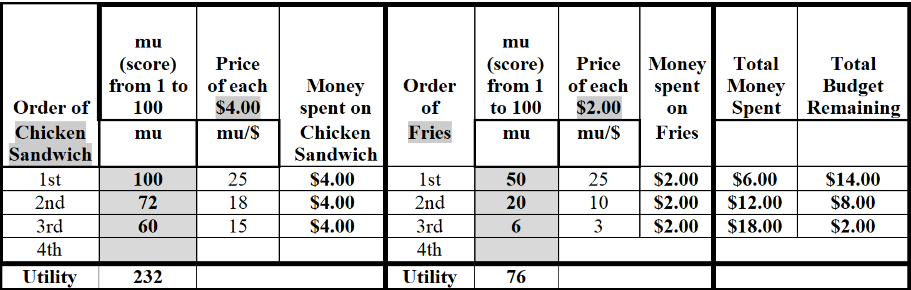
Below is the university students completed experiment tally sheet of Janes marginal utility scores and the calculation of her marginal utility per dollar, given that each sandwich costs $4.00, and each order of fries costs $2.00. Her budget is $20.
The student filled in the shaded cells based on Janes responses, then computed the values in the remaining cells. Using this information, answer the following questions.
Students completed experiment tally sheet. Available budget is $20.
Total spent on chicken sandwiches: $12
Total spent on fries: $6.00
Total money spent: $18.00
Total budget remaining: $2.00
Marginal utility per dollar for chicken sandwiches of the last item purchased: 15 mu/$
Marginal utility per dollar for fries of the last item purchased: 3 mu/$
Total utility for both: 308
a. Is Jane maximizing her utility? Explain your reasoning and show any calculations.
(Enter your response here.)
b. If Jane is not maximizing her utility, remembering the law of diminishing marginal utility, would she be better off to buy one less chicken sandwich and one more order of fries? You will need to enter a
number for marginal utility, based upon the law of diminishing marginal utility, for an additional order of fries. Be sure to explain your reasoning and show your calculations.
(Enter your response here.)
c. If Jane is not maximizing her utility with the original purchase combination, remembering the law of diminishing marginal utility, would she be better off buying just one more order of fries? You will need to enter a number for marginal utility, based upon the law of diminishing marginal utility, for an additional order of fries. Be sure to explain your reasoning and show your calculations.
(Enter your response here.)
d. If Jane is not maximizing her utility with the original purchase, remembering the law of diminishing marginal utility, would she be better off buying one less order of fries and one more chicken sandwich? You will need to enter a number for marginal utility, based upon the law of diminishing marginal utility, for an additional chicken sandwich. Be sure to explain your reasoning and show your calculations.
(Enter your response here.)
Step by Step Solution
There are 3 Steps involved in it

Get step-by-step solutions from verified subject matter experts
 Study Help