



Question: 1. Kinematic analysis: The electrons arrive at the deflection plates with a velocity vx along the x-axis. The width of the plates (along the
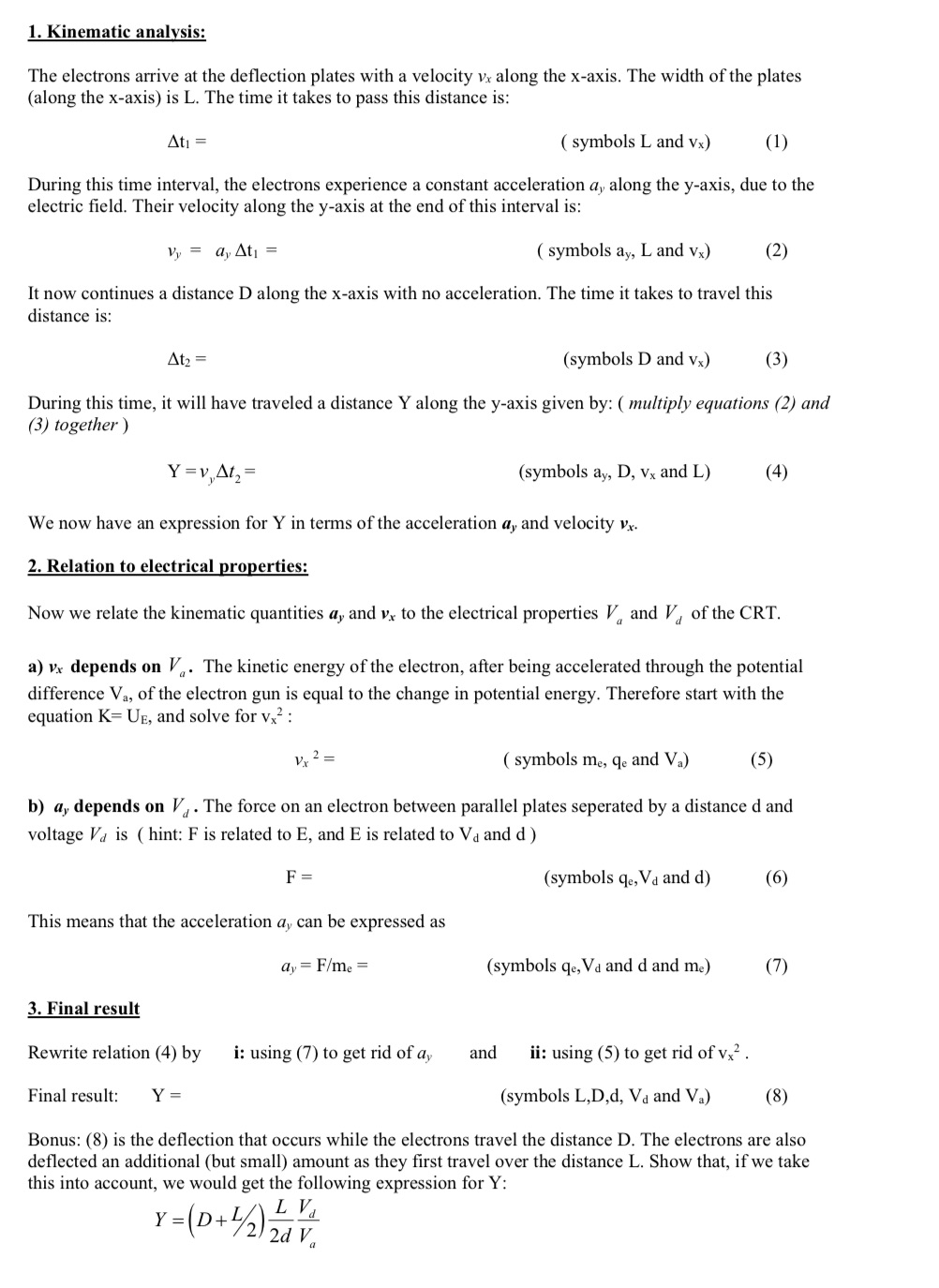
1. Kinematic analysis: The electrons arrive at the deflection plates with a velocity vx along the x-axis. The width of the plates (along the x-axis) is L. The time it takes to pass this distance is: At = (symbols Land vs) (1) During this time interval, the electrons experience a constant acceleration a, along the y-axis, due to the electric field. Their velocity along the y-axis at the end of this interval is: Vy=ay At = (symbols a,, L and v.) (2) It now continues a distance D along the x-axis with no acceleration. The time it takes to travel this distance is: At = (symbols D and v.) (3) During this time, it will have traveled a distance Y along the y-axis given by: (multiply equations (2) and (3) together) Y-v,M,- (symbols a,, D, v, and L) (4) We now have an expression for Y in terms of the acceleration a, and velocity vx. 2. Relation to electrical properties: Now we relate the kinematic quantities a, and v, to the electrical properties V and V, of the CRT. a) v. depends on V. The kinetic energy of the electron, after being accelerated through the potential difference V., of the electron gun is equal to the change in potential energy. Therefore start with the equation K-U, and solve for v: Vx 2 = (symbols m., q. and V) (5) b) a, depends on V. The force on an electron between parallel plates seperated by a distance d and voltage Vais (hint: F is related to E, and E is related to Va and d) F = This means that the acceleration a, can be expressed as ay = F/me= (symbols qe, Va and d) (6) (symbols qe,Va and d and me) (7) 3. Final result Rewrite relation (4) by i: using (7) to get rid of ay and Final result: Y = ii: using (5) to get rid of v,2. (symbols L,D,d, Va and V.) (8) Bonus: (8) is the deflection that occurs while the electrons travel the distance D. The electrons are also deflected an additional (but small) amount as they first travel over the distance L. Show that, if we take this into account, we would get the following expression for Y: Y = (D+); LV 2) 2d Va
Step by Step Solution
There are 3 Steps involved in it

Get step-by-step solutions from verified subject matter experts