Question: 1. Let A, B, and C be arbitrary matrices for which the indicated sums and products are defined. Determine whether the statement below is true

1.
1. Let A, B, and C be arbitrary matrices for1. Let A, B, and C be arbitrary matrices for1. Let A, B, and C be arbitrary matrices for1. Let A, B, and C be arbitrary matrices for1. Let A, B, and C be arbitrary matrices for1. Let A, B, and C be arbitrary matrices for1. Let A, B, and C be arbitrary matrices for
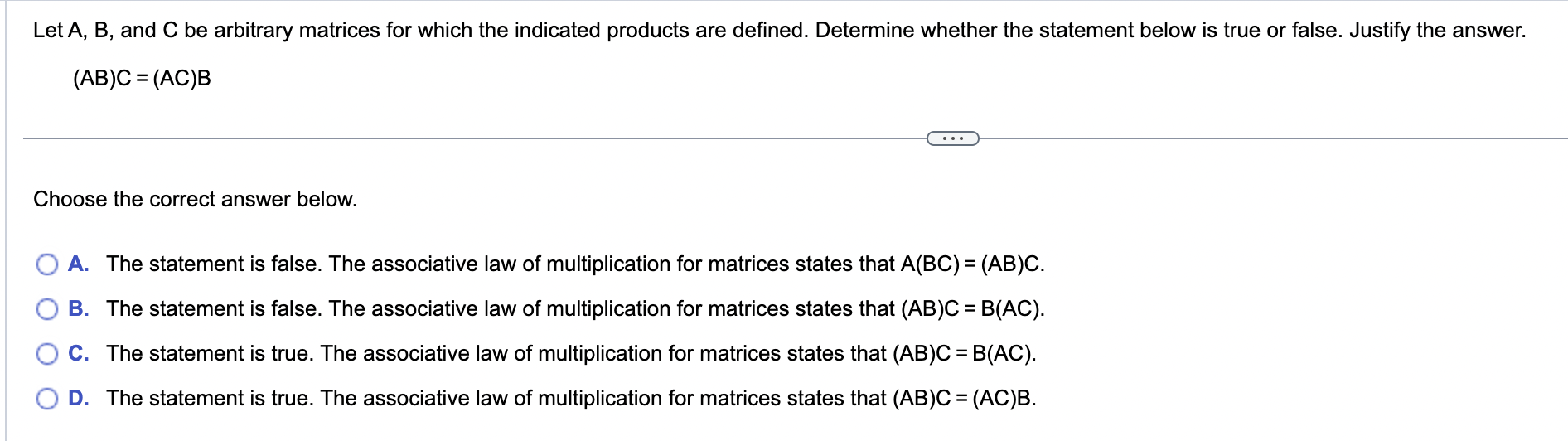
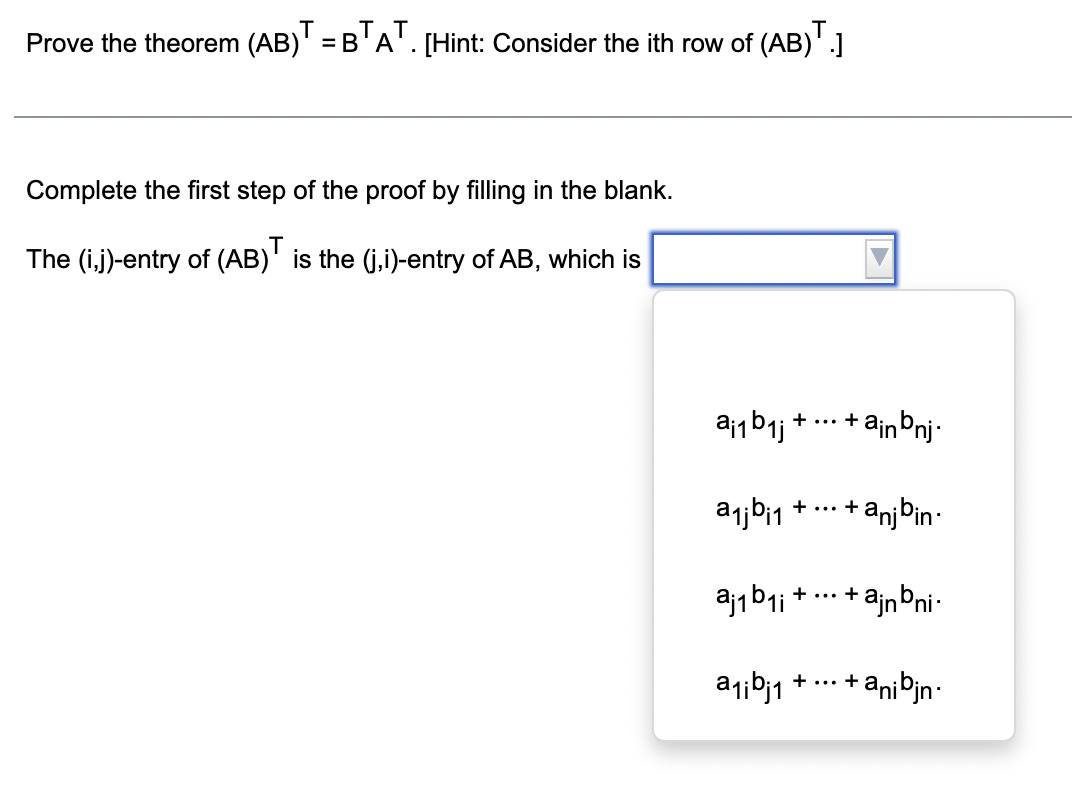
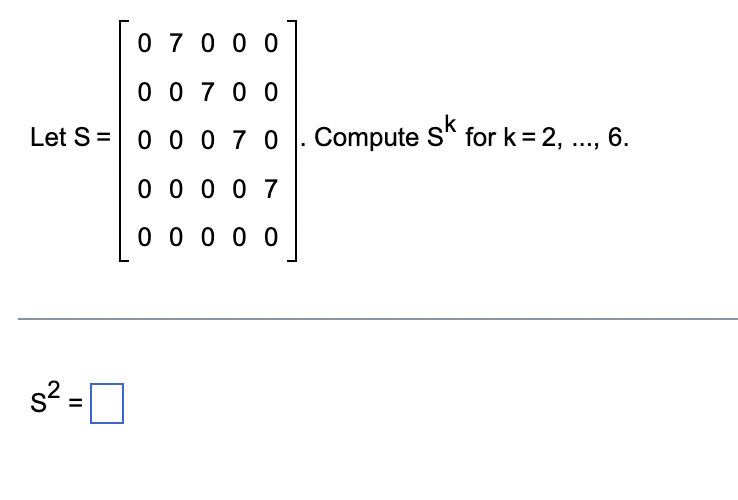
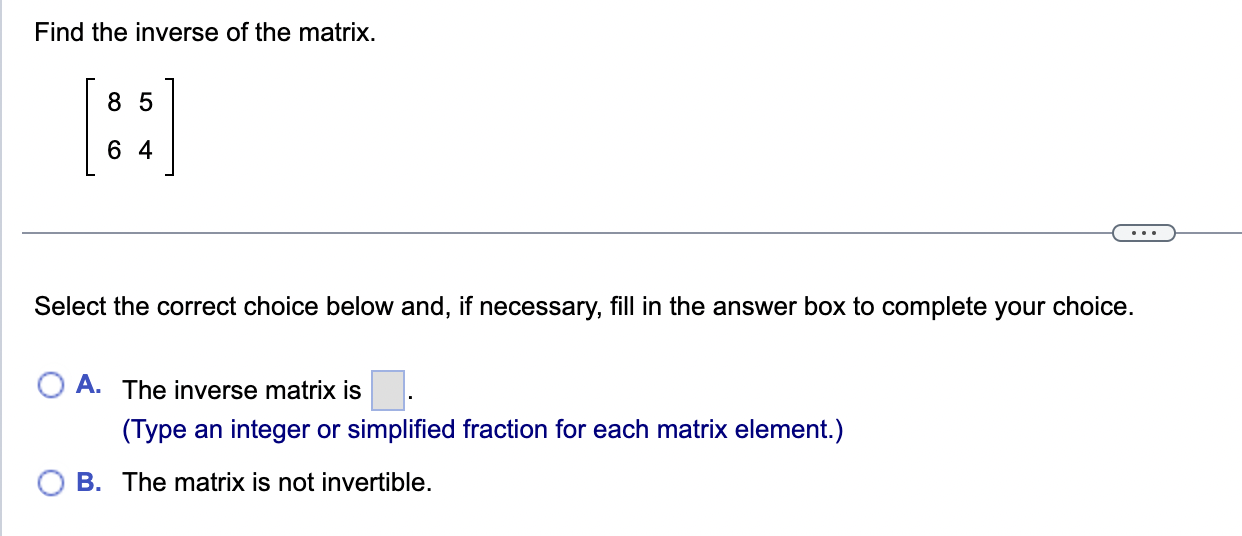
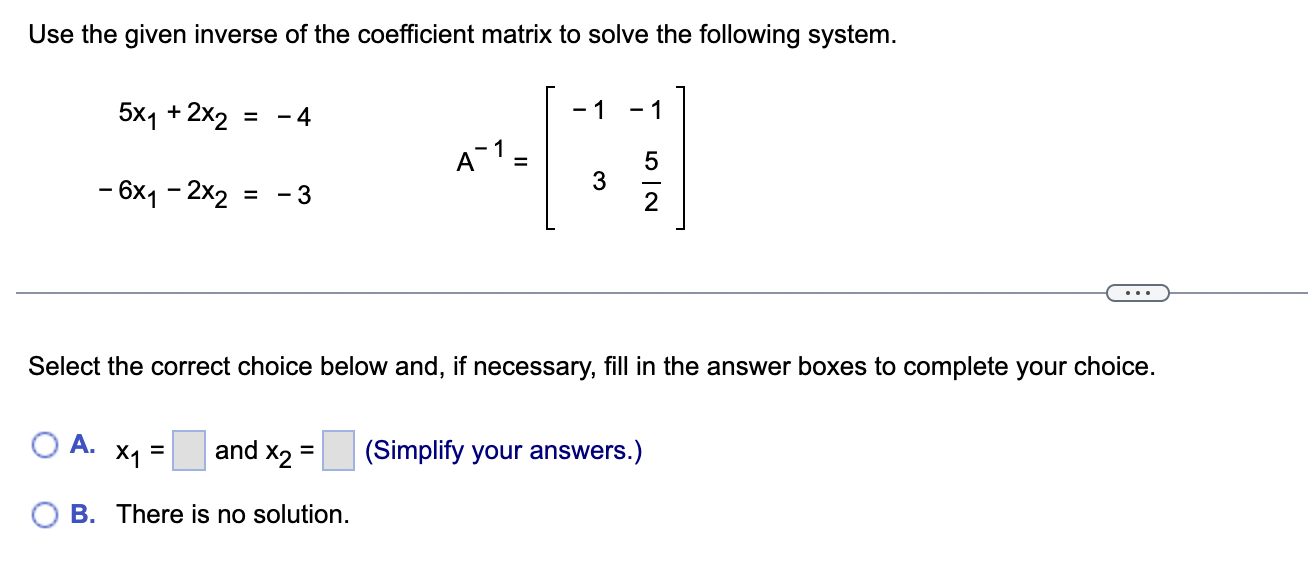
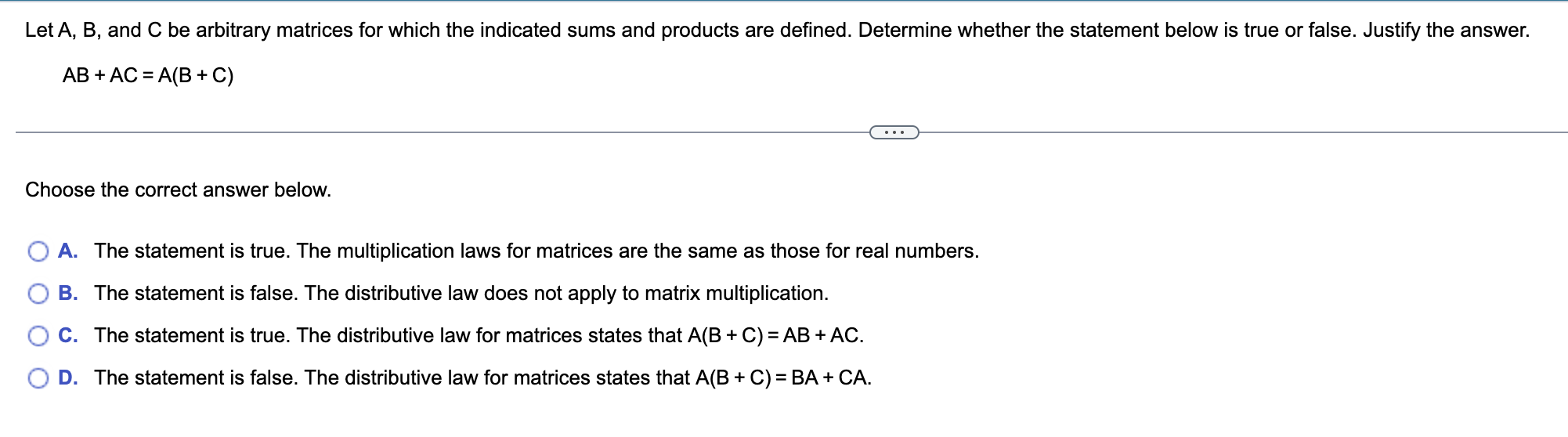
Let A, B, and C be arbitrary matrices for which the indicated sums and products are defined. Determine whether the statement below is true or false. Justify the answer. AB+AC=A(B+C) Choose the correct answer below. cj '2- A. The statement is true. The multiplication laws for matrices are the same as those for real numbers. I: ':- B. The statement is false. The distributive law does not apply to matrix multiplication. i: '2' C. The statement is true. The distributive law for matrices states that A(B + C) = AB + AC. '1: 'i- D. The statement is false. The distributive law for matrices states that A(B + C) = BA + CA. Let A, B, and C be arbitrary matrices for which the indicated products are defined. Determine whether the statement below is true or false. Justify the answer. (AB)C = (AC)B Choose the correct answer below. The statement is false. The associative law of multiplication for matrices states that A(BC) = (AB)C. The statement is false. The associative law of multiplication for matrices states that (AB)C = B(AC). The statement is true. The associative law of multiplication for matrices states that (AB)C = B(AC). b.6195? The statement is true. The associative law of multiplication for matrices states that (AB)C = (AC)B. Prove the theorem (AB)' = B A' . [Hint: Consider the ith row of (AB) ' .] Complete the first step of the proof by filling in the blank. The (i,j)-entry of (AB) ' is the (j,i)-entry of AB, which is ajjbyj+ ... + ainbnj aqibin + ... + anibin. aj1b1i + ... + ajnbni alibi1 + ... + anibin.\fFind the inverse of the matrix. 85 64 (3 Select the correct choice below and, if necessary, ll in the answer box to complete your choice. '11:} A- The inverse matrix is (Type an integer or simplified fraction for each matrix element.) f} B. The matrix is not invertible. Use the given inverse of the coefficient matrix to solve the following system. 5X1 + 2x2 = - 4 -1 -1 A = -6x1 - 2X2 = - 3 3 . . . Select the correct choice below and, if necessary, fill in the answer boxes to complete your choice. OA. X= and X2 = (Simplify your answers.) O B. There is no solution.Let A = a. Find A and use it solve the four equations Ax = by , Ax = b2 , Ax = b3, and Ax = b4. b. The four equations in part (a) can be solved by the same set of operations, since the coefficient matrix is the same in each case. Solve the four equations in part (a) by row reducing the augmented matrix [A b1 b2 b3 b4]

Step by Step Solution

There are 3 Steps involved in it

1 Expert Approved Answer
Step: 1 Unlock blur-text-image

Question Has Been Solved by an Expert!

Get step-by-step solutions from verified subject matter experts

Step: 2 Unlock
Step: 3 Unlock

Students Have Also Explored These Related Mathematics Questions!