Question: 1. Let F be a function from a set X to a set Y, F is one-to-one, injective if and only if for all elements
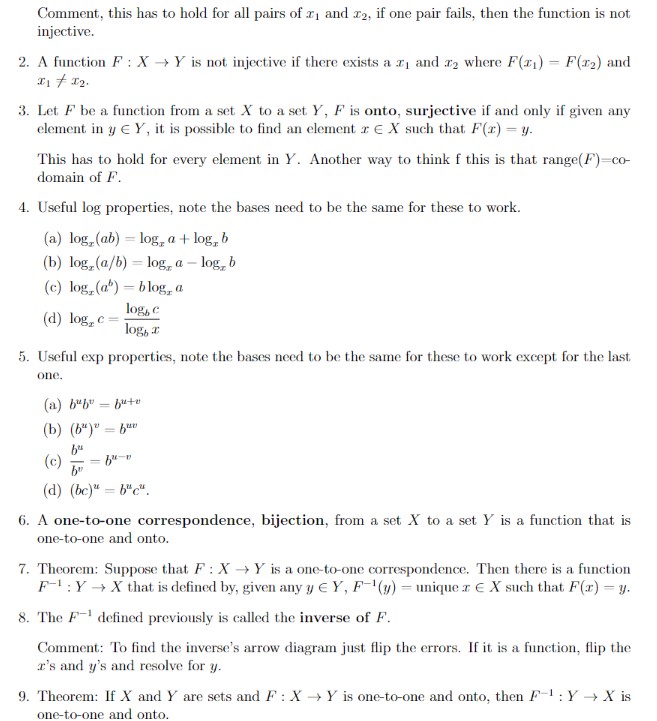
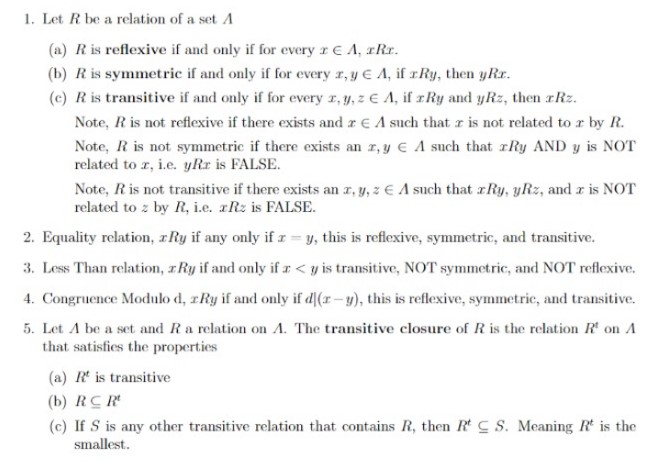
1. Let F be a function from a set X to a set Y, F is one-to-one, injective if and only if for all elements :1, 12 ( X, if F(a) = F(x2), the m1 = 12. Equivalently, 21 / 12 implies that F(a) / F(.2).Comment, this has to hold for all pairs of r, and 22, if one pair fails, then the function is not injective. 2. A function F : X - Y is not injective if there exists a 2, and a2 where F(2,) - F(x2) and I1 7 12. 3. Let F be a function from a set X to a set Y, F is onto, surjective if and only if given any element in y C Y, it is possible to find an element z ( X such that F(x) = y. This has to hold for every element in Y. Another way to think f this is that range(F)=co- domain of F. 4. Useful log properties, note the bases need to be the same for these to work. (a) log, (ab) = log, a + log, b (b) log,(a/b) = log, a - log, b (c) log, (a") - blog, a (d) log, C= logs c logh I 5. Useful exp properties, note the bases need to be the same for these to work except for the last. one. (a) bub" = bute (b) (bu) = bum (C) 70 (d) (bc)" = bcu 6. A one-to-one correspondence, bijection, from a set X to a set Y is a function that is one-to-one and onto. 7. Theorem: Suppose that F : X - Y is a one-to-one correspondence. Then there is a function F-1: Y - X that is defined by, given any y c Y, F-'(y) - unique a E X such that F(x) = y. 8. The F- defined previously is called the inverse of F. Comment: To find the inverse's arrow diagram just flip the errors. If it is a function, flip the r's and y's and resolve for y. 9. Theorem: If X and Y are sets and F : X -> Y is one-to-one and onto, then F-1 : Y - X is one-to-one and onto.1. Let R be a relation of a set A (a) R is reflexive if and only if for every r E A, ERr. (b) R is symmetric if and only if for every r, y e A, if rRy, then yRr. (c) R is transitive if and only if for every r, 1, z C A, if rRy and yRz, then IRz. Note, R is not reflexive if there exists and r E A such that r is not related to r by R. Note, R is not symmetric if there exists an r, y E 4 such that rRy AND y is NOT related to r, i.e. yRr is FALSE. Note, R is not transitive if there exists an r, y, z ( 4 such that a Ry, yRz, and a is NOT related to z by R, i.e. aRe is FALSE. 2. Equality relation, rRy if any only if r = y, this is reflexive, symmetric, and transitive. 3. Less Than relation, r Ry if and only if a
Step by Step Solution
There are 3 Steps involved in it
1 Expert Approved Answer
Step: 1 Unlock
Question Has Been Solved by an Expert!
Get step-by-step solutions from verified subject matter experts
Step: 2 Unlock
Step: 3 Unlock
Students Have Also Explored These Related Mathematics Questions!










 Study Help