



Question: 1. Let f(:1:) = (sin 3:)CD l (cos 3:)Si. A (hypothetical) student is asked to find a formula for f'(a:). They submit the following work.
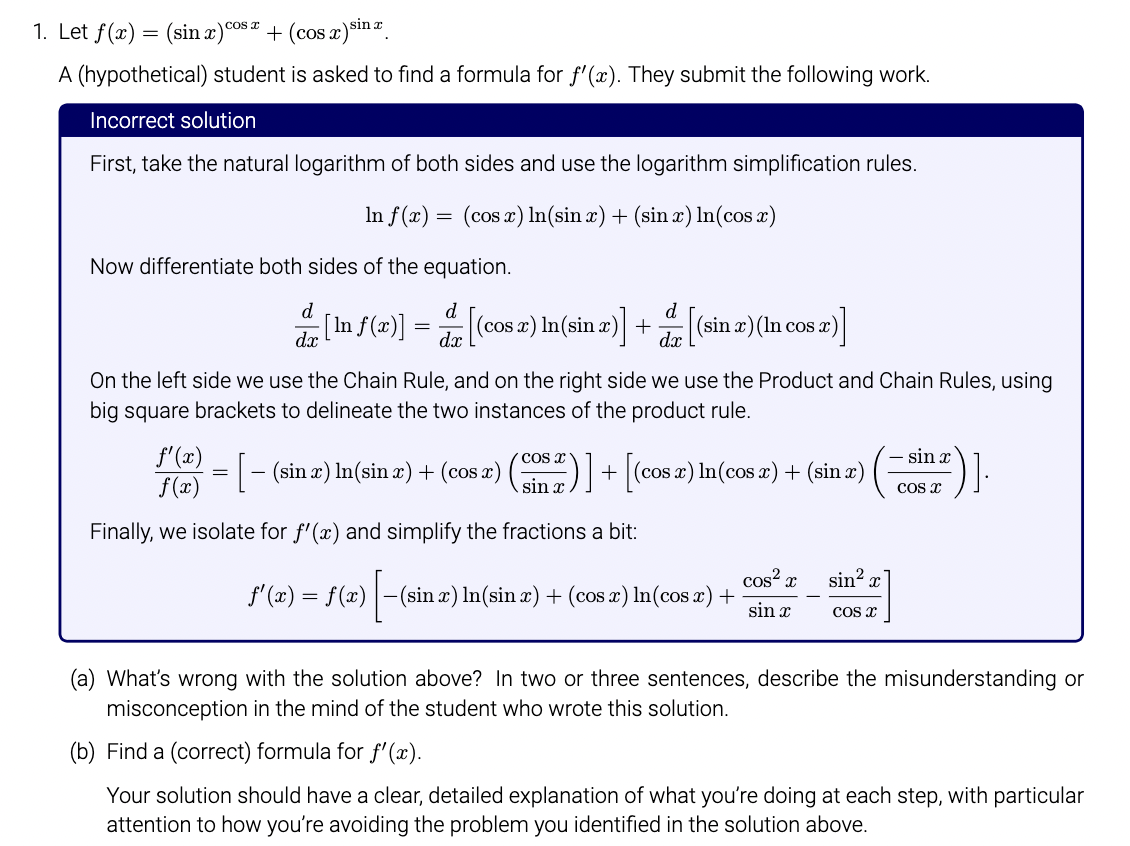
1. Let f(:1:) = (sin 3:)CD\" l (cos 3:)Si\". A (hypothetical) student is asked to find a formula for f'(a:). They submit the following work. Incorrect solution First, take the natural logarithm of both sides and use the logarithm simplication rules. In f(x) = (coax) ln(sin$) + (sinm) 111(006 :13) Now differentiate both sides of the equation. 0! [Inf(m)] = % [(cos 2:) ln(sin 22)] + dim [(sin 2:) (1.11 cos 22)] On the left side we use the Chain Rule, and on the right side we use the Product and Chain Rules, using big square brackets to delineate the two instances of the product rule. \"21;; = [ (sine?) ln(sin :13) l (cos :12) (005:: Finally, we isolate for f'(a:) and simplify the fractions 3 bit: COS .13 81111: )1+[(cosm)]n(cosm)+(sinx)(Sinm)] 0052 :1: sin2 1:] f'($) = f(:r) [(sin 2:) 111(sin x) + (cos a?) ln(cos x) + , SH] .1": COS {LT (a) What's wrong with the solution above? In two or three sentences, describe the misunderstanding or misconception in the mind of the student who wrote this solution. (b) Find a (correct) formula for f'(:::). Your solution should have a clear, detailed explanation of what you're doing at each step, with particular attention to how you're avoiding the problem you identied in the solution above
Step by Step Solution
There are 3 Steps involved in it

Get step-by-step solutions from verified subject matter experts