





Question: 1) Let X : (X1,X2,. . . ,Xn) be a sample of n observations each with a uniform in [(1,6) density H0 0 is an
  1.  1) Let X : (X1,X2,. . . ,Xn) be a sampleof n observations each with a uniform in [(1,6) density H0 0

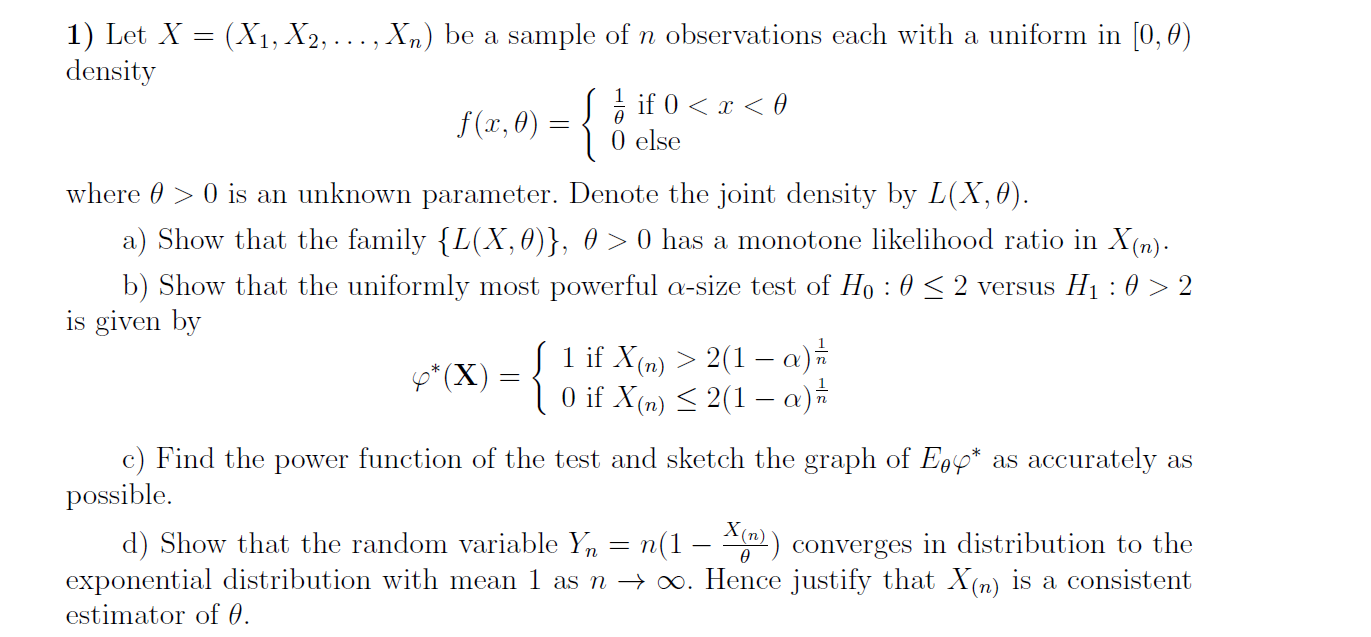
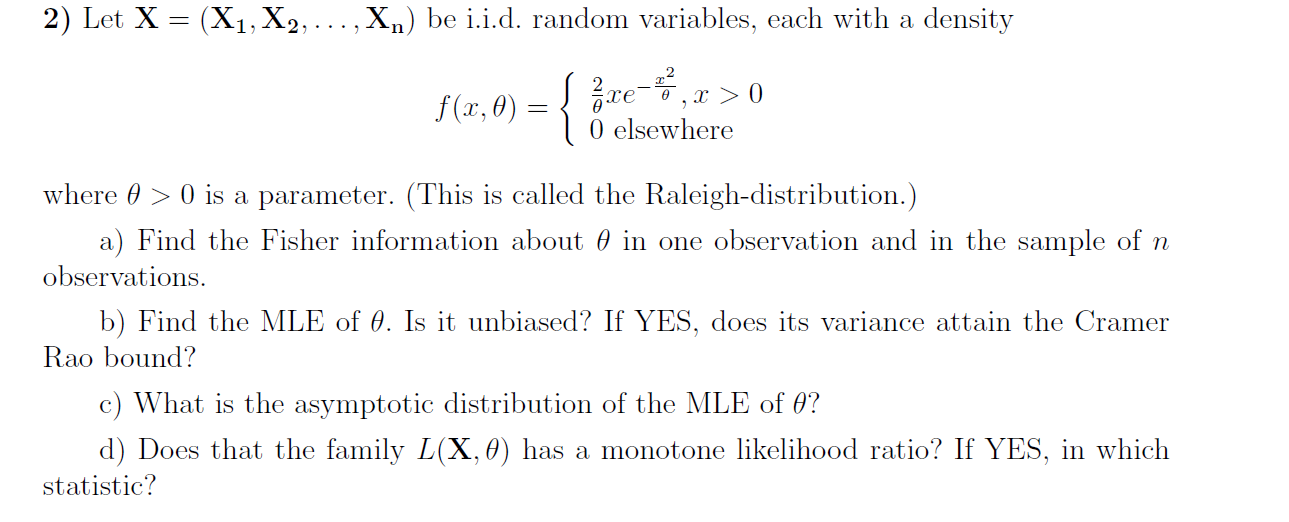
1) Let X : (X1,X2,. . . ,Xn) be a sample of n observations each with a uniform in [(1,6) density H0 0 is an unknown parameter. Denote the joint density by L(X, 6). a) Show that the family {L(X, 6)}, 6 > 0 has a monotone likelihood ratio in X0\"). b) Show that the uniformly most powerful a-size test of H0 : 9 S 2 versus H1 : 9 > 2 is given by lX >2ia) *X : (71) () {OHXWS2UM IH SlH c) Find the power function of the test and sketch the graph of Ema\" as accurately as possible. d) Show that the random variable Yn : n( %) converges in distribution to the exponential distribution with mean 1 as n > 00. Hence justify that X91) is a consistent estimator of 3. 2) Let X : (X1, X2, . . . ,Xn) be i.i.d. random variables, each with a density 2 axeo,$>0 0 elsewhere Lm{ where 9 > 0 is a parameter. (This is called the Raleighdistribution.) a) Find the Fisher information about 19 in one observation and in the sample of n observations. b) Find the MLE of 9. Is it unbiased? If YES, does its variance attain the Cramer Rao bound? c) What is the asymptotic distribution of the MLE of (9? d) Does that the family L(X, 19) has a monotone likelihood ratio? If YES, in which statistic

Step by Step Solution

There are 3 Steps involved in it

1 Expert Approved Answer
Step: 1 Unlock blur-text-image
Question Has Been Solved by an Expert!

Get step-by-step solutions from verified subject matter experts

Step: 2 Unlock
Step: 3 Unlock

Students Have Also Explored These Related Mathematics Questions!