







Question: 1 . Librarian - Attributes: - librarianId ( Primary Key ) : Unique identifier for each librarian. - name: Full name of the librarian. -
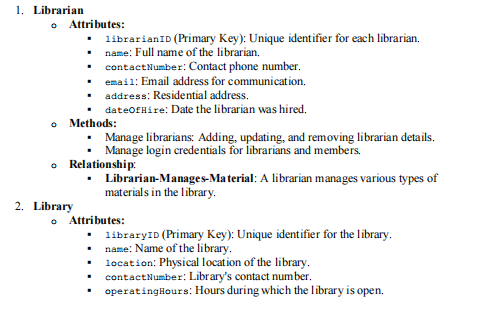
Librarian
Attributes:
librarianId Primary Key: Unique identifier for each librarian.
name: Full name of the librarian.
contactNumber: Contact phone number.
email: Email address for communication.
address: Residential address.
dateoffire: Date the librarian was hired.
Methods:
Manage librarians: Adding, updating, and removing librarian details.
Manage login credentials for librarians and members.
Relationship:
LibrarianManagesMaterial: A librarian manages various types of materials in the library.
Library
Attributes:
libraryID Primary Key: Unique identifier for the library.
name: Name of the library.
location: Physical location of the library.
contactNumber: Library's contact number.
operatingHours: Hours during which the library is open. totalMaterials: Number of materials available in the library.
Relationship:
LibraryHasMaterials: The library contains various materials that can be borrowed or accessed by members.
Member Superclass
Attributes:
memberID Primary Key: Unique ID for each member.
name: Member's full name.
contactNumber: Phone number for contact.
email: Email address for notifications.
membershipType: Indicates if the member is a "Student" or "Staff."
books Issued: Number of books currently issued to the member.
accountstatus: Shows if the member account is active or suspended.
Methods:
Register and manage account details.
View account information and issued books.
Specializations:
Student
Attributes: enrollmentNumber, finemount for outstanding fines
Methods: Pay fine.
Staff
Attributes: staffid, department, designation.
Relationship:
LibraryMembership: Members are registered with the library, giving them access to resources.
Material Superclass
Attributes:
materialID Primary Key: Unique identifier for each material.
title: Title of the material.
publicationYear: Year of publication.
isavailable: Boolean indicating availability.
borrowedCount: Count of times the material has been issued. Methods:
Manage materials: Adding, updating, deleting materials.
Check availability.
Specializations:
Book: Attributes include author, ISBN, genre.
QuestionPaper: Attributes include subject, coursecode, semester.
CDDVD: Attributes include duration, type eg Educational, Entertainment icense Type.
Relationship:
MaterialIssuedToMember: Tracks materials borrowed by members, with issue and return functions.
Guest
Attributes:
guestId Primary Key: Unique identifier for each guest.
name: Full name.
contactNumber: Contact number.
email: Email address.
requestDate: Date when the guest requested registration.
Methods:
Request membership.
Search for materials in the library.
Relationship:
GuestRequestsMembership: Guest users can apply to become members for greater access. Key Relationships and Operations
Relationships:
LibrarianManagesMaterial: Librarians are responsible for adding, updating, and deleting materials.
LibraryHasMaterials: The library contains various materials.
LibraryMembership: Indicates that members are associated with the library and can access resources.
MaterialIssuedToMember: Members can borrow materials, and the library tracks each material's issue and return status.
GuestRequestsMembership: Guests can request membership to access library resources fully.
Operations:
Authentication and Registration: Members can register and authenticate to gain access. Librarians manage these processes.
Material Management: Librarians can add, delete, and update materials in the system.
Borrowing and Returning: Members can search for, issue, and return materials in the library, facilitated by librarians.
Account Management: Members can check their accounts and view issued materials, while librarians handle memberrelated inquiries.
Instructions: Using the details provided above, complete the following tasks:
EER Diagram: Create an ER and Enhanced EntityRelationship EER diagram that accurately represents the entities, attributes, and hierarchical relationships within the Library Management System. Ensure that the diagram includes:
Specializations eg Student and Staff under Member, Book and CDDVD under Material
Relationships and their cardinalities, Primary keys, foreign keys, and relevant attributes for each entity.
Database Schema: Based on your EER diagram, design a database schema that captures the logical structure of the Library Management System. Your schema should detail:
Tables for each entity and specialization,
Columns representing the attributes, including data types and constraints eg primary keys, foreign keys, NOT NULL constraints
Relationships between tables, clearly indicating primary and foreign keys.
Catalog Table
MySQL Implementation: Write MySQL code to implement the database schema.
Step by Step Solution
There are 3 Steps involved in it
1 Expert Approved Answer
Step: 1 Unlock

Question Has Been Solved by an Expert!
Get step-by-step solutions from verified subject matter experts
Step: 2 Unlock
Step: 3 Unlock
 Study Help