







Question: 1. Limited Liability and Risk-Loving Behavior This problem is designed to illustrate the fact that limited liability may induce risk-neutral borrowers into risk-loving behavior. Suppose
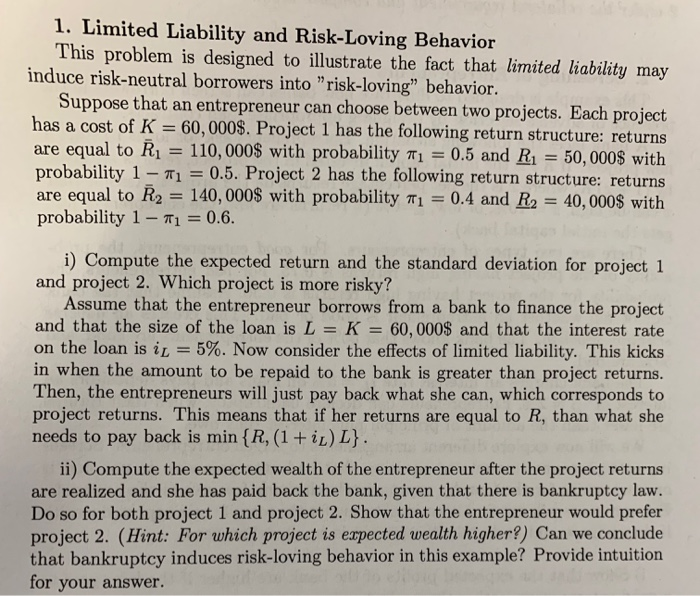
1. Limited Liability and Risk-Loving Behavior This problem is designed to illustrate the fact that limited liability may induce risk-neutral borrowers into "risk-loving" behavior. Suppose that an entrepreneur can choose between two projects. Each project has a cost of K are equal to R 110,000S with probability 0.5 and R probability 1- = are equal to R2 140, 000S with probability T 0.4 and R2 40,000S with probability 1- T0.6. 60,000S. Project 1 has the following return structure: returns 50,000S with 0.5. Project 2 has the following return structure: returns i) Compute the expected return and the standard deviation for project 1 and project 2. Which project is more risky? Assume that the entrepreneur borrows from a bank to finance the project and that the size of the loan is L K-60.000$ and that the interest rate on the loan is 5%. Now consider the effects of limited liability. This kicks in when the amount to be repaid to the bank is greater than project returns. Then, the entrepreneurs will just pay back what she can, which corresponds to project returns. This means that if her returns are equal to R, than what she needs to pay back is min (R, (1 +iL) L) ii) Compute the expected wealth of the entrepreneur after the project returns are realized and she has paid back the bank, given that there is bankruptcy law. Do so for both project 1 and project 2. Show that the entrepreneur would prefer project 2. (Hint: For which project is expected wealth higher?) Can we conclude that bankruptcy induces risk-loving behavior in this example? Provide intuition for your answer. 1. Limited Liability and Risk-Loving Behavior This problem is designed to illustrate the fact that limited liability may induce risk-neutral borrowers into "risk-loving" behavior. Suppose that an entrepreneur can choose between two projects. Each project has a cost of K are equal to R 110,000S with probability 0.5 and R probability 1- = are equal to R2 140, 000S with probability T 0.4 and R2 40,000S with probability 1- T0.6. 60,000S. Project 1 has the following return structure: returns 50,000S with 0.5. Project 2 has the following return structure: returns i) Compute the expected return and the standard deviation for project 1 and project 2. Which project is more risky? Assume that the entrepreneur borrows from a bank to finance the project and that the size of the loan is L K-60.000$ and that the interest rate on the loan is 5%. Now consider the effects of limited liability. This kicks in when the amount to be repaid to the bank is greater than project returns. Then, the entrepreneurs will just pay back what she can, which corresponds to project returns. This means that if her returns are equal to R, than what she needs to pay back is min (R, (1 +iL) L) ii) Compute the expected wealth of the entrepreneur after the project returns are realized and she has paid back the bank, given that there is bankruptcy law. Do so for both project 1 and project 2. Show that the entrepreneur would prefer project 2. (Hint: For which project is expected wealth higher?) Can we conclude that bankruptcy induces risk-loving behavior in this example? Provide intuition for your
Step by Step Solution
There are 3 Steps involved in it

Get step-by-step solutions from verified subject matter experts
 Study Help