







Question: (1) Name three programming languages in the Object-Oriented paradigm. (2) A class is... ......... (2 3 lines description/definition..... (3) Fill in the blanks in each
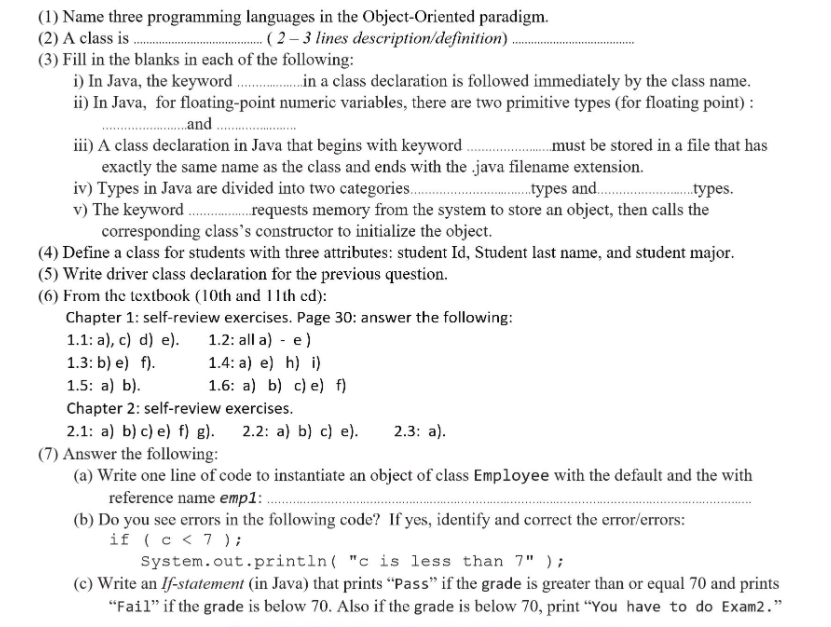
(1) Name three programming languages in the Object-Oriented paradigm. (2) A class is... ......... (2 3 lines description/definition..... (3) Fill in the blanks in each of the following: i) In Java, the keyword. ...in a class declaration is followed immediately by the class name. ii) In Java, for floating-point numeric variables, there are two primitive types (for floating point) : ........and...... iii) A class declaration in Java that begins with keyword ...must be stored in a file that has exactly the same name as the class and ends with the java filename extension. iv) Types in Java are divided into two categories....... ...types and.. types. v) The keyword............requests memory from the system to store an object, then calls the corresponding class's constructor to initialize the object. (4) Define a class for students with three attributes: student Id, Student last name, and student major. (5) Write driver class declaration for the previous question. (6) From the textbook (10th and 11th ed): Chapter 1: self-review exercises. Page 30: answer the following: 1.1: a), c) d) e). 1.2: all a) - e) 1.3.b) e) f). 1.4: a) e) h) i) 1.5: a) b). 1.6: a) b) c) e) f) Chapter 2: self-review exercises. 2.1: a) b) c) e) f) g). 2.2: a) b) c) e). 2.3: a). (7) Answer the following: (a) Write one line of code to instantiate an object of class Employee with the default and the with reference name emp1: ..... (b) Do you see errors in the following code? If yes, identify and correct the error/errors: if (
Step by Step Solution
There are 3 Steps involved in it

Get step-by-step solutions from verified subject matter experts
 Study Help