



Question: 1. Nusselt number is a dimensionless number that is commonly used in representing the heat transfer performance of devices/systems. Show derivation on how Nusselt
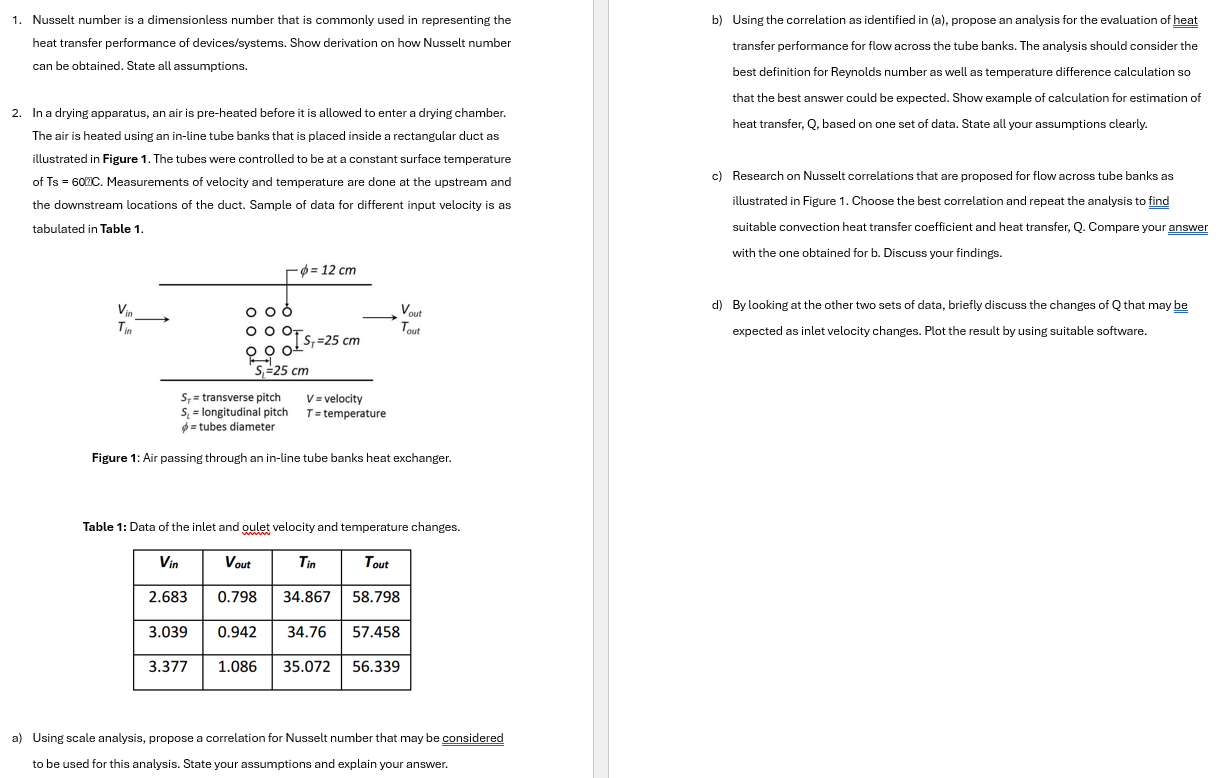
1. Nusselt number is a dimensionless number that is commonly used in representing the heat transfer performance of devices/systems. Show derivation on how Nusselt number can be obtained. State all assumptions. 2. In a drying apparatus, an air is pre-heated before it is allowed to enter a drying chamber. The air is heated using an in-line tube banks that is placed inside a rectangular duct as illustrated in Figure 1. The tubes were controlled to be at a constant surface temperature of Ts = 60 C. Measurements of velocity and temperature are done at the upstream and the downstream locations of the duct. Sample of data for different input velocity is as tabulated in Table 1. Vin Tin Vin 2.683 -= 12 cm ooo O O OT IS,=25 cm 200+ S=25 cm S, transverse pitch S = longitudinal pitch -tubes diameter Figure 1: Air passing through an in-line tube banks heat exchanger. 3.039 3.377 Table 1: Data of the inlet and oulet velocity and temperature changes. Tout Vout Tin 0.798 34.867 58.798 34.76 57.458 56.339 0.942 V = velocity T = temperature Vout Tout 1.086 35.072 a) Using scale analysis, propose a correlation for Nusselt number that may be considered to be used for this analysis. State your assumptions and explain your answer. b) Using the correlation as identified in (a), propose an analysis for the evaluation of heat transfer performance for flow across the tube banks. The analysis should consider the best definition for Reynolds number as well as temperature difference calculation so that the best answer could be expected. Show example of calculation for estimation of heat transfer, Q, based on one set of data. State all your assumptions clearly. c) Research on Nusselt correlations that are proposed for flow across tube banks as illustrated in Figure 1. Choose the best correlation and repeat the analysis to find suitable convection heat transfer coefficient and heat transfer, Q. Compare your answer with the one obtained for b. Discuss your findings. d) By looking at the other two sets of data, briefly discuss the changes of Q that may be expected as inlet velocity changes. Plot the result by using suitable software.
Step by Step Solution
3.42 Rating (142 Votes )
There are 3 Steps involved in it
a Derivation of Nusselt Number The Nusselt number Nu is a dimensionless number used to characterize the convective heat transfer performance of a system It can be derived using scale analysis and some ... View full answer

Get step-by-step solutions from verified subject matter experts