







Question: 1 of20 The least expected value in each contingency table cell in order for a chi-square test to be effective is... 5 4 3 2
1 of20
The least expected value in each contingency table cell in order for a chi-square test to be effective is...
| 5 | |
| 4 | |
| 3 | |
| 2 |
2 of20
The null hypothesis for the chi-square goodness-of-fit test states that the distribution of
| cases for each group is equal to the expected distribution based on theory/knowledge of the population. | |
| cases for each group is not equal to the expected distribution based on theory/knowledge of the population. | |
| sample means is equal to expectation. | |
| sample means for each group is equal. |
3 of20
The number of accidents in a factory for each month is provided:
Jan | Feb | Mar | Apr | May | June | July | Aug | Sep | Oct | Nov | Dec |
25 | 28 | 24 | 18 | 17 | 27 | 9 | 18 | 22 | 14 | 12 | 26 |
Which hypothesis test would be appropriate for determining whether some months have a greater number of accidents than others?
| Least-squares regression | |
| Two-sample z-test for means | |
| Chi-square test for goodness of fit | |
| Chi-square test for independence | |
| One-sample z-test for means |
4 of20
The degrees of freedom for a 2 x 2 contingency table for the chi-square test of independence equal
| 4 | |
| 1 | |
| 2 | |
| 3 |
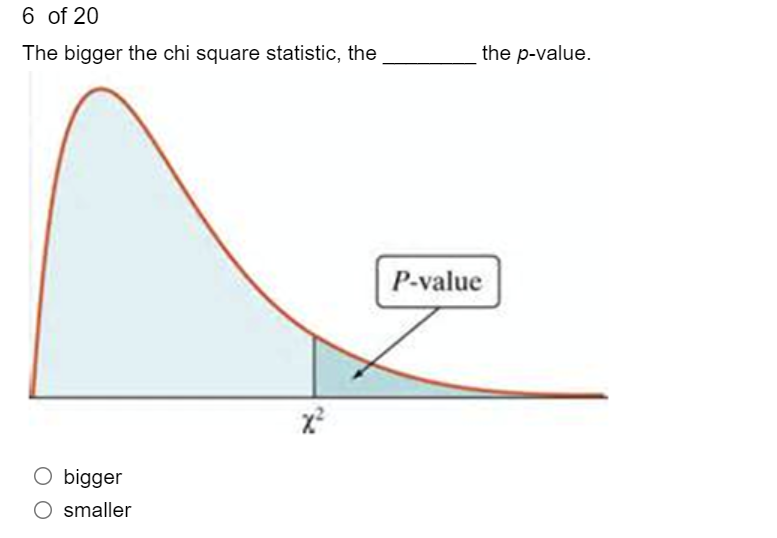
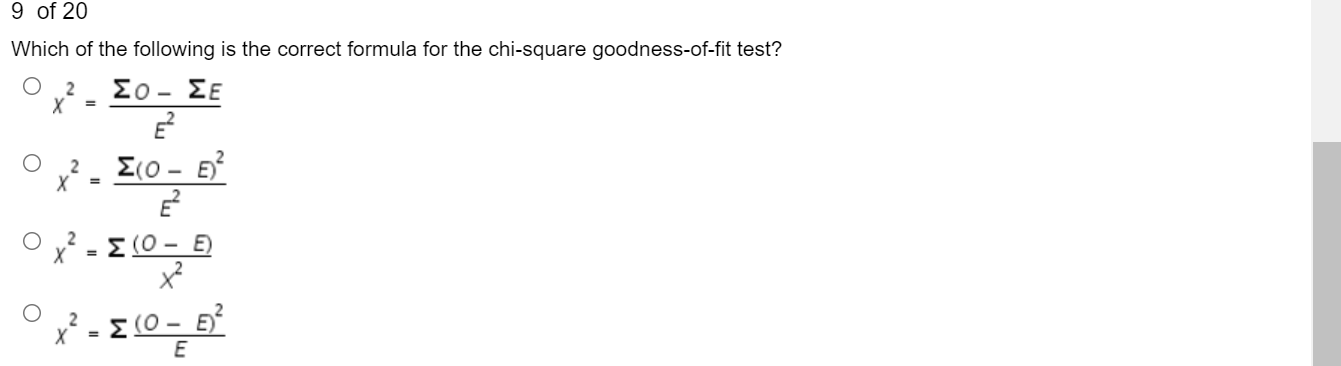
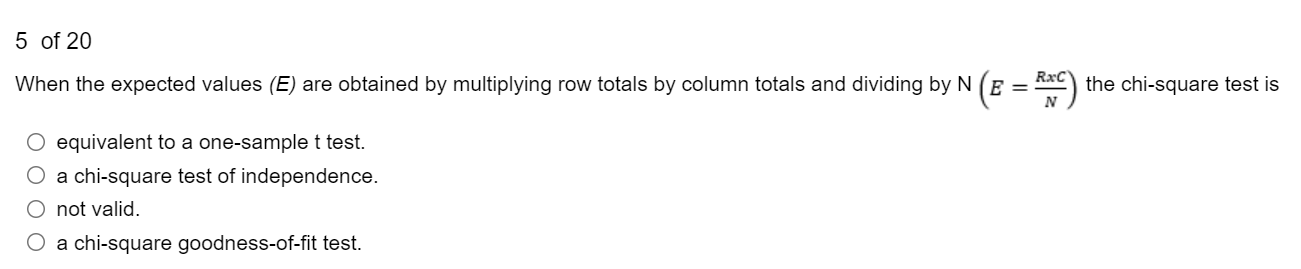
6 of 20 The bigger the chi square statistic, the the p-value. P-value O bigger O smaller9 of 20 Which of the following is the correct formula for the chi-square goodness-of-fit test? O EO - EE E O X E(0 - E) E O 2 = E (0 - E) O X' = [(0 - E) E\f5 of 20 When the expected values (E) are obtained by multiplying row totals by column totals and dividing by N E = x the chi-square test is N O equivalent to a one-sample t test. O a chi-square test of independence. O not valid. O a chi-square goodness-of-fit test
Step by Step Solution
There are 3 Steps involved in it

Get step-by-step solutions from verified subject matter experts
 Study Help