





Question: 1. Once again consider human resource management problem discussed in class. Namely, a company is planning their hiring strategy for the next T time periods.
1. Once again consider human resource management
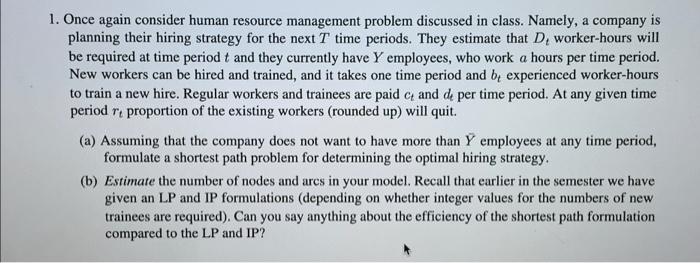
1. Once again consider human resource management problem discussed in class. Namely, a company is planning their hiring strategy for the next T time periods. They estimate that D, worker-hours will be required at time period t and they currently have y employees, who work a hours per time period. New workers can be hired and trained, and it takes one time period and be experienced worker-hours to train a new hire. Regular workers and trainees are paid c and de per time period. At any given time period re proportion of the existing workers (rounded up) will quit. (a) Assuming that the company does not want to have more than Y employees at any time period, formulate a shortest path problem for determining the optimal hiring strategy. (b) Estimate the number of nodes and arcs in your model. Recall that earlier in the semester we have given an LP and IP formulations (depending on whether integer values for the numbers of new trainees are required). Can you say anything about the efficiency of the shortest path formulation compared to the LP and IP? 1. Once again consider human resource management problem discussed in class. Namely, a company is planning their hiring strategy for the next T time periods. They estimate that D, worker-hours will be required at time period t and they currently have y employees, who work a hours per time period. New workers can be hired and trained, and it takes one time period and be experienced worker-hours to train a new hire. Regular workers and trainees are paid c and de per time period. At any given time period re proportion of the existing workers (rounded up) will quit. (a) Assuming that the company does not want to have more than Y employees at any time period, formulate a shortest path problem for determining the optimal hiring strategy. (b) Estimate the number of nodes and arcs in your model. Recall that earlier in the semester we have given an LP and IP formulations (depending on whether integer values for the numbers of new trainees are required). Can you say anything about the efficiency of the shortest path formulation compared to the LP and IP

Step by Step Solution

There are 3 Steps involved in it

1 Expert Approved Answer
Step: 1 Unlock blur-text-image

Question Has Been Solved by an Expert!

Get step-by-step solutions from verified subject matter experts

Step: 2 Unlock
Step: 3 Unlock

Students Have Also Explored These Related General Management Questions!