







Question: 1. Open a new spreadsheet. 2. Enter: a t in cell A1 0 t+h in cell A2 a t) in cell Cl 0 f(t+h) in
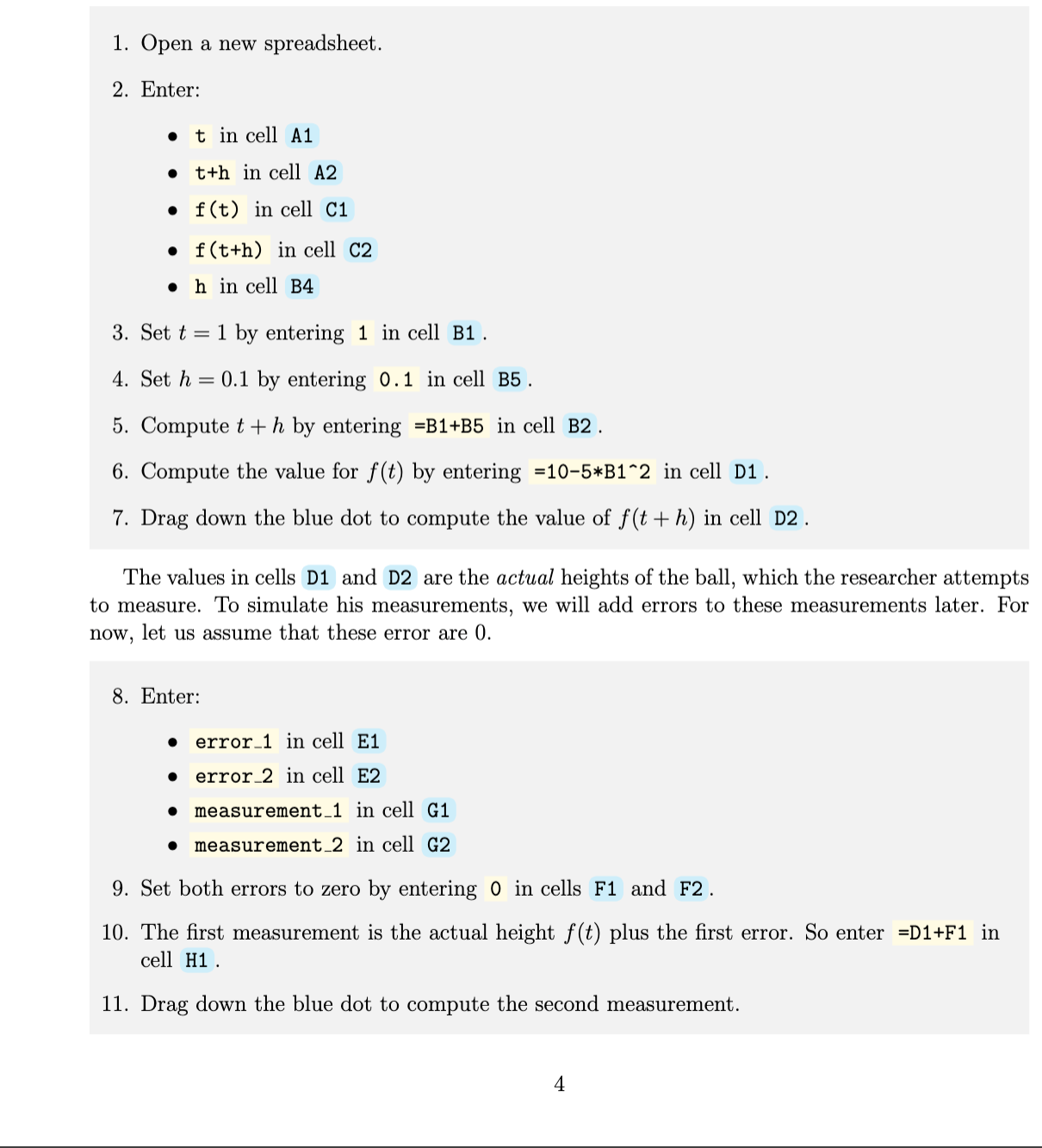
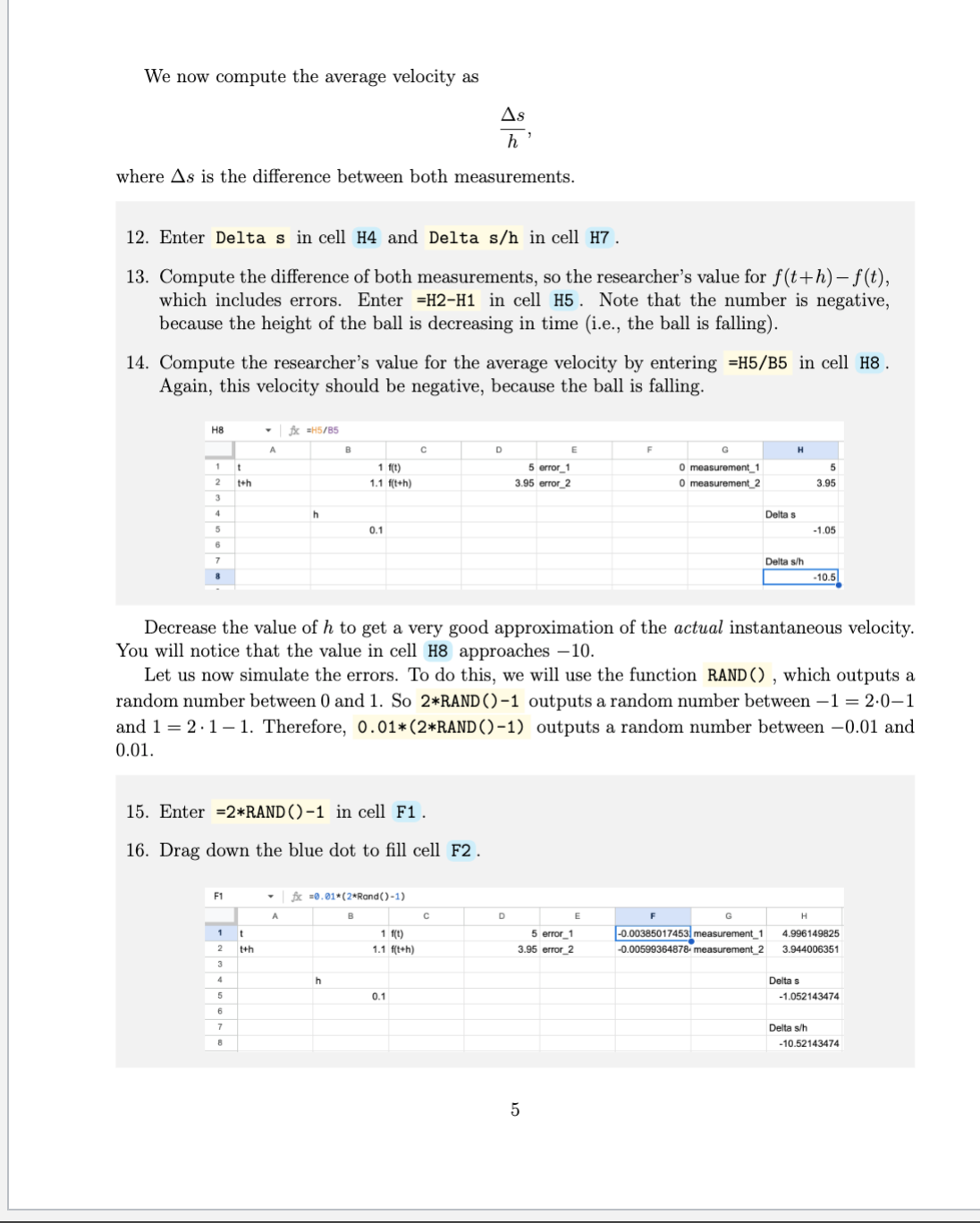
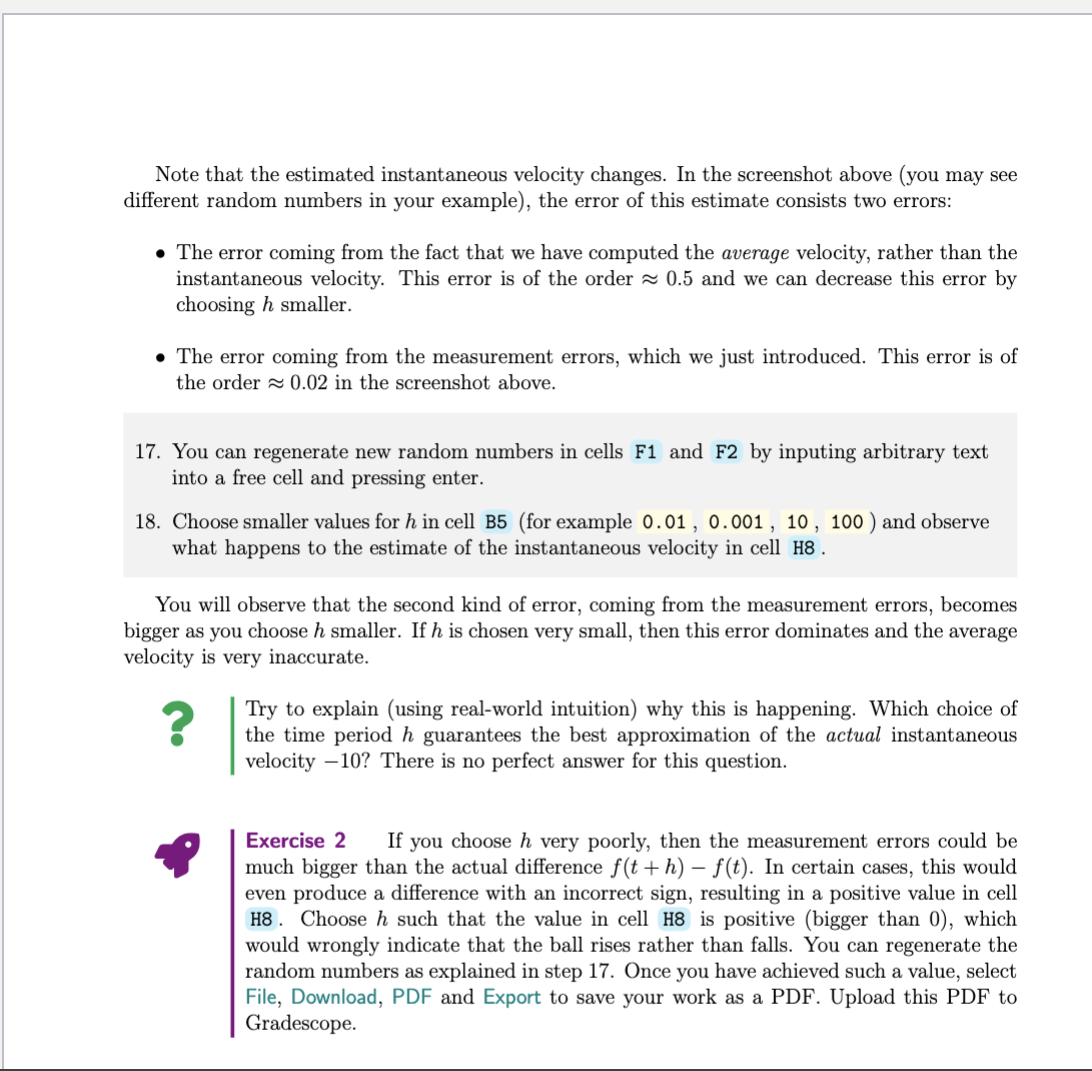
1. Open a new spreadsheet. 2. Enter: a t in cell A1 0 t+h in cell A2 a t) in cell Cl 0 f(t+h) in cell C2 0 h in cell B4 3. Set t = 1 by entering 1 in cell Bl . 4. Set h. = 0.1 by entering 0.1 in cell B5 . 5. Compute t + h by entering =B1+BS in cell B2 . 6. Compute the value for f (t) by entering =10-5*B1\"2 in cell D1 . 7. Drag down the blue dot to compute the value of f (t + h) in cell D2 . The values in cells D1 and D2 are the actual heights of the ball, which the researcher attempts to measure. To simulate his measurements, we will add errors to these measurements later. For now, let us assume that these error are 0. 8. Enter: 0 error_1 in cell E1 o errorj in cell E2 0 measurement_1 in cell G1 0 measurement} in cell G2 9. Set both errors to zero by entering O in cells F1 and F2 . 10. The rst measurement is the actual height t) plus the rst error. So enter =D1+F1 in cell H1 . 11. Drag down the blue dot to compute the second measurement. We now compute the average velocity as As h where As is the difference between both measurements. 12. Enter Delta s in cell H4 and Delta s/h in cell H7 . 13. Compute the difference of both measurements, so the researcher's value for f(tth) - f(t), which includes errors. Enter =H2-H1 in cell H5 . Note that the number is negative, because the height of the ball is decreasing in time (i.e., the ball is falling). 14. Compute the researcher's value for the average velocity by entering =H5/B5 in cell H8 . Again, this velocity should be negative, because the ball is falling. H8 Ac =H5/85 C 1 f(t) 5 error_1 0 measurement_1 Itth 1.1 f(t+h) 3.95 error_2 0 measurement_2 3.95 Delta s 0.1 -1.05 Delta s/h -10.5 Decrease the value of h to get a very good approximation of the actual instantaneous velocity. You will notice that the value in cell H8 approaches -10. Let us now simulate the errors. To do this, we will use the function RAND () , which outputs a random number between 0 and 1. So 2*RAND()-1 outputs a random number between -1 = 2.0-1 and 1 = 2 . 1 - 1. Therefore, 0.01*(2*RAND()-1) outputs a random number between -0.01 and 0.01. 15. Enter =2*RAND ()-1 in cell F1 . 16. Drag down the blue dot to fill cell F2 . Ac =0. 01*(2*Rand()-1) C D 1 f(t) 5 error_1 -0.00385017453) measurement_1 4.996149825 1.1 f(t+h) 3.95 error 2 -0.00599364878. measurement 2 3.944006351 Delta s 0.1 -1.052143474 Delta s/h -10.52143474 5Note that the estimated instantaneous velocity changes. In the screenshot above (you may see dierent random numbers in your example), the error of this estimate consists two errors: 0 The error coming from the fact that we have computed the average velocity, rather than the instantaneous velocity. This error is of the order a 0.5 and we can decrease this error by choosing it smaller. 0 The error coming from the measurement errors, which we just introduced. This error is of the order as 0.02 in the screenshot above. 17. You can regenerate new random numbers in cells F1 and F2 by inputing arbitrary text into a free cell and pressing enter. 18. Choose smaller values for h in cell 35 (for example 0.01 , 0.001 , 10 , 100 ) and observe what happens to the estimate of the instantaneous velocity in cell H8 . You will observe that the second kind of error, coming from the measurement errors, becomes bigger as you choose h smaller. If h is chosen very small, then this error dominates and the average velocity is very inaccurate. g Try to explain (using real-world intuition) why this is happening. Which choice of . the time period it guarantees the best approximation of the actual instantaneous velocity 10? There is no perfect answer for this question. Exercise 2 If you choose h very poorly, then the measurement errors could be ' much bigger than the actual difference f (t + h) f (t) In certain cases, this would even produce a dierence with an incorrect sign, resulting in a positive value in cell H8 . Choose h such that the value in cell H8 is positive (bigger than 0), which would wrongly indicate that the ball rises rather than falls. You can regenerate the random numbers as explained in step 17. Once you have achieved such a value, select File, Download, PDF and Export to save your work as a PDF. Upload this PDF to Gradescope
Step by Step Solution
There are 3 Steps involved in it

Get step-by-step solutions from verified subject matter experts
 Study Help