







Question: 1. Partition Function Write a little program (e.g., in PHYTHON) to evaluate the partition function for atomic hydrogen, as a function of gas temperature k=1
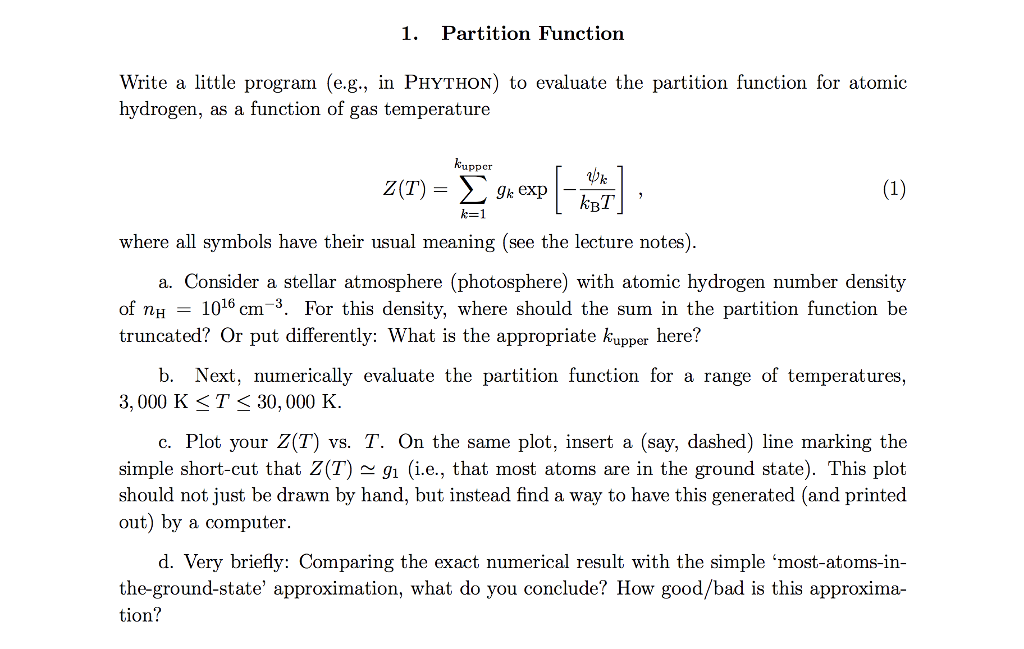
1. Partition Function Write a little program (e.g., in PHYTHON) to evaluate the partition function for atomic hydrogen, as a function of gas temperature k=1 where all symbols have their usual meaning (see the lecture notes). a. Consider a stellar atmosphere (photosphere) with atomic hydrogen number density of nH-1016cm-3. For this density, where should the sum in the partition function be truncated? Or put differently: What is the appropriate kupper here? b. Next, numerically evaluate the partition function for a range of temperatures, 3,000 K 3 T 30,000 K c. Plot your Z(T) vs. T. On the same plot, insert a (say, dashed) line marking the simple short-cut that Z(T) J1 (i.e., that most atoms are in the ground state). This plot should not just be drawn by hand, but instead find a way to have this generated (and printed out) by a computer. d. Very briefly: Comparing the exact numerical result with the simple 'most-atoms-in the-ground-state' approximation, what do you conclude? How good/bad is this approxima- tion? 1. Partition Function Write a little program (e.g., in PHYTHON) to evaluate the partition function for atomic hydrogen, as a function of gas temperature k=1 where all symbols have their usual meaning (see the lecture notes). a. Consider a stellar atmosphere (photosphere) with atomic hydrogen number density of nH-1016cm-3. For this density, where should the sum in the partition function be truncated? Or put differently: What is the appropriate kupper here? b. Next, numerically evaluate the partition function for a range of temperatures, 3,000 K 3 T 30,000 K c. Plot your Z(T) vs. T. On the same plot, insert a (say, dashed) line marking the simple short-cut that Z(T) J1 (i.e., that most atoms are in the ground state). This plot should not just be drawn by hand, but instead find a way to have this generated (and printed out) by a computer. d. Very briefly: Comparing the exact numerical result with the simple 'most-atoms-in the-ground-state' approximation, what do you conclude? How good/bad is this approxima- tion
Step by Step Solution
There are 3 Steps involved in it

Get step-by-step solutions from verified subject matter experts
 Study Help