







Question: 1) Phase changes occur at constant temperature and pressure. With reference to Gibbs free energy, and using the terms endothermic and exothermic, where appropriate. (Hint:
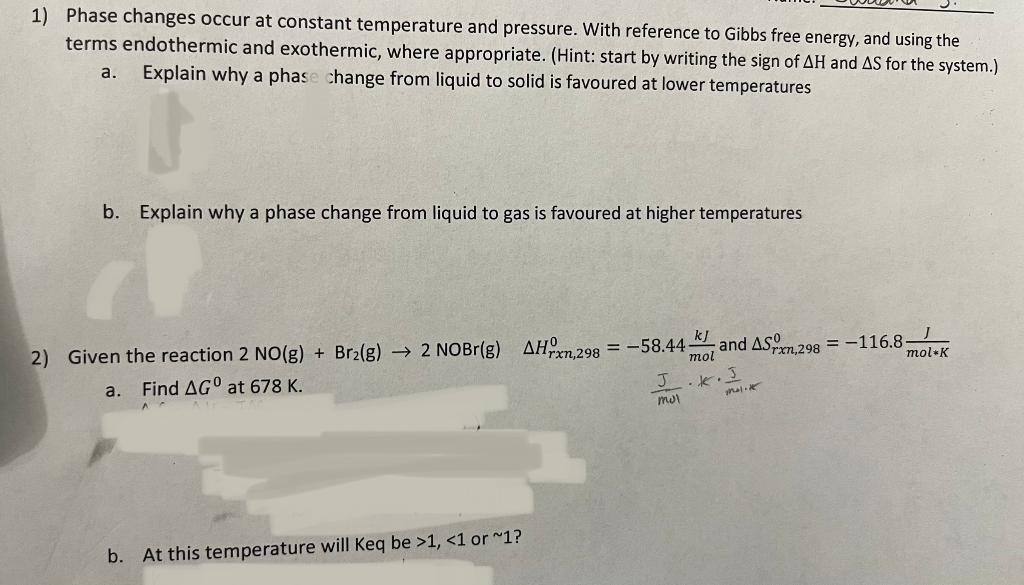
1) Phase changes occur at constant temperature and pressure. With reference to Gibbs free energy, and using the terms endothermic and exothermic, where appropriate. (Hint: start by writing the sign of H and S for the system.) a. Explain why a phas change from liquid to solid is favoured at lower temperatures b. Explain why a phase change from liquid to gas is favoured at higher temperatures 2) Given the reaction 2NO(g)+Br2(g)2NOBr(g)Hrxn,2980=58.44molkJ and Srxn,2980=116.8molKJ a. Find G0 at 678K. mulJkmalkJ b. At this temperature will Keq be >1,
Step by Step Solution
There are 3 Steps involved in it
1 Expert Approved Answer
Step: 1 Unlock

Question Has Been Solved by an Expert!
Get step-by-step solutions from verified subject matter experts
Step: 2 Unlock
Step: 3 Unlock
 Study Help