







Question: 1. Please list some Relevant Facts 2. A Problem Statement 3. And A Recommendation, preferably using some concepts like these (if you can). Distribution Process/
1. Please list some Relevant Facts
2. A Problem Statement
3. And A Recommendation, preferably using some concepts like these (if you can).
Distribution Process/ Structure- Trading Companies, Export Trading, Agent/ Merchant Middlemen.
Middlemen- Identify Markets, Specify Trade Goods, Specify Financial and Personal Requirements, Identify Control
Complimentary Marketing- Piggybacking, Expand or Complete Line, Use Excess Resources Seasonally
Integrated Market Communication - Ads, Promos, Trade Shows, Personal Selling, PR.
International Ad Campain - Market research, Goals, Message, Media, Budget, Evaluate Coding/ Decoding Message
Info, Encode, Message, Decode, Receive, Feedback, Noise
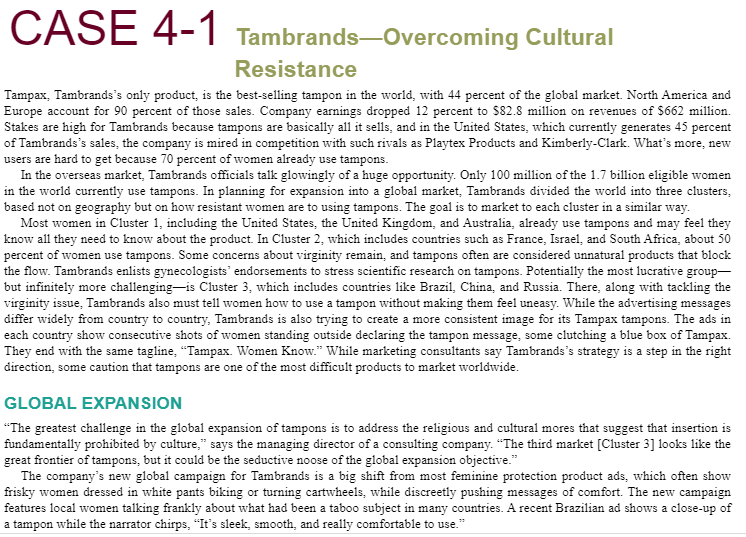
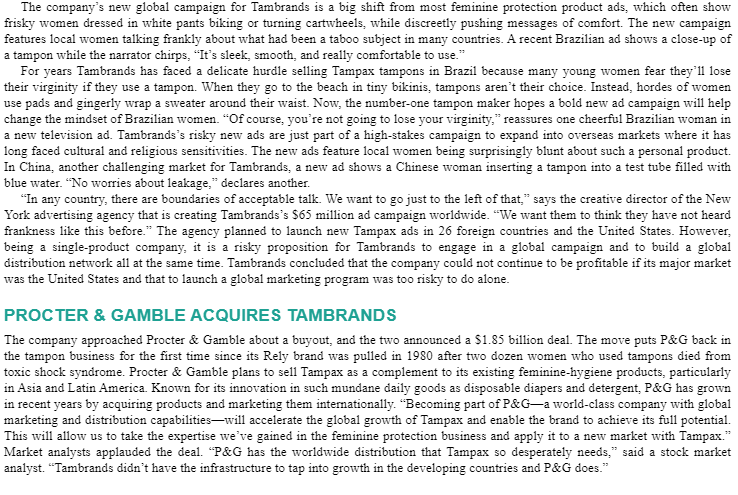
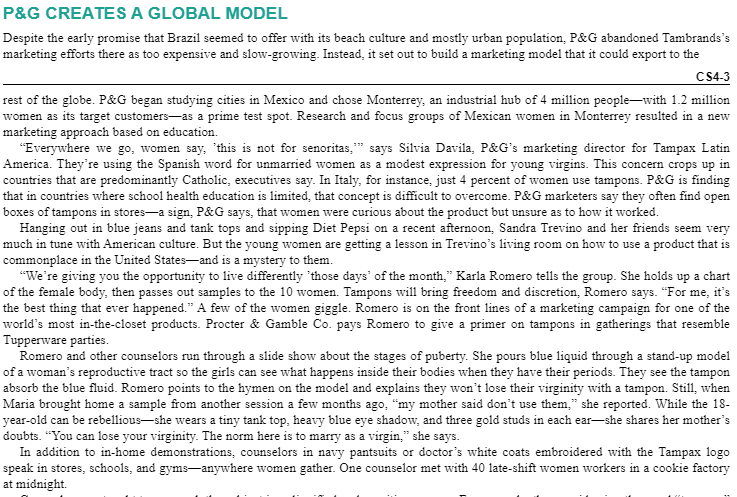
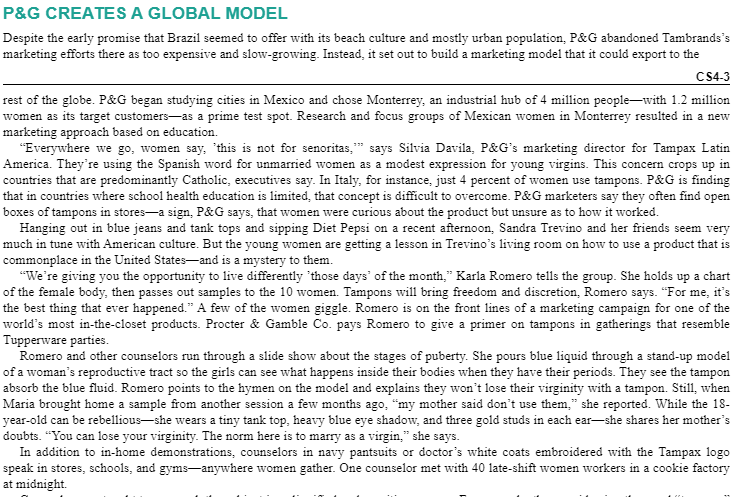
CASE 4-1 TambrandsOvercoming Cultural Resistance Tampax, Tambrands's only product, is the best-selling tampon in the world, with 44 percent of the global market. North America and Europe account for 90 percent of those sales. Company earnings dropped 12 percent to $82.8 million on revenues of $662 million. Stakes are high for Tambrands because tampons are basically all it sells, and in the United States, which currently generates 45 percent of Tambrands's sales, the company is mired in competition with such rivals as Playtex Products and Kimberly-Clark. What's more, new users are hard to get because 70 percent of women already use tampons. In the overseas market. Tambrands officials talk glowingly of a huge opportunity. Only 100 million of the 1.7 billion eligible women in the world currently use tampons. In planning for expansion into a global market. Tambrands divided the world into three clusters, based not on geography but on how resistant women are to using tampons. The goal is to market to each cluster in a similar way. Most women in Cluster 1, including the United States, the United Kingdom, and Australia, already use tampons and may feel they know all they need to know about the product. In Cluster 2, which includes countries such as France, Israel, and South Africa, about 50 percent of women use tampons. Some concerns about virginity remain, and tampons often are considered unnatural products that block the flow. Tambrands enlists gynecologists' endorsements to stress scientific research on tampons. Potentially the most lucrative group, but infinitely more challengingis Cluster 3, which includes countries like Brazil, China, and Russia. There, along with tackling the virginity issue. Tambrands also must tell women how to use a tampon without making them feel uneasy. While the advertising messages differ widely from country to country, Tambrands is also trying to create a more consistent image for its Tampax tampons. The ads in each country show consecutive shots of women standing outside declaring the tampon message, some clutching a blue box of Tampax. They end with the same tagline, "Tampax. Women Know." While marketing consultants say Tambrands's strategy is a step in the right direction, some caution that tampons are one of the most difficult products to market worldwide. GLOBAL EXPANSION "The greatest challenge in the global expansion of tampons is to address the religious and cultural mores that suggest that insertion is fundamentally prohibited by culture," says the managing director of a consulting company. "The third market (Cluster 3] looks like the great frontier of tampons, but it could be the seductive noose of the global expansion objective." The company's new global campaign for Tambrands is a big shift from most feminine protection product ads, which often show frisky women dressed in white pants biking or turning cartwheels, while discreetly pushing messages of comfort. The new campaign features local women talking frankly about what had been a taboo subject in many countries. A recent Brazilian ad shows a close-up of a tampon while the narrator chirps, It's sleek, smooth, and really comfortable to use." The company's new global campaign for Tambrands is a big shift from most feminine protection product ads, which often show frisky women dressed in white pants biking or turning cartwheels, while discreetly pushing messages of comfort. The new campaign features local women talking frankly about what had been a taboo subject in many countries. A recent Brazilian ad shows a close-up of a tampon while the narrator chirps, It's sleek, smooth, and really comfortable to use." For years Tambrands has faced a delicate hurdle selling Tampax tampons in Brazil because many young women fear they'll lose their virginity if they use a tampon. When they go to the beach in tiny bikinis, tampons aren't their choice. Instead, hordes of women use pads and gingerly wrap a sweater around their waist. Now, the number-one tampon maker hopes a bold new ad campaign will help change the mindset of Brazilian women. Of course, you're not going to lose your virginity," reassures one cheerful Brazilian woman in a new television ad. Tambrands's risky new ads are just part of a high-stakes campaign to expand into overseas markets where it has long faced cultural and religious sensitivities. The new ads feature local women being surprisingly blunt about such a personal product. In China, another challenging market for Tambrands, a new ad shows a Chinese woman inserting a tampon into a test tube filled with blue water. "No worries about leakage," declares another. "In any country, there are boundaries of acceptable talk. We want to go just to the left of that," says the creative director of the New York advertising agency that is creating Tambrands's $65 million ad campaign worldwide. We want them to think they have not heard frankness like this before." The agency planned to launch new Tampax ads in 26 foreign countries and the United States. However, being a single-product company, it is a risky proposition for Tambrands to engage in a global campaign and to build a global distribution network all at the same time. Tambrands concluded that the company could not continue to be profitable if its major market was the United States and that to launch a global marketing program was too risky to do alone. PROCTER & GAMBLE ACQUIRES TAMBRANDS The company approached Procter & Gamble about a buyout, and the two announced a $1.85 billion deal. The move puts P&G back in the tampon business for the first time since its Rely brand was pulled in 1980 after two dozen women who used tampons died from toxic shock syndrome. Procter & Gamble plans to sell Tampax as a complement to its existing feminine-hygiene products, particularly in Asia and Latin America. Known for its innovation in such mundane daily goods as disposable diapers and detergent. P&G has grown in recent years by acquiring products and marketing them internationally. Becoming part of P&Ga world-class company with global marketing and distribution capabilitieswill accelerate the global growth of Tampax and enable the brand to achieve its full potential. This will allow us to take the expertise we've gained in the feminine protection business and apply it to a new market with Tampax." Market analysts applauded the deal. P&G has the worldwide distribution that Tampax so desperately needs," said a stock market analyst. Tambrands didn't have the infrastructure to tap into growth in the developing countries and P&G does." P&G CREATES A GLOBAL MODEL Despite the early promise that Brazil seemed to offer with its beach culture and mostly urban population, P&G abandoned Tambrands's marketing efforts there as too expensive and slow-growing. Instead, it set out to build a marketing model that it could export to the CS4-3 rest of the globe. P&G began studying cities in Mexico and chose Monterrey, an industrial hub of 4 million peoplewith 1.2 million women as its target customersas a prime test spot. Research and focus groups of Mexican women in Monterrey resulted in a new marketing approach based on education. "Everywhere we go, women say, 'this is not for senoritas," says Silvia Davila. P&G's marketing director for Tampax Latin America. They're using the Spanish word for unmarried women as a modest expression for young virgins. This concern crops up in countries that are predominantly Catholic, executives say. In Italy, for instance, just 4 percent of women use tampons. P&G is finding that in countries where school health education is limited that concept is difficult to overcome. P&G marketers say they often find open boxes of tampons in storesa sign, P&G says that women were curious about the product but unsure as to how it worked. Hanging out in blue jeans and tank tops and sipping Diet Pepsi on a recent afternoon, Sandra Trevino and her friends seem very much in tune with American culture. But the young women are getting a lesson in Trevino's living room on how to use a product that is commonplace in the United Statesand is a mystery to them. "We're giving you the opportunity to live differently those days of the month," Karla Romero tells the group. She holds up a chart of the female body, then passes out samples to the 10 women. Tampons will bring freedom and discretion, Romero says. "For me, it's the best thing that ever happened." A few of the women giggle. Romero is on the front lines of a marketing campaign for one of the world's most in-the-closet products. Procter & Gamble Co. pays Romero to give a primer on tampons in gatherings that resemble Tupperware parties. Romero and other counselors run through a slide show about the stages of puberty. She pours blue liquid through a stand-up model of a woman's reproductive tract so the girls can see what happens inside their bodies when they have their periods. They see the tampon absorb the blue fluid. Romero points to the hymen on the model and explains they won't lose their virginity with a tampon. Still, when Maria brought home a sample from another session a few months ago, "my mother said don't use them, she reported. While the 18- year-old can be rebelliousshe wears a tiny tank top, heavy blue eye shadow, and three gold studs in each ear-she shares her mother's doubts. "You can lose your virginity. The norm here is to marry as a virgin," she says. In addition to in-home demonstrations, counselors in navy pantsuits or doctor's white coats embroidered with the Tampax logo speak in stores, schools, and gyms-anywhere women gather. One counselor met with 40 late-shift women workers in a cookie factory at midnight P&G CREATES A GLOBAL MODEL Despite the early promise that Brazil seemed to offer with its beach culture and mostly urban population, P&G abandoned Tambrands's marketing efforts there as too expensive and slow-growing. Instead, it set out to build a marketing model that it could export to the CS4-3 rest of the globe. P&G began studying cities in Mexico and chose Monterrey, an industrial hub of 4 million peoplewith 1.2 million women as its target customersas a prime test spot. Research and focus groups of Mexican women in Monterrey resulted in a new marketing approach based on education. "Everywhere we go, women say, 'this is not for senoritas," says Silvia Davila. P&G's marketing director for Tampax Latin America. They're using the Spanish word for unmarried women as a modest expression for young virgins. This concern crops up in countries that are predominantly Catholic, executives say. In Italy, for instance, just 4 percent of women use tampons. P&G is finding that in countries where school health education is limited that concept is difficult to overcome. P&G marketers say they often find open boxes of tampons in storesa sign, P&G says that women were curious about the product but unsure as to how it worked. Hanging out in blue jeans and tank tops and sipping Diet Pepsi on a recent afternoon, Sandra Trevino and her friends seem very much in tune with American culture. But the young women are getting a lesson in Trevino's living room on how to use a product that is commonplace in the United Statesand is a mystery to them. "We're giving you the opportunity to live differently those days of the month," Karla Romero tells the group. She holds up a chart of the female body, then passes out samples to the 10 women. Tampons will bring freedom and discretion, Romero says. "For me, it's the best thing that ever happened." A few of the women giggle. Romero is on the front lines of a marketing campaign for one of the world's most in-the-closet products. Procter & Gamble Co. pays Romero to give a primer on tampons in gatherings that resemble Tupperware parties. Romero and other counselors run through a slide show about the stages of puberty. She pours blue liquid through a stand-up model of a woman's reproductive tract so the girls can see what happens inside their bodies when they have their periods. They see the tampon absorb the blue fluid. Romero points to the hymen on the model and explains they won't lose their virginity with a tampon. Still, when Maria brought home a sample from another session a few months ago, "my mother said don't use them, she reported. While the 18- year-old can be rebelliousshe wears a tiny tank top, heavy blue eye shadow, and three gold studs in each ear-she shares her mother's doubts. "You can lose your virginity. The norm here is to marry as a virgin," she says. In addition to in-home demonstrations, counselors in navy pantsuits or doctor's white coats embroidered with the Tampax logo speak in stores, schools, and gyms-anywhere women gather. One counselor met with 40 late-shift women workers in a cookie factory at midnight P&G CREATES A GLOBAL MODEL Despite the early promise that Brazil seemed to offer with its beach culture and mostly urban population, P&G abandoned Tambrands's marketing efforts there as too expensive and slow-growing. Instead, it set out to build a marketing model that it could export to the CS4-3 rest of the globe. P&G began studying cities in Mexico and chose Monterrey, an industrial hub of 4 million peoplewith 1.2 million women as its target customersas a prime test spot. Research and focus groups of Mexican women in Monterrey resulted in a new marketing approach based on education. "Everywhere we go, women say, 'this is not for senoritas," says Silvia Davila. P&G's marketing director for Tampax Latin America. They're using the Spanish word for unmarried women as a modest expression for young virgins. This concern crops up in countries that are predominantly Catholic, executives say. In Italy, for instance, just 4 percent of women use tampons. P&G is finding that in countries where school health education is limited that concept is difficult to overcome. P&G marketers say they often find open boxes of tampons in storesa sign, P&G says that women were curious about the product but unsure as to how it worked. Hanging out in blue jeans and tank tops and sipping Diet Pepsi on a recent afternoon, Sandra Trevino and her friends seem very much in tune with American culture. But the young women are getting a lesson in Trevino's living room on how to use a product that is commonplace in the United Statesand is a mystery to them. "We're giving you the opportunity to live differently those days of the month," Karla Romero tells the group. She holds up a chart of the female body, then passes out samples to the 10 women. Tampons will bring freedom and discretion, Romero says. "For me, it's the best thing that ever happened." A few of the women giggle. Romero is on the front lines of a marketing campaign for one of the world's most in-the-closet products. Procter & Gamble Co. pays Romero to give a primer on tampons in gatherings that resemble Tupperware parties. Romero and other counselors run through a slide show about the stages of puberty. She pours blue liquid through a stand-up model of a woman's reproductive tract so the girls can see what happens inside their bodies when they have their periods. They see the tampon absorb the blue fluid. Romero points to the hymen on the model and explains they won't lose their virginity with a tampon. Still, when Maria brought home a sample from another session a few months ago, "my mother said don't use them, she reported. While the 18- year-old can be rebelliousshe wears a tiny tank top, heavy blue eye shadow, and three gold studs in each ear-she shares her mother's doubts. "You can lose your virginity. The norm here is to marry as a virgin," she says. In addition to in-home demonstrations, counselors in navy pantsuits or doctor's white coats embroidered with the Tampax logo speak in stores, schools, and gyms-anywhere women gather. One counselor met with 40 late-shift women workers in a cookie factory at midnight
Step by Step Solution
There are 3 Steps involved in it

Get step-by-step solutions from verified subject matter experts
 Study Help