







Question: (1 point) Given the data set below, calculate the range, variance, and standard deviation. 31, 44, 18, 21, 38, 27, 18, 53, 6 range
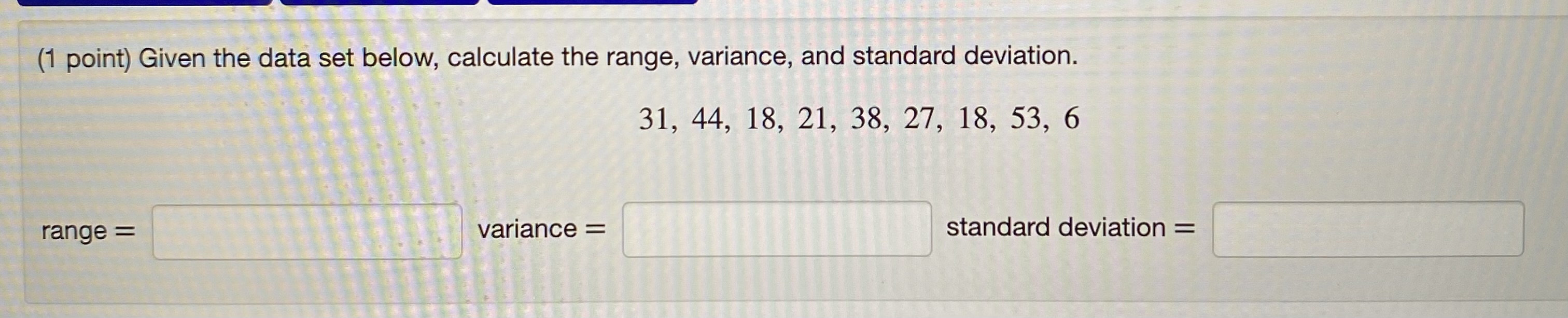
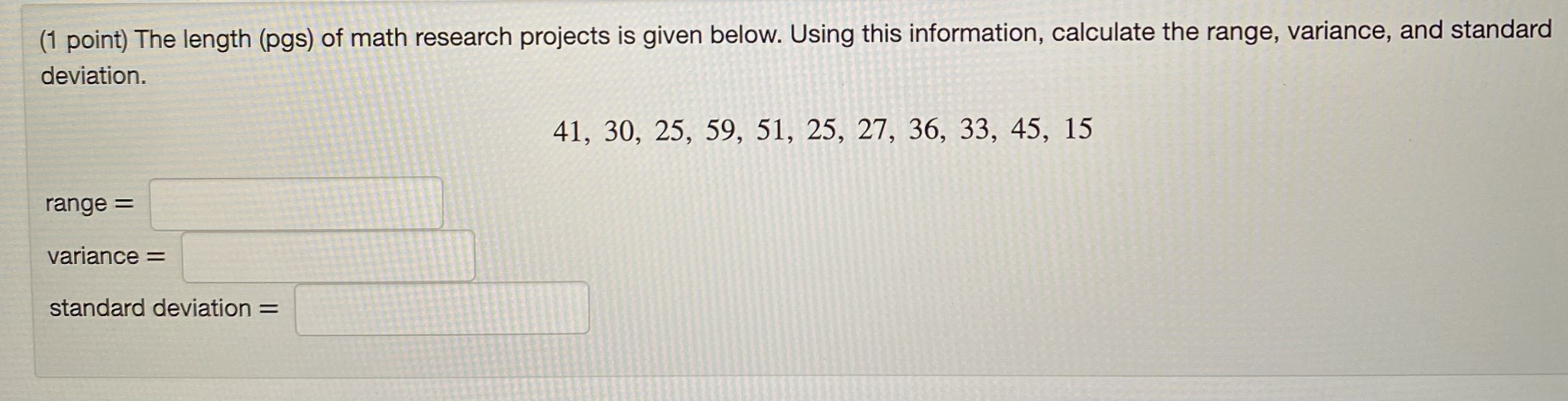
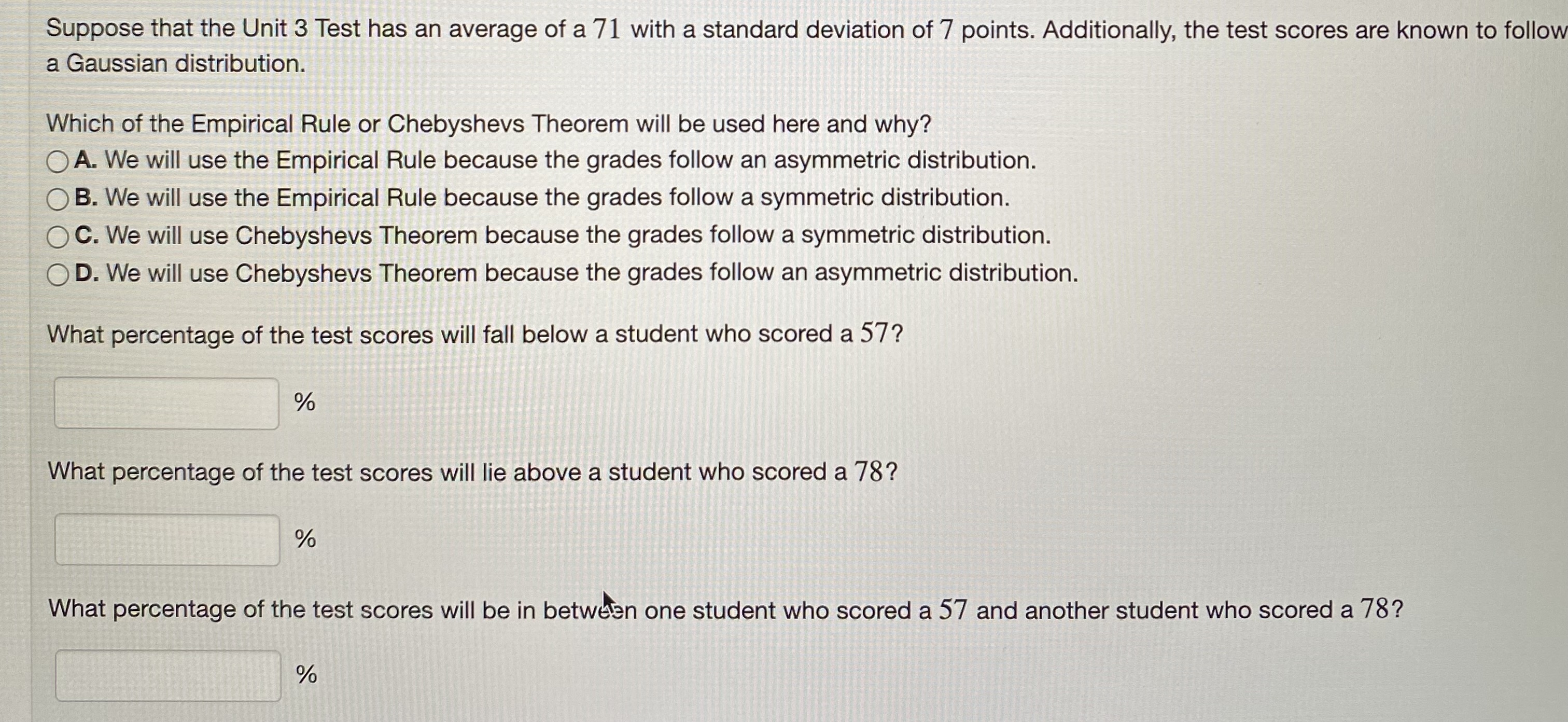

(1 point) Given the data set below, calculate the range, variance, and standard deviation. 31, 44, 18, 21, 38, 27, 18, 53, 6 range = variance = standard deviation = (1 point) The length (pgs) of math research projects is given below. Using this information, calculate the range, variance, and standard deviation. 41, 30, 25, 59, 51, 25, 27, 36, 33, 45, 15 range= variance = standard deviation = Suppose that the Unit 3 Test has an average of a 71 with a standard deviation of 7 points. Additionally, the test scores are known to follow a Gaussian distribution. Which of the Empirical Rule or Chebyshevs Theorem will be used here and why? OA. We will use the Empirical Rule because the grades follow an asymmetric distribution. OB. We will use the Empirical Rule because the grades follow a symmetric distribution. C. We will use Chebyshevs Theorem because the grades follow a symmetric distribution. D. We will use Chebyshevs Theorem because the grades follow an asymmetric distribution. What percentage of the test scores will fall below a student who scored a 57? % What percentage of the test scores will lie above a student who scored a 78? % What percentage of the test scores will be in between one student who scored a 57 and another student who scored a 78? % Previous Problem Problem List Next Problem (1 point) If the average low temperature of a winter month in Rochester, NY is 19 and the standard deviation is 6.4, then according to Chebyshev's theorem, the percentage of average low temperatures in Rochester, NY between 6.2 and 31.8 is at least %.
Step by Step Solution
There are 3 Steps involved in it

Get step-by-step solutions from verified subject matter experts
 Study Help