







Question: 1. Porter 5 Factor Analysis: identify members in each factor of this model. Discuss which of these factors is likely to affect move ahead the
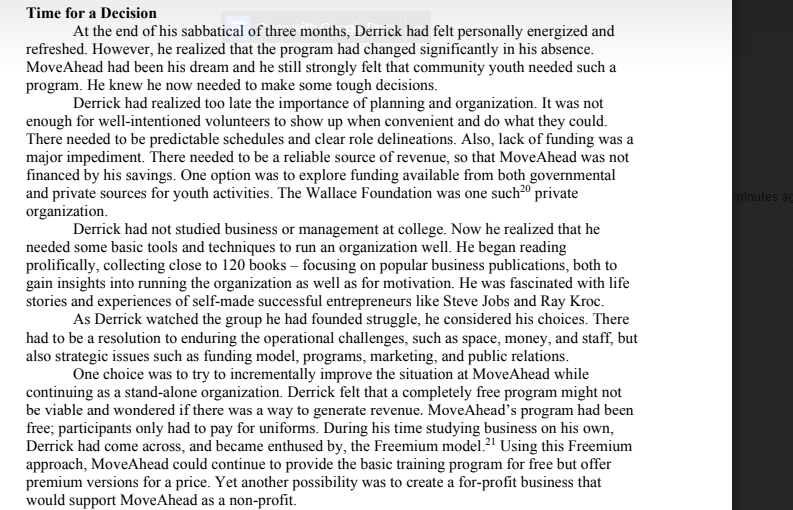
1. Porter 5 Factor Analysis: identify members in each factor of this model. Discuss which of these factors is likely to affect move ahead the most.
2. Swot Analysis for move ahead. Discuss which of these is likely to be most important for move ahead in the future
3. Propose a future strategy for Move ahead.
read the posted case and base responses on ONLY what is presented in the case. The report should not be more than 4 page
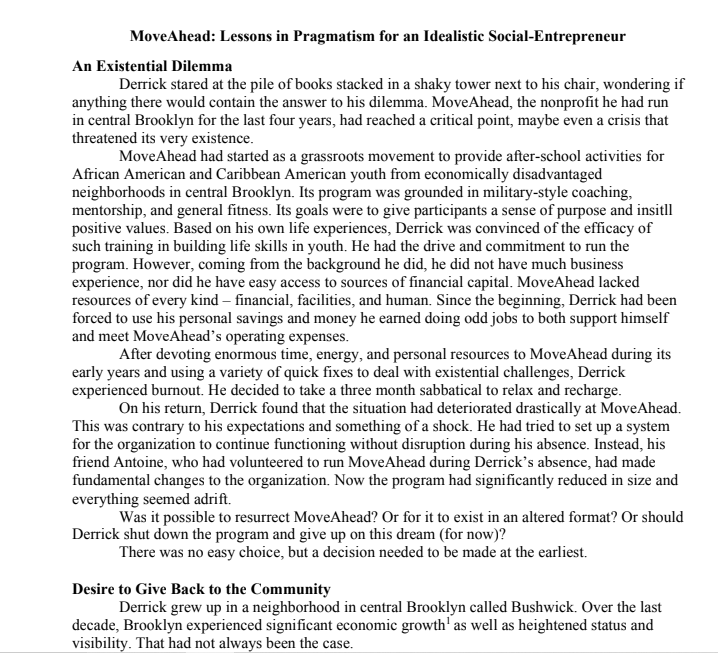
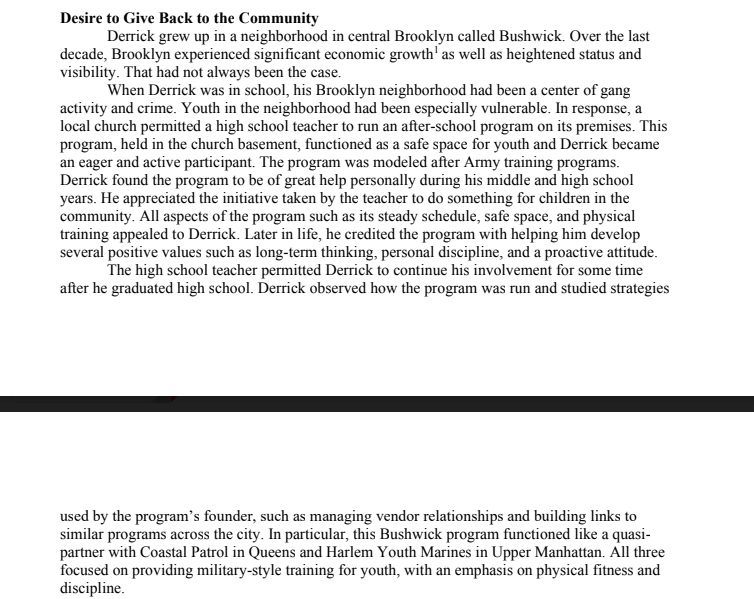
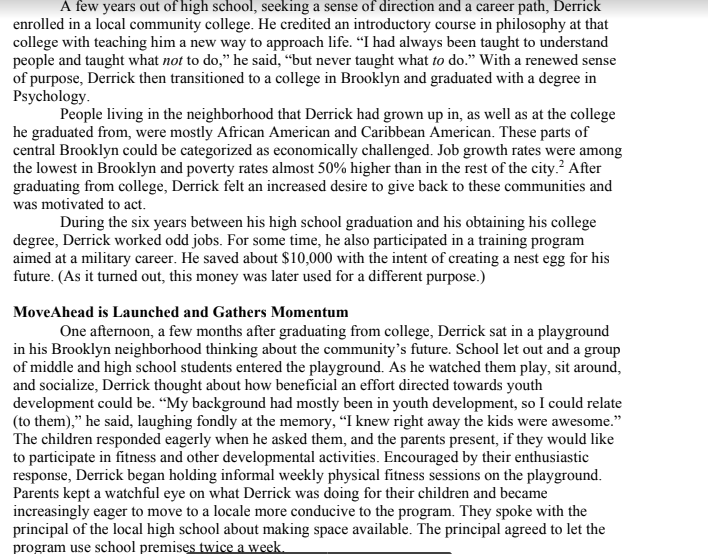
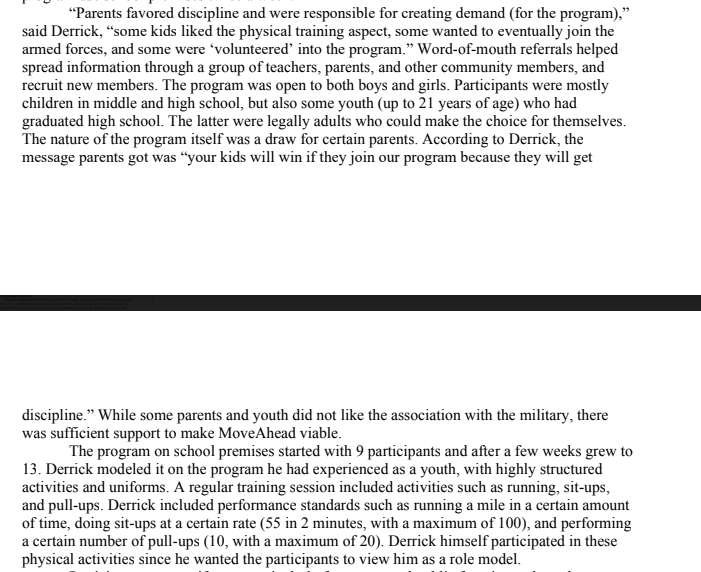
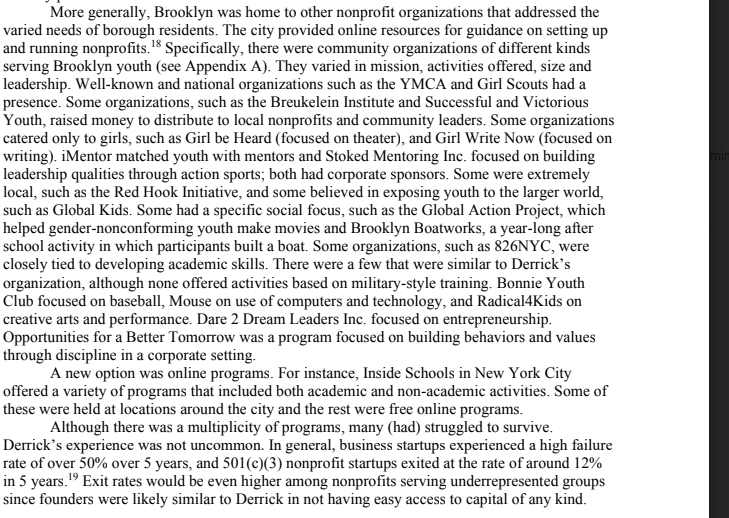
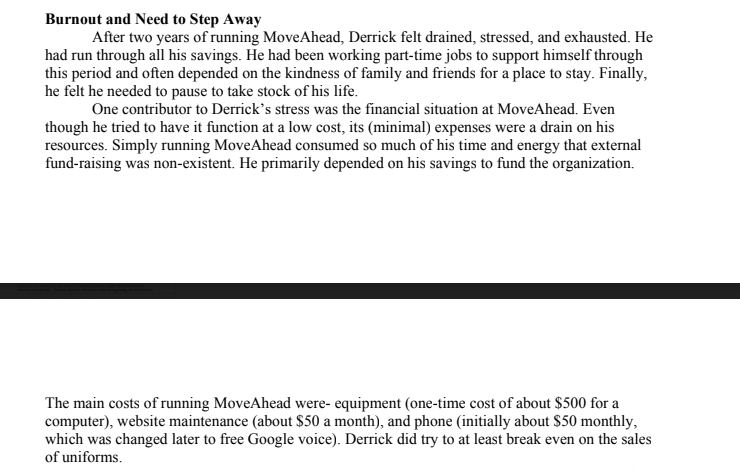
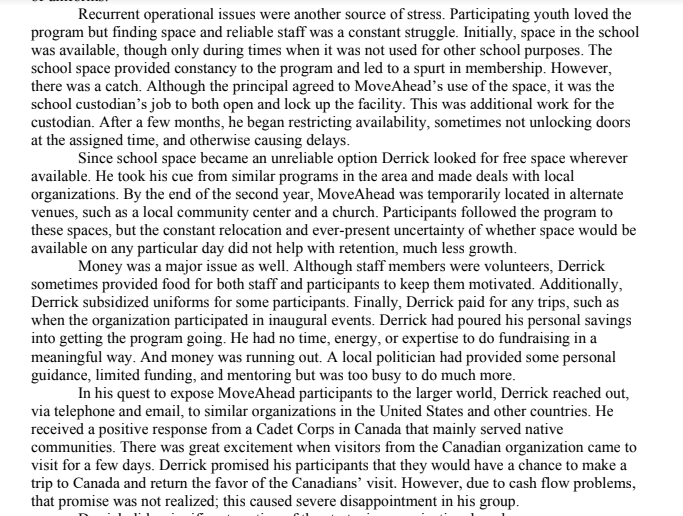
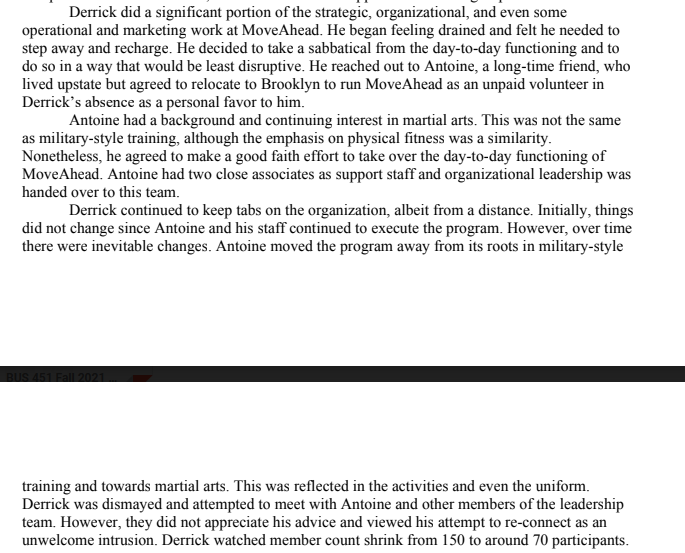
MoveAhead: Lessons in Pragmatism for an Idealistic Social-Entrepreneur An Existential Dilemma Derrick stared at the pile of books stacked in a shaky tower next to his chair, wondering if anything there would contain the answer to his dilemma. MoveAhead, the nonprofit he had run in central Brooklyn for the last four years, had reached a critical point, maybe even a crisis that threatened its very existence. MoveAhead had started as a grassroots movement to provide after-school activities for African American and Caribbean American youth from economically disadvantaged neighborhoods in central Brooklyn. Its program was grounded in military-style coaching, mentorship, and general fitness. Its goals were to give participants a sense of purpose and insitll positive values. Based on his own life experiences, Derrick was convinced of the efficacy of such training in building life skills in youth. He had the drive and commitment to run the program. However, coming from the background he did, he did not have much business experience, nor did he have easy access to sources of financial capital. MoveAhead lacked resources of every kind financial, facilities, and human. Since the beginning, Derrick had been forced to use his personal savings and money he earned doing odd jobs to both support himself and meet MoveAhead's operating expenses. After devoting enormous time, energy, and personal resources to MoveAhead during its early years and using a variety of quick fixes to deal with existential challenges, Derrick experienced burnout. He decided to take a three month sabbatical to relax and recharge. On his return, Derrick found that the situation had deteriorated drastically at MoveAhead. This was contrary to his expectations and something of a shock. He had tried to set up a system for the organization to continue functioning without disruption during his absence. Instead, his friend Antoine, who had volunteered to run MoveAhead during Derrick's absence, had made fundamental changes to the organization. Now the program had significantly reduced in size and everything seemed adrift. Was it possible to resurrect MoveAhead? Or for it to exist in an altered format? Or should Derrick shut down the program and give up on this dream (for now)? There was no easy choice, but a decision needed to be made at the earliest. Desire to Give Back to the Community Derrick grew up in a neighborhood in central Brooklyn called Bushwick. Over the last decade, Brooklyn experienced significant economic growth' as well as heightened status and visibility. That had not always been the case. Desire to Give Back to the Community Derrick grew up in a neighborhood in central Brooklyn called Bushwick. Over the last decade, Brooklyn experienced significant economic growth' as well as heightened status and visibility. That had not always been the case. When Derrick was in school, his Brooklyn neighborhood had been a center of gang activity and crime. Youth in the neighborhood had been especially vulnerable. In response, a local church permitted a high school teacher to run an after-school program on its premises. This program, held in the church basement, functioned as a safe space for youth and Derrick became an eager and active participant. The program was modeled after Army training programs. Derrick found the program to be of great help personally during his middle and high school years. He appreciated the initiative taken by the teacher to do something for children in the community. All aspects of the program such as its steady schedule, safe space, and physical training appealed to Derrick. Later in life, he credited the program with helping him develop several positive values such as long-term thinking, personal discipline and a proactive attitude. The high school teacher permitted Derrick to continue his involvement for some time after he graduated high school. Derrick observed how the program was run and studied strategies used by the program's founder, such as managing vendor relationships and building links to similar programs across the city. In particular, this Bushwick program functioned like a quasi- partner with Coastal Patrol in Queens and Harlem Youth Marines in Upper Manhattan. All three focused on providing military-style training for youth, with an emphasis on physical fitness and discipline. A few years out of high school, seeking a sense of direction and a career path, Derrick enrolled in a local community college. He credited an introductory course in philosophy at that college with teaching him a new way to approach life. "I had always been taught to understand people and taught what not to do," he said, but never taught what to do. With a renewed sense of purpose, Derrick then transitioned to a college in Brooklyn and graduated with a degree in Psychology. People living in the neighborhood that Derrick had grown up in, as well as at the college he graduated from, were mostly African American and Caribbean American. These parts of central Brooklyn could be categorized as economically challenged. Job growth rates were among the lowest in Brooklyn and poverty rates almost 50% higher than in the rest of the city. After graduating from college, Derrick felt an increased desire to give back to these communities and was motivated to act. During the six years between his high school graduation and his obtaining his college degree, Derrick worked odd jobs. For some time, he also participated in a training program aimed at a military career. He saved about $10,000 with the intent of creating a nest egg for his future. (As it turned out, this money was later used for a different purpose.) MoveAhead is Launched and Gathers Momentum One afternoon, a few months after graduating from college, Derrick sat in a playground in his Brooklyn neighborhood thinking about the community's future. School let out and a group of middle and high school students entered the playground. As he watched them play, sit around, and socialize, Derrick thought about how beneficial an effort directed towards youth development could be. My background had mostly been in youth development, so I could relate (to them)," he said, laughing fondly at the memory, I knew right away the kids were awesome." The children responded eagerly when he asked them, and the parents present, if they would like to participate in fitness and other developmental activities. Encouraged by their enthusiastic response, Derrick began holding informal weekly physical fitness sessions on the playground. Parents kept a watchful eye on what Derrick was doing for their children and became increasingly eager to move to a locale more conducive to the program. They spoke with the principal of the local high school about making space available. The principal agreed to let the program use school premises twice a week Parents favored discipline and were responsible for creating demand (for the program)," said Derrick, "some kids liked the physical training aspect, some wanted to eventually join the armed forces, and some were 'volunteered into the program. Word-of-mouth referrals helped spread information through a group of teachers, parents, and other community members, and recruit new members. The program was open to both boys and girls. Participants were mostly children in middle and high school, but also some youth (up to 21 years of age) who had graduated high school. The latter were legally adults who could make the choice for themselves. The nature of the program itself was a draw for certain parents. According to Derrick, the message parents got was your kids will win if they join our program because they will get discipline. While some parents and youth did not like the association with the military, there was sufficient support to make MoveAhead viable. The program on school premises started with 9 participants and after a few weeks grew to 13. Derrick modeled it on the program he had experienced as a youth, with highly structured activities and uniforms. A regular training session included activities such as running, sit-ups, and pull-ups. Derrick included performance standards such as running a mile in a certain amount of time, doing sit-ups at a certain rate (55 in 2 minutes, with a maximum of 100), and performing a certain number of pull-ups (10, with a maximum of 20). Derrick himself participated in these physical activities since he wanted the participants to view him as a role model. Participants wore uniforms, particularly for events and public functions where the organization made appearances. Derrick charged $6 for a pair of shorts and $8 for a shirt. "Parents were giving me money for their kids' uniforms," said Derrick, "I did want to charge them for it. If they were serious about the program, they could find the money for it. Derrick sold these almost at cost; he thought it was important for participants to wear uniforms but he simply could not afford to give them away for free. There were no other fees for participation in the program The staff was all volunteers. There were approximately 7 permanent and reliably available members, and a pool of around 10 floating staff. About 60% of the staff was a mix of personal contacts and other committed community members. Parents would come when they could and composed about 20% of the staff. The remaining 20% were policemen, policewomen, and firefighters from the neighborhood. Core staff members were alumni of either military-style or physical fitness training programs. They provided a strong operational foundation, so Derrick could occasionally take time away from day-to-day activities. Derrick envisioned the program as contributing to not just the physical, but also the emotional and social development of youth. He wanted MoveAhead to develop a public profile, which he felt would be an asset to the endeavor, and in this quest, he solicited help from local politicians. Some brushed him off, but some were enthusiastic and provided support of different kinds, including money in one case). Some politicians did provide opportunities to make public appearances, by allowing MoveAhead to serve as the color guard for high profile ceremonies like inaugurations. From its modest but stable beginnings, the program grew over time to more than 150 participants. Derrick threw himself heart and soul into the management of the program. He tried to develop operating procedures, build online communication processes, and create marketing materials. For instance, he developed manuals to aid in running the organization, and documents with descriptions of program activities. He also created a form that parents of participants had to complete and sign. The form outlined program details, as well as the responsibilities of participants and parents. All these efforts formalized the program to a certain extent, but challenges remained. Securing space for the long-term was critical, as was having a core staff to deliver programs. The organization appeared loosely knit and always in a state of flux. Participants could leave at any time, since they did not pay for membership. Volunteers who had responded to a personal plea from Derrick faced competing demands for their time and could step away at any moment. There was also the ever-present matter of finances. There were some expenses for running the program such as food and travel. Derrick had been using his own savings, which would soon run out. The program took up all his time and he needed to start making a living wage. Youth in the Community Could Pick and Choose New York City was the most populous city in the United States. It was big and complex in many ways. Apart from the daily influx of commuters who lived outside the city but worked there, it was also home to millions. The city was made of several neighborhoods and, for many, family life revolved around the local neighborhood. Children went to local schools and families shopped in local stores. New York City consisted of five boroughs - Brooklyn, Bronx, Manhattan, Queens, and Staten Island. According to the U.S. Census Bureau," the metropolitan area had a population of about 8.5 million, of which about 21% was younger than 18 years old. The population of Brooklyn was around 2.5 million. The average school graduation rate was around 70%. There were around 120 public high schools in the borough.? About 20% of households had incomes below the federal poverty level."8 Since the first day in the playground and the later relocation to school premises, Derrick's program had grown in number of participants. Derrick's original impulse in setting up the MoveAhead program had been driven by his own experiences growing up in circumstances similar to that of the youth in this neighborhood. He knew that the military-style program had a significant impact but he felt community programs like his needed to provide more comprehensive support. Thus, he tried to offer a broader scope of activities, and over time, the program expanded to include activities like homework help. There were other military-style training programs around the city and country, such as Harlem Youth Marines, New York Military Youth Cadets, and Young Marines. Harlem Youth Marines, with which Derrick was familiar from his Bushwick days, was established in 1980 and located in Manhattan, about 45 minutes away by train. This organization's founder stated that, despite its name, the program was not about youth joining the military. Rather, the emphasis was on learning discipline and respect. The program hosted leadership courses and military style trainingll with the objective of instilling a sense of duty. Although participants were referred to as cadets and wore military uniforms, the program was neither affiliated with, not funded by the military. The New York Military Youth Cadets, in the borough of Queens, was about an hour away by train. The organization aimed to provide great training and excellent discipline" for youth, to help the "community at large and, most importantly, "building the next generation of leadership." 9:12 Their activities included community service military-style practice drills, and parades. Page 4 / 10 + 113 On a national level, Young Maper with Google Docs utv Organization!3 was a nonprofit, 501(C)(3) entity with headquarters in Dumfries, Virginia. Young Marines was founded in 1959 and had grown from one location to a national and international organization with a board of directors, including legal counsel, a secretary, and a treasurer. Its stated mission was to "positively impact America's future by providing quality youth development programs for boys and girls that nurtures and develops its members into responsible citizens who enjoy and promote a healthy, drug-free lifestyle."14 This organization had corporate sponsors and celebrity supporters. The organization ran 3 programs Drug Demand Reduction that focused on combating the influence of drugs; Spaces that linked participants to military-style training but also adventurous activities like scuba diving; and Veterans Appreciation, a weeklong tribute to veterans 15 Young Marines had multiple units across the U.S. including some in the New York metropolitan area but none in central Brooklyn. Nonprofit organizations with military-style training activities had a few things in common. They focused on youth between the ages of 7 to 20 years and primarily provided afterschool activities. Their foundation was a belief in the value of military-style training and discipline, including wearing uniforms. While these organizations were not part of the military, they could get authorization for use of uniforms. 16, 17 These organizations stressed a positive outlook on life, and often explicitly mentioned the destructive effect of drugs. Finally, they depended on volunteers to coach, guide, and mentor participants; some volunteers were ex- military personnel More generally, Brooklyn was home to other nonprofit organizations that addressed the varied needs of borough residents. The city provided online resources for guidance on setting up and running nonprofits.18 Specifically, there were community organizations of different kinds serving Brooklyn youth (see Appendix A). They varied in mission, activities offered, size and leadership. Well-known and national organizations such as the YMCA and Girl Scouts had a presence. Some organizations, such as the Breukelein Institute and Successful and Victorious Youth, raised money to distribute to local nonprofits and community leaders. Some organizations catered only to girls, such as Girl be Heard (focused on theater), and Girl Write Now (focused on writing). iMentor matched youth with mentors and Stoked Mentoring Inc. focused on building leadership qualities through action sports; both had corporate sponsors. Some were extremely local, such as the Red Hook Initiative, and some believed in exposing youth to the larger world, such as Global Kids. Some had a specific social focus, such as the Global Action Project, which helped gender-nonconforming youth make movies and Brooklyn Boatworks, a year-long after school activity in which participants built a boat. Some organizations, such as 826NYC, were closely tied to developing academic skills. There were a few that were similar to Derrick's organization, although none offered activities based on military-style training. Bonnie Youth Club focused on baseball, Mouse on use of computers and technology, and Radical4Kids on creative arts and performance. Dare 2 Dream Leaders Inc. focused on entrepreneurship. Opportunities for a Better Tomorrow was a program focused on building behaviors and values through discipline in a corporate setting. A new option was online programs. For instance, Inside Schools in New York City offered a variety of programs that included both academic and non-academic activities. Some of these were held at locations around the city and the rest were free online programs. Although there was a multiplicity of programs, many (had) struggled to survive. Derrick's experience was not uncommon. In general, business startups experienced a high failure rate of over 50% over 5 years, and 501(c)(3) nonprofit startups exited at the rate of around 12% in 5 years." Exit rates would be even higher among nonprofits serving underrepresented groups since founders were likely similar to Derrick in not having easy access to capital of any kind. Burnout and Need to Step Away After two years of running MoveAhead, Derrick felt drained, stressed, and exhausted. He had run through all his savings. He had been working part-time jobs to support himself through this period and often depended on the kindness of family and friends for a place to stay. Finally, he felt he needed to pause to take stock of his life. One contributor to Derrick's stress was the financial situation at MoveAhead. Even though he tried to have it function at a low cost, its (minimal) expenses were a drain on his resources. Simply running MoveAhead consumed so much of his time and energy that external fund-raising was non-existent. He primarily depended on his savings to fund the organization. The main costs of running MoveAhead were-equipment (one-time cost of about $500 for a computer), website maintenance about $50 a month), and phone initially about $50 monthly, which was changed later to free Google voice). Derrick did try to at least break even on the sales of uniforms. Recurrent operational issues were another source of stress. Participating youth loved the program but finding space and reliable staff was a constant struggle. Initially, space in the school was available, though only during times when it was not used for other school purposes. The school space provided constancy to the program and led to a spurt in membership. However, there was a catch. Although the principal agreed to MoveAhead's use of the space, it was the school custodian's job to both open and lock up the facility. This was additional work for the custodian. After a few months, he began restricting availability, sometimes not unlocking doors at the assigned time, and otherwise causing delays. Since school space became an unreliable option Derrick looked for free space wherever available. He took his cue from similar programs in the area and made deals with local organizations. By the end of the second year, MoveAhead was temporarily located in alternate venues, such as a local community center and a church. Participants followed the program to these spaces, but the constant relocation and ever-present uncertainty of whether space would be available on any particular day did not help with retention, much less growth. Money was a major issue as well. Although staff members were volunteers, Derrick sometimes provided food for both staff and participants to keep them motivated. Additionally, Derrick subsidized uniforms for some participants. Finally, Derrick paid for any trips, such as when the organization participated in inaugural events. Derrick had poured his personal savings into getting the program going. He had no time, energy, or expertise to do fundraising in a meaningful way. And money was running out. A local politician had provided some personal guidance, limited funding, and mentoring but was too busy to do much more. In his quest to expose MoveAhead participants to the larger world, Derrick reached out, via telephone and email, to similar organizations in the United States and other countries. He received a positive response from a Cadet Corps in Canada that mainly served native communities. There was great excitement when visitors from the Canadian organization came to visit for a few days. Derrick promised his participants that they would have a chance to make a trip to Canada and return the favor of the Canadians' visit. However, due to cash flow problems, that promise was not realized; this caused severe disappointment in his group. Derrick did a significant portion of the strategic, organizational, and even some operational and marketing work at MoveAhead. He began feeling drained and felt he needed to step away and recharge. He decided to take a sabbatical from the day-to-day functioning and to do so in a way that would be least disruptive. He reached out to Antoine, a long-time friend, who lived upstate but agreed to relocate to Brooklyn to run MoveAhead as an unpaid volunteer in Derrick's absence as a personal favor to him. Antoine had a background and continuing interest in martial arts. This was not the same as military-style training, although the emphasis on physical fitness was a similarity. Nonetheless, he agreed to make a good faith effort to take over the day-to-day functioning of MoveAhead. Antoine had two close associates as support staff and organizational leadership was handed over to this team. Derrick continued to keep tabs on the organization, albeit from a distance. Initially, things did not change since Antoine and his staff continued to execute the program. However, over time there were inevitable changes. Antoine moved the program away from its roots in military-style training and towards martial arts. This was reflected in the activities and even the uniform. Derrick was dismayed and attempted to meet with Antoine and other members of the leadership team. However, they did not appreciate his advice and viewed his attempt to re-connect as an unwelcome intrusion. Derrick watched member count shrink from 150 to around 70 participants. minutes ac Time for a Decision At the end of his sabbatical of three months, Derrick had felt personally energized and refreshed. However, he realized that the program had changed significantly in his absence. MoveAhead had been his dream and he still strongly felt that community youth needed such a program. He knew he now needed to make some tough decisions. Derrick had realized too late the importance of planning and organization. It was not enough for well-intentioned volunteers to show up when convenient and do what they could. There needed to be predictable schedules and clear role delineations. Also, lack of funding was a major impediment. There needed to be a reliable source of revenue, so that MoveAhead was not financed by his savings. One option was to explore funding available from both governmental and private sources for youth activities. The Wallace Foundation was one such private organization. Derrick had not studied business or management at college. Now he realized that he needed some basic tools and techniques to run an organization well. He began reading prolifically, collecting close to 120 books focusing on popular business publications, both to gain insights into running the organization as well as for motivation. He was fascinated with life stories and experiences of self-made successful entrepreneurs like Steve Jobs and Ray Kroc. As Derrick watched the group he had founded struggle, he considered his choices. There had to be a resolution to enduring the operational challenges, such as space, money, and staff, but also strategic issues such as funding model, programs, marketing, and public relations. One choice was to try to incrementally improve the situation at MoveAhead while continuing as a stand-alone organization. Derrick felt that a completely free program might not be viable and wondered if there was a way to generate revenue. MoveAhead's program had been free; participants only had to pay for uniforms. During his time studying business on his own, Derrick had come across, and became enthused by, the Freemium model.2. Using this Freemium approach, MoveAhead could continue to provide the basic training program for free but offer premium versions for a price. Yet another possibility was to create a for-profit business that would support MoveAhead as a non-profitStep by Step Solution
There are 3 Steps involved in it
1 Expert Approved Answer
Step: 1 Unlock

Question Has Been Solved by an Expert!
Get step-by-step solutions from verified subject matter experts
Step: 2 Unlock
Step: 3 Unlock
 Study Help