







Question: 1. Prediction Markets - Continuous Double Auctions We will analyze a market with a Continuous Double Auction mechanism and one contract traded (XYZ). Assume
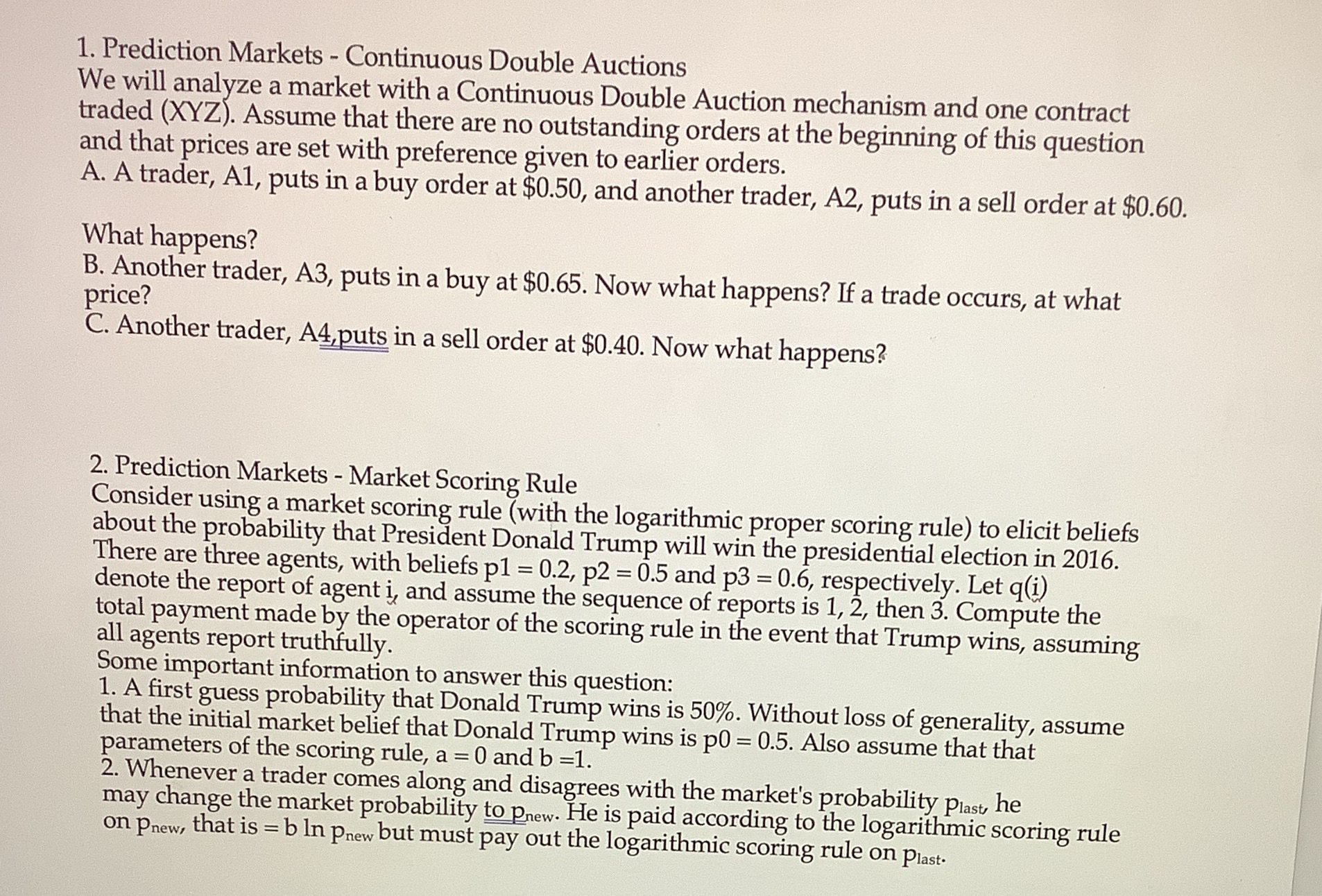
1. Prediction Markets - Continuous Double Auctions We will analyze a market with a Continuous Double Auction mechanism and one contract traded (XYZ). Assume that there are no outstanding orders at the beginning of this question and that prices are set with preference given to earlier orders. A. A trader, A1, puts in a buy order at $0.50, and another trader, A2, puts in a sell order at $0.60. What happens? B. Another trader, A3, puts in a buy at $0.65. Now what happens? If a trade occurs, at what price? C. Another trader, A4,puts in a sell order at $0.40. Now what happens? 2. Prediction Markets - Market Scoring Rule Consider using a market scoring rule (with the logarithmic proper scoring rule) to elicit beliefs about the probability that President Donald Trump will win the presidential election in 2016. There are three agents, with beliefs p1 = 0.2, p2 = 0.5 and p3 = 0.6, respectively. Let q(i) denote the report of agent i, and assume the sequence of reports is 1, 2, then 3. Compute the total payment made by the operator of the scoring rule in the event that Trump wins, assuming all agents report truthfully. Some important information to answer this question: 1. A first guess probability that Donald Trump wins is 50%. Without loss of generality, assume that the initial market belief that Donald Trump wins is p0= 0.5. Also assume that that parameters of the scoring rule, a = 0 and b=1. 2. Whenever a trader comes along and disagrees with the market's probability plast, he may change the market probability to pnew. He is paid according to the logarithmic scoring rule on pnew, that is = b ln pnew but must pay out the logarithmic scoring rule on plast.
Step by Step Solution
There are 3 Steps involved in it

Get step-by-step solutions from verified subject matter experts
 Study Help