







Question: 1 Problem 1 (6 + 6 + 6 + 7 = 25 points) Myopia (nearsightedness), results from a combination of genetic and environmental factors. A
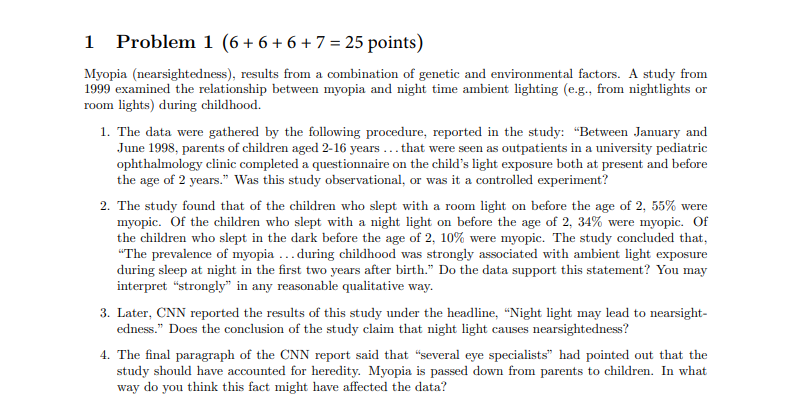
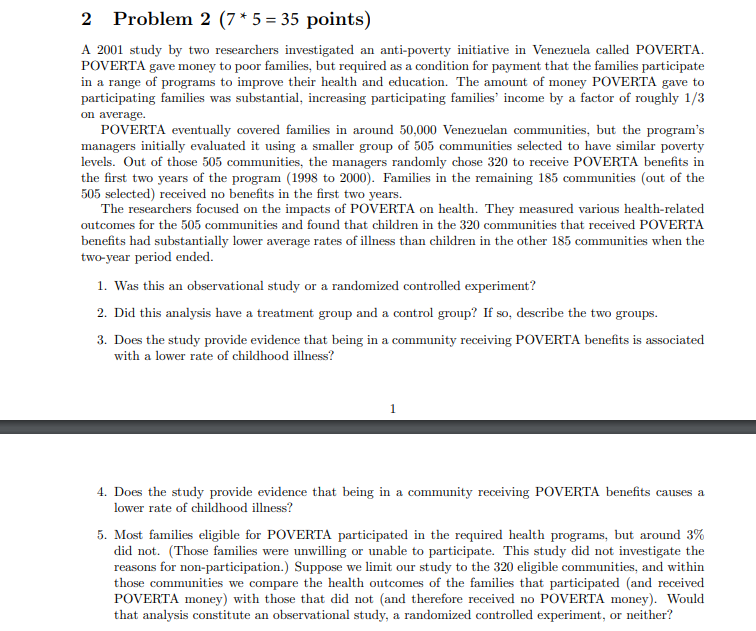
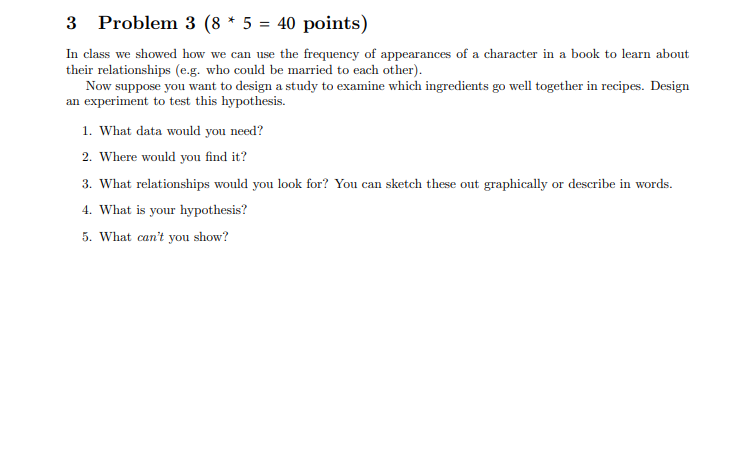
1 Problem 1 (6 + 6 + 6 + 7 = 25 points) Myopia (nearsightedness), results from a combination of genetic and environmental factors. A study from 1999 examined the relationship between myopia and night time ambient lighting (e.g., from nightlights or room lights) during childhood. 1. The data were gathered by the following procedure, reported in the study: "Between January and June 1998, parents of children aged 2-16 years ... that were seen as outpatients in a university pediatric ophthalmology clinic completed a questionnaire on the child's light exposure both at present and before the age of 2 years." Was this study observational, or was it a controlled experiment? 2. The study found that of the children who slept with a room light on before the age of 2, 55% were myopic. Of the children who slept with a night light on before the age of 2, 34% were myopic. Of the children who slept in the dark before the age of 2, 10% were myopic. The study concluded that, "The prevalence of myopia ... during childhood was strongly associated with ambient light exposure during sleep at night in the first two years after birth." Do the data support this statement? You may interpret "strongly" in any reasonable qualitative way. 3. Later, CNN reported the results of this study under the headline, "Night light may lead to nearsight- edness." Does the conclusion of the study claim that night light causes nearsightedness? 4. The final paragraph of the CNN report said that "several eye specialists" had pointed out that the study should have accounted for heredity. Myopia is passed down from parents to children. In what way do you think this fact might have affected the data? 2 Problem 2 (7* 5 = 35 points) A 2001 study by two researchers investigated an anti-poverty initiative in Venezuela called POVERTA. POVERTA gave money to poor families, but required as a condition for payment that the families participate in a range of programs to improve their health and education. The amount of money POVERTA gave to participating families was substantial, increasing participating families' income by a factor of roughly 1/3 on average. POVERTA eventually covered families in around 50,000 Venezuelan communities, but the program's managers initially evaluated it using a smaller group of 505 communities selected to have similar poverty levels. Out of those 505 communities, the managers randomly chose 320 to receive POVERTA benefits in the first two years of the program (1998 to 2000). Families in the remaining 185 communities (out of the 505 selected) received no benefits in the first two years. The researchers focused on the impacts of POVERTA on health. They measured various health-related outcomes for the 505 communities and found that children in the 320 communities that received POVERTA benefits had substantially lower average rates of illness than children in the other 185 communities when the two-year period ended. 1. Was this an observational study or a randomized controlled experiment? 2. Did this analysis have a treatment group and a control group? If so, describe the two groups. 3. Does the study provide evidence that being in a community receiving POVERTA benefits is associated with a lower rate of childhood illness? 4. Does the study provide evidence that being in a community receiving POVERTA benefits causes a lower rate of childhood illness? 5. Most families eligible for POVERTA participated in the required health programs, but around 3% did not. Those families were unwilling or unable to participate. This study did not investigate the reasons for non-participation.) Suppose we limit our study to the 320 eligible communities, and within those communities we compare the health outcomes of the families that participated and received POVERTA money) with those that did not (and therefore received no POVERTA money). Would that analysis constitute an observational study, a randomized controlled experiment, or neither? 3 Problem 3 (8 * 5 = 40 points) In class we showed how we can use the frequency of appearances of a character in a book to learn about their relationships (e.g. who could be married to each other). Now suppose you want to design a study to examine which ingredients go well together in recipes. Design an experiment to test this hypothesis. 1. What data would you need? 2. Where would you find it? 3. What relationships would you look for? You can sketch these out graphically or describe in words. 4. What is your hypothesis? 5. What can't you show? 1 Problem 1 (6 + 6 + 6 + 7 = 25 points) Myopia (nearsightedness), results from a combination of genetic and environmental factors. A study from 1999 examined the relationship between myopia and night time ambient lighting (e.g., from nightlights or room lights) during childhood. 1. The data were gathered by the following procedure, reported in the study: "Between January and June 1998, parents of children aged 2-16 years ... that were seen as outpatients in a university pediatric ophthalmology clinic completed a questionnaire on the child's light exposure both at present and before the age of 2 years." Was this study observational, or was it a controlled experiment? 2. The study found that of the children who slept with a room light on before the age of 2, 55% were myopic. Of the children who slept with a night light on before the age of 2, 34% were myopic. Of the children who slept in the dark before the age of 2, 10% were myopic. The study concluded that, "The prevalence of myopia ... during childhood was strongly associated with ambient light exposure during sleep at night in the first two years after birth." Do the data support this statement? You may interpret "strongly" in any reasonable qualitative way. 3. Later, CNN reported the results of this study under the headline, "Night light may lead to nearsight- edness." Does the conclusion of the study claim that night light causes nearsightedness? 4. The final paragraph of the CNN report said that "several eye specialists" had pointed out that the study should have accounted for heredity. Myopia is passed down from parents to children. In what way do you think this fact might have affected the data? 2 Problem 2 (7* 5 = 35 points) A 2001 study by two researchers investigated an anti-poverty initiative in Venezuela called POVERTA. POVERTA gave money to poor families, but required as a condition for payment that the families participate in a range of programs to improve their health and education. The amount of money POVERTA gave to participating families was substantial, increasing participating families' income by a factor of roughly 1/3 on average. POVERTA eventually covered families in around 50,000 Venezuelan communities, but the program's managers initially evaluated it using a smaller group of 505 communities selected to have similar poverty levels. Out of those 505 communities, the managers randomly chose 320 to receive POVERTA benefits in the first two years of the program (1998 to 2000). Families in the remaining 185 communities (out of the 505 selected) received no benefits in the first two years. The researchers focused on the impacts of POVERTA on health. They measured various health-related outcomes for the 505 communities and found that children in the 320 communities that received POVERTA benefits had substantially lower average rates of illness than children in the other 185 communities when the two-year period ended. 1. Was this an observational study or a randomized controlled experiment? 2. Did this analysis have a treatment group and a control group? If so, describe the two groups. 3. Does the study provide evidence that being in a community receiving POVERTA benefits is associated with a lower rate of childhood illness? 4. Does the study provide evidence that being in a community receiving POVERTA benefits causes a lower rate of childhood illness? 5. Most families eligible for POVERTA participated in the required health programs, but around 3% did not. Those families were unwilling or unable to participate. This study did not investigate the reasons for non-participation.) Suppose we limit our study to the 320 eligible communities, and within those communities we compare the health outcomes of the families that participated and received POVERTA money) with those that did not (and therefore received no POVERTA money). Would that analysis constitute an observational study, a randomized controlled experiment, or neither? 3 Problem 3 (8 * 5 = 40 points) In class we showed how we can use the frequency of appearances of a character in a book to learn about their relationships (e.g. who could be married to each other). Now suppose you want to design a study to examine which ingredients go well together in recipes. Design an experiment to test this hypothesis. 1. What data would you need? 2. Where would you find it? 3. What relationships would you look for? You can sketch these out graphically or describe in words. 4. What is your hypothesis? 5. What can't you show
Step by Step Solution
There are 3 Steps involved in it

Get step-by-step solutions from verified subject matter experts
 Study Help